
Seawall Tiebacks and Deadmen: The Hidden Anchors That Fail First
The anchoring system buried in your yard is what actually holds a seawall up. Here's how tiebacks and deadmen corrode, why that makes a wall lean, and how it gets fixed.
Key takeaways
- A seawall tieback is a steel rod that ties the wall to a buried anchor (a deadman) in your yard; that hidden system, not the visible panels, is what resists the soil and water pressure pushing toward the canal.
- When salt and saturated soil corrode the tieback rods, the wall loses its restraint and starts leaning or bowing toward the water — that lean is the single most reliable sign the anchors have failed.
- Failed anchors are the most common root cause of a leaning seawall in SW Florida, and they fail out of sight, years before the wall visibly moves.
- Many walls can be re-anchored with new helical (auger) tiebacks instead of fully replaced, if you catch the lean before panels crack.
- Restoration is quoted free on-site; the right fix depends on how far the wall has already moved.
When a Southwest Florida seawall starts leaning toward the canal, almost everyone blames the wall. They see the cracks, the rust streaks, the panels tipping out over the water, and figure the concrete or vinyl has finally given up. But the wall is usually the victim, not the culprit. The real failure happened years earlier, out of sight, buried back in your own yard.
Your seawall is the front face of a much larger system you can’t see, and the hidden part of that system — the anchoring — is almost always what fails first. Understanding it is the difference between fixing the actual problem and pouring money into the symptoms.
What is a seawall tieback (and a deadman anchor)?
A tieback is a steel rod that ties the top of your seawall back to an anchor buried in your yard, and a deadman is that anchor — a heavy concrete block or beam set in stable soil that the rod pulls against. Together they hold the wall back like a guy-wire holds a pole.
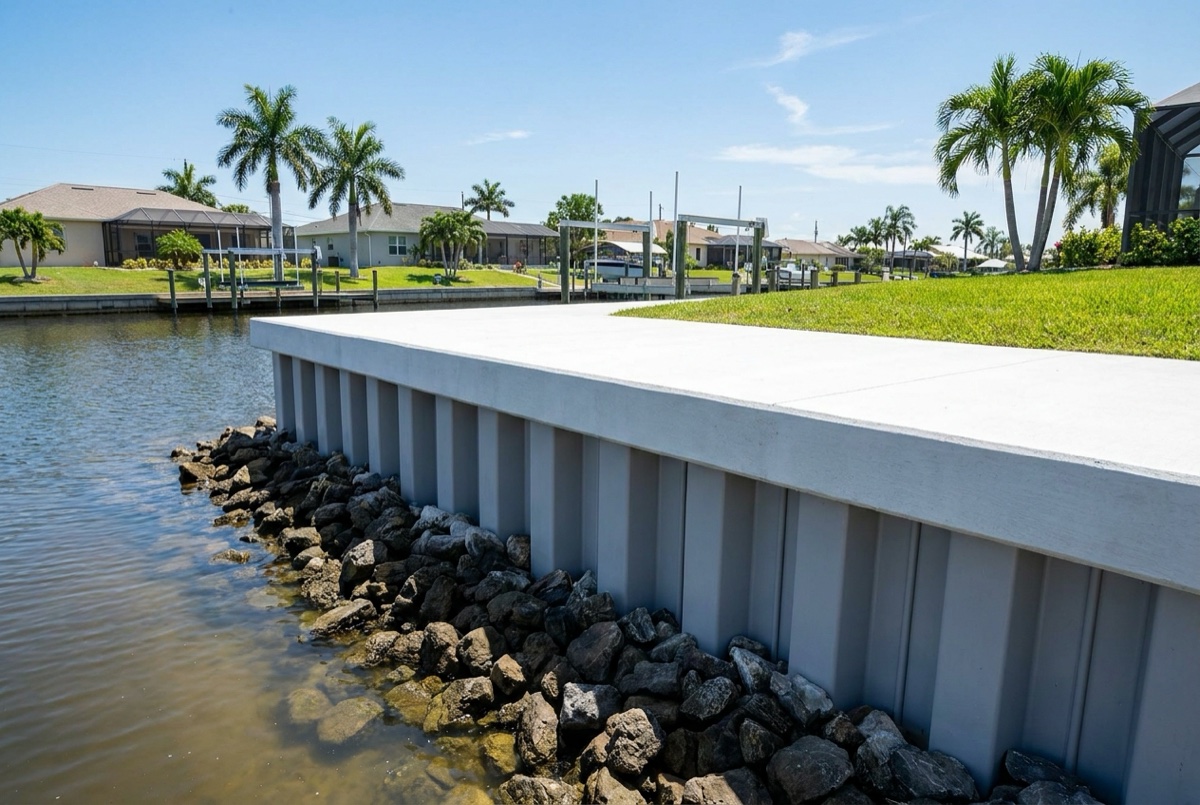
Here’s the picture. The visible panels and the concrete cap along the top are only the front of the structure. Running back into your yard, hidden under the grass, are steel tieback rods, each connected to an anchor set in firm soil several feet behind the wall. On many SW Florida walls that anchor is a poured deadman; on newer or restored walls it’s a helical anchor — a steel shaft with a screw-like plate that augers deep into stable ground.
That buried system is the muscle. The wall you see is just the skin over it.
Why does the anchoring system fail before the wall?
It fails first because it lives in the harshest spot on the whole structure: buried in saturated, salty soil where you can’t inspect it. The steel down there corrodes years before the visible concrete shows real age.
Think about what those rods endure on a Caloosahatchee or Charlotte Harbor canal. They sit in fill that’s soaked with brackish groundwater, and our high water table rises and falls with the tide, so the steel cycles through a wet-dry zone twice a day. That wet-dry line is exactly where corrosion runs fastest, because it gets both moisture and oxygen, and salt accelerates everything. An older galvanized rod can be rusted halfway through while the front of your wall still looks clean.
A few things make it worse here specifically:
- Saltwater canals keep chloride in constant contact with buried steel.
- A high, tide-driven water table keeps the soil saturated and the corrosion zone active.
- Storm surge during hurricane season (June through November) drives water deep into the backfill, then drags it out, scouring soil and loading the weakened anchors all at once.
- Sandy fill washes out through any crack or failed joint, removing the very soil a deadman needs to grip.
By the time you see trouble at the surface, the anchors have usually been letting go for a long time.
Why does a failing tieback make the wall lean toward the water?
Because the tiebacks are the only thing resisting the pressure behind the wall. When they corrode through or pull loose, that pressure wins and the wall rotates toward the canal.
A seawall holds back tons of soil plus the water saturating it — what engineers call lateral earth pressure and hydrostatic pressure. While the tiebacks are intact, they pull the top back and keep it plumb. The moment the anchors give out, nothing restrains the top, and soil and groundwater shove the wall outward into a lean or bow toward the water.
That lean is the single most reliable signal that the buried anchoring has failed. A wall can have hairline cracks and rust stains and still be structurally fine, but a wall tilting toward the canal is actively moving — and it only moves once its anchors have let go. We cover every red flag in the signs your seawall is failing, but if you watch for one, watch for the lean.
Where do tiebacks and deadmen fit in the whole wall?
The anchoring is one piece of a system that also includes the panels, cap, toe, and drainage. Each part fails in its own way, and a lean points specifically back to the anchors.
| Part of the wall | What it does | What its failure looks like |
|---|---|---|
| Panels | Hold back the soil face | Cracking, spalling, bowing between anchors |
| Cap | Ties the top together, caps the panels | Cracks, separation, rotating forward |
| Tiebacks & deadmen | Anchor the wall against soil pressure | Wall leaning or tilting toward the canal |
| Toe | The base, below the waterline | Scour and undermining at the bottom |
| Weep holes | Relieve water pressure behind the wall | Clogging, which raises pressure on everything |
When the toe scours out or the weep holes clog, the anchors carry more load than they were built for — which is why these failures travel together. Stopping scour at the base is one reason rip-rap is often part of a seawall repair.
How is a failing tieback system restored?
Often without tearing out the wall. If the panels and cap are still sound and the lean is caught early, new anchors can restore the restraint and stop the movement — frequently helical tiebacks.
It depends on how far the wall has moved, and the only way to know is to look. Common paths we use:
- New helical (auger) tiebacks. Steel shafts with a screw plate are augered deep into stable soil and tied back to the cap or a new waler — little excavation, and they reach soil that still has holding power.
- Supplemental deadman anchors. Where there’s room and the soil cooperates, new buried anchors and rods can take over the load the corroded ones lost.
- Re-anchoring plus toe protection. Re-anchoring while placing rip-rap at the toe stops both the lean and the scour feeding it.
- Full replacement. Once panels crack or the wall has rotated significantly, chasing repairs stops making sense and a new wall is the better long-term value.
Which side of that line you’re on is the whole decision, and it’s exactly what we walk through in seawall repair vs. replacement. It’s also worth understanding the soil and sinkholes forming behind a failing wall, since that lost fill is part of the same story.
How do I know if my anchors are the problem?
You can’t see the rods, so you read the wall. A lean or bow toward the canal, a cap rotating forward, or fresh dips in the yard all point back to anchoring that’s losing its grip. None of it should sit through hurricane season — surge loads a weak wall harder than any tide, and a wall already leaning can go from a repair to a replacement in one storm.
If your seawall is tipping toward the water, the buried anchoring is almost certainly why, and the sooner it’s looked at, the more likely re-anchoring beats replacement. Florida Lifts & Docks has restored seawalls across Southwest Florida since 2008 with our own local crew — never subcontracted — and we handle permitting in-house. We give free on-site estimates seven days a week from Cape Coral to Punta Gorda and across the rest of the coast. See everything we do on our seawalls page, or call (239) 397-3400 and we’ll come read your wall for you.