
Backyard Washing Into the Canal? How to Stop Shoreline Erosion
Why Southwest Florida banks erode, how to tell mild loss from active failure, and the fixes that actually hold — from erosion blankets to rip-rap to a seawall.
Key takeaways
- Shoreline erosion is the gradual loss of soil from your bank into the water, driven in SW Florida by boat wakes, tidal flow, storm surge, heavy rain, and the loss of a vegetated edge.
- Waiting is the expensive part — an unprotected bank can lose several feet over time and start undermining pools, decks, irrigation, and lot value.
- Mild, slow loss on a calm canal can often be handled with regrading, an erosion blanket, and native plantings; active loss with a visible scarp or exposed roots usually needs rip-rap or a seawall.
- Rip-rap absorbs wave energy with sloped stone; a vinyl or concrete seawall holds a vertical edge and maximizes usable yard — both are quoted free on-site and permitted in-house.
You walk out to the water and the edge of the yard isn’t where it used to be. The grass ends in a little dirt cliff, a sprinkler head is hanging in midair, and there’s a fresh scoop of soil missing at the waterline. If your Southwest Florida backyard is washing into the canal, you’re watching shoreline erosion in real time — and the bank rarely fixes itself.
The good news is that erosion is solvable at almost any stage. The trick is matching the fix to how fast you’re losing ground, because the answer ranges from a weekend of planting to a permitted seawall. Here’s how to read your shoreline and choose the right protection.
What is shoreline erosion, and why is it happening to my yard?
Shoreline erosion is the gradual loss of soil from your bank into the water. In Southwest Florida it’s driven by a stack of forces all working on the same vulnerable edge of your lot.
On our saltwater canals and the open water of Charlotte Harbor and the Caloosahatchee, the usual culprits are:
- Boat wakes. Every passing hull throws a wave at your bank — on a busy canal that’s hundreds of small impacts a day, each pulling a little soil into the water.
- Tidal flow. Twice-daily tides rise, fall, and move water sideways along the shore, steadily working loose dirt off the edge.
- Storm surge. During hurricane season (June through November), surge pushes water up the bank and yanks soil back out as it recedes — sometimes feet in a single storm.
- Heavy rain and runoff. Florida’s downpours sheet across the lawn and over the edge, carving channels and washing the top of the bank in from above.
- Loss of a vegetated edge. Manicured sod has shallow roots. When the deep-rooted natives that once held the bank are gone, nothing is knitting the soil together.
Most eroding shorelines aren’t suffering from one of these — they’re losing to all of them at once.
How do I know if my erosion is mild or serious?
Look at the shape of the bank and how fast it’s changing. A gentle, stable slope with grass growing to the water is mild; a steep dirt face, exposed roots, or soil disappearing behind an existing seawall is active loss that needs hard armor.
Walk your waterline and check for these warning signs:
- A scarp — a small vertical dirt cliff where the lawn ends — instead of a gentle slope
- Exposed tree or shrub roots dangling over the water
- Sprinkler lines, irrigation heads, or pavers that are now hanging at the edge
- Slumping or cracking in the yard a few feet back from the water
- A sinkhole or low spot forming behind a seawall (a sign soil is washing out through the wall — see signs your seawall is failing)
- Cloudy, muddy water along your bank after rain or a passing boat
One or two minor signs on a quiet canal can often be managed. Multiple signs, or any movement after a single storm, means the bank is actively failing and waiting will only make the repair bigger.
Why is waiting the most expensive option?
Because erosion accelerates and what it threatens gets pricier the longer you wait. A bare bank loses ground faster every season, and eventually it stops being a landscaping problem and starts being a structural one.
An unprotected SW Florida shoreline can quietly give up several feet of yard over time. Once the edge retreats far enough, it starts undermining the expensive things near the water: pool decks and cages, patios, screen enclosures, irrigation, and the seawall or dock itself. Lost waterfront also chips away at what makes the lot valuable in the first place. A modest stabilization job today is almost always cheaper than rebuilding a deck or replacing a wall that erosion has compromised. Which fix belongs on your bank is also a question of what the shoreline is made of; seawalls and shorelines in Estero works that through where wall, rock and root each have a place.
What are my options to stop the erosion?
Match the fix to the severity. Light, slow erosion gets a soft fix; active, fast loss gets hard armor. Here’s the ladder from lightest to heaviest.
| Fix | Best for | What it does |
|---|---|---|
| Regrade + erosion blanket + native planting | Mild, slow loss on a calm, sheltered canal | Re-slopes the bank, holds soil with biodegradable matting, and lets deep roots take over |
| Rip-rap | Active loss, exposed banks, wakes, protecting a failing seawall toe | Sloped layer of heavy stone that absorbs and dissipates wave energy |
| Seawall (vinyl or concrete) | Severe loss, deep water at the edge, max usable yard | A vertical structural wall that holds the bank and the waterline in place |
Soft fixes work when the bank is only losing ground slowly and the canal is sheltered. Re-grade to a stable slope, lay an erosion-control blanket, and plant deep-rooted Florida natives so living roots hold the soil. It’s the lowest-cost approach — but on a wake-heavy canal or open water, soil stabilization alone won’t keep up.
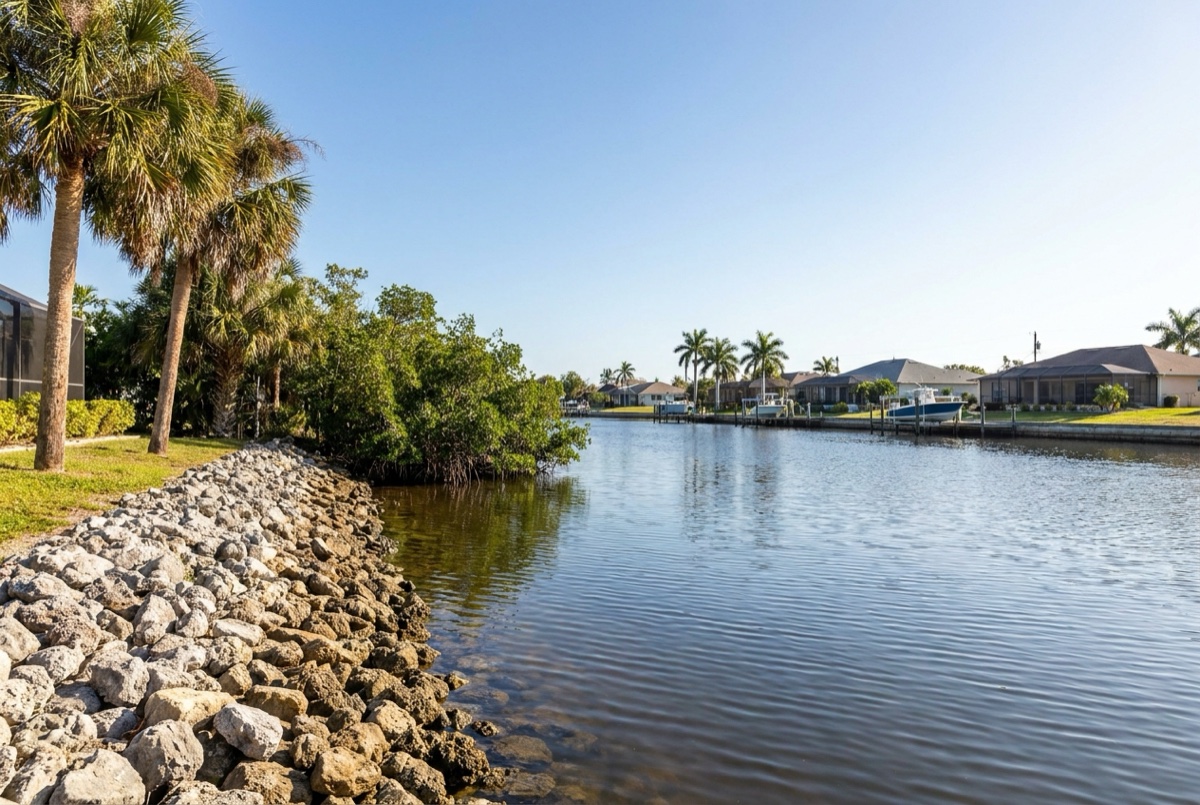
Rip-rap is the workhorse for active erosion. It’s a sloped blanket of heavy stone, sized for our conditions, that takes the punch out of boat wakes and surge before it reaches the dirt. It’s also the standard fix for shoring up the toe of a failing seawall. The one trade-off is footprint: because it’s sloped, rip-rap takes up some space at the waterline. Our rip-rap vs. seawall guide breaks down that choice, and you’ll find pricing factors in our rip-rap cost per linear foot guide.
A seawall is the heaviest option and the right one when erosion is severe, the water is deep right at your edge, or you want to keep every square foot of yard. A vinyl or concrete seawall holds a clean vertical line and locks the shoreline in place for decades.
Which fix do I actually need?
The honest answer is that it depends on your specific bank, and that’s exactly what an on-site look is for. A quiet, narrow canal with a gentle slope and slow loss may only need planting and a blanket. A wide canal with heavy traffic, a steep scarp, and exposed roots needs rip-rap or a wall.
What we check at the estimate:
- How fast you’re losing ground and how steep the bank is now
- Your exposure — canal width, boat traffic, and how open you are to wind and surge
- Water depth right at the edge and your tide swing
- Whether an existing seawall is involved and whether it’s sound or failing
- How much usable yard and waterfront you want to keep
From there we recommend the lightest fix that will genuinely hold — not the biggest one we can sell.
Stop the bank before it costs you the yard
Eroding shorelines don’t heal, they spread. The sooner you armor the bank, the less you’ll ultimately spend and the more of your waterfront you’ll keep. Florida Lifts & Docks has protected Southwest Florida shorelines since 2008 with our own local crew — never subcontracted — and we handle permitting in-house, so the whole project is one phone call.
If your backyard is washing into the canal, start with our rip-rap page or seawalls page, or get a clear next step from a free on-site estimate. We’re out seven days a week across Cape Coral, Naples, Fort Myers, and the rest of the coast. Call (239) 397-3400.