
Storm Claim Timelines: Patience, Paper & Persistence
Nobody can honestly tell you how long a dock claim will take, so here is the part that is genuinely yours: the record, the receipts, the material you keep, and the follow-up you write down.
Key takeaways
- Nobody outside your carrier can honestly tell you how long a claim will take. A firm answer from anyone else is a guess, and it is worth treating as one.
- Everything genuinely in your hands is paper: a dated baseline of the structure, an organized after-record, receipts and permits, and a written itemized scope.
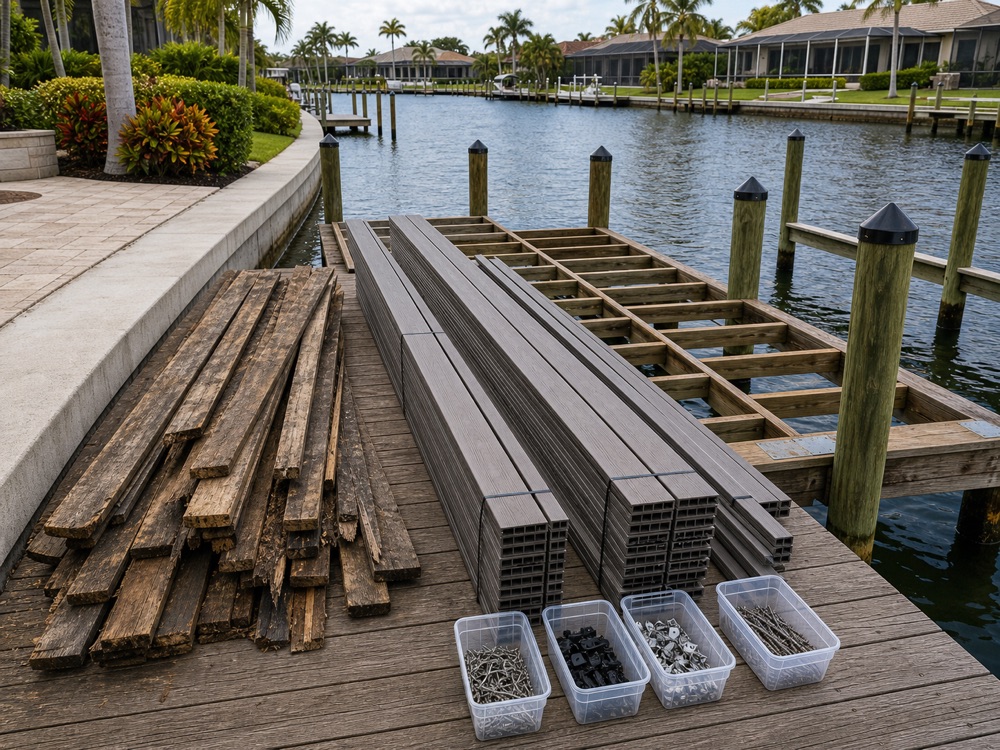
- Keep the failed material, the sheared bolt, the cracked bracket, the cut section of decking, until it has been seen. Once it goes to the curb after a storm, it is gone.
- Persistence is a log and a written follow-up, not pressure. Note who you spoke with, what was asked for, what you sent, and when.
- Florida Lifts & Docks does not file, handle, negotiate, or advocate a claim. We document our own work and give you a written scope. Read your policy and talk to your agent for the rest.
Somebody asks us this every season, usually while standing on a seawall looking at what is left of a dock: how long is this going to take? The honest answer is that we do not know. Neither does anyone who has not read your policy and does not work for your carrier.
What we can tell you is which parts of this are yours. Florida Lifts & Docks is a marine contractor, not a public adjuster, not an insurer, and not an attorney. We do not file claims, handle them, negotiate them, or advocate on them. We inspect the structure, document what failed and what was already worn, and put a written itemized scope in your hand. The rest of this page is about what you control while everything else runs on somebody else’s schedule.
How long does a storm claim actually take?
Nobody can answer that honestly, and a firm number from anyone outside your carrier is a guess. It moves with the policy, the complexity of the loss, and how much of the coast is going through the same thing at the same time.
Only one variable in that list has your name on it: how quickly the information everyone needs comes together. That is why this page is called patience, paper, and persistence instead of something with a number in it.
| Yours | Not yours |
|---|---|
| A dated baseline of what the structure was | How the claim is evaluated |
| The after-record, organized and honest | What the policy language means |
| Receipts, invoices, permits, prior scopes | Who decides what, and when |
| The failed material, kept until it is seen | The pace of a coast-wide event |
| Answering requests promptly, in writing | The outcome |
Everything in the left column is available to you today. Nothing in the right column becomes available by pushing on it.
What actually belongs in the file?
One folder, in an order you can walk through, added to as you go. Digital or paper does not matter; findable does.
- Dated before-photos of the dock, lift, seawall, and pilings, the shot list is in our guide to documenting waterfront storm damage.
- After-photos, wide and close, grouped by area rather than dumped in one pile.
- Permits, drawings, prior repair invoices, maintenance receipts, and lift paperwork.
- The written itemized scope from your marine contractor.
- Receipts for temporary work, labeled as temporary: see temporary fixes versus permanent repairs.
- A contact log, and a copy of everything you send with the date you sent it.
What the policy says about the structure shapes what belongs in there too, which is a conversation to have with your agent, our page on dock and lift insurance riders covers the vocabulary.
Why keep the failed material until somebody has seen it?
Because a photograph shows that a bolt sheared, and the bolt shows how. Hardware, connectors, a split cap, a cracked bracket, the cut-out section of decking. Those pieces are the clearest account of a failure that exists, and they cannot be reconstructed later.
Photograph everything where it landed first. Then bag what you keep, label it with where it came from, and put it somewhere dry and out of the way. Safety outranks all of it: anything hazardous, anything sharp in a walkway, anything blocking safe access to the property goes. You document it and then you deal with it. What you cannot do is get it back off the curb after a storm cleanup.
What does persistence look like without becoming pressure?
A log and a written follow-up. Nothing dramatic, and nothing that requires being difficult with anyone.
Note the date, who you spoke with, what was asked for, and what you sent. Ask what is still outstanding and who owns the next step. Send requested items promptly, in writing, and keep copies. When something is requested twice, send it twice without editorializing. And when the walk-through comes, have the folder ready, our page on the adjuster’s visit to a damaged dock covers how to make the visit count.
What is our part in it, and what will we not do?
A written, itemized scope, and nothing past it. Pilings, framing, decking, lift, electrical, and seawall on their own lines rather than lumped into “dock damage.” Storm damage and pre-existing wear written as two separate categories, because that is what stands up. What we inspected, what we could not inspect, and whether the honest call is repair or rebuild.
What we will not do is file it, handle it, speak for you, or predict an outcome, and it is worth being careful with anyone who offers to. The full sequence, from the first morning to the rebuild, is laid out in our dock storm damage and claim guide.
We have inspected and rebuilt storm-hit docks, lifts, and seawalls across Southwest Florida since 2008 with our own crew and in-house permitting. See our dock repair and storm damage page or call (239) 397-3400 for a free on-site estimate.