
72 Hours Out: The Waterfront Homeowner's Checklist
A hurricane watch is up and your dock, lift, and seawall are on the clock: here's what to do with the first and most valuable block of time you'll get.
Key takeaways
- If your county issues an evacuation order for your zone, it outranks every item on this list. Leave. Nothing on a dock is worth staying for.
- A hurricane watch means conditions are possible, not certain: it's the signal to start, not the signal to panic. The 72-hour block is the most valuable time you'll get, because things are still open and reachable.
- Do documents and photos first. It takes minutes, it's the highest-value thing you'll do all week, and it's worthless if you wait until the wind is up.
- Clear the water of everything loose. Unsecured gear is what turns wind into impact damage on your dock, your boat, and your neighbor's property.
- Start boat and lift decisions now: haul-out slots, dry storage, and a hurricane hole all fill up early. Lift position, straps, and canopy removal are rig-specific: follow your lift manufacturer's guidance and confirm with your insurer.
A hurricane watch just went up and you own waterfront. The good news is that this is the block of time that actually matters: roads are open, ramps are running, hardware stores still have supplies, and you can think clearly. Three days out you have options. Twenty-four hours out you have chores.
Here’s how to spend it, in the order that gets the most value out of it.
Rule zero: an evacuation order outranks this entire list
If your county’s emergency management office issues an evacuation order for your zone, go. Not after one more trip to the dock. Not after you finish the boat. Everything below this line is what you do with the time you have. It is never a reason to still be at the house when officials have told you to be gone.
Your dock, your lift, and your seawall are replaceable. We rebuild them for a living. Know your evacuation zone now, before you need it, and understand that the zone is assigned by your county, not by a flood map or an insurance rating. Orders come from your county’s emergency management office; the storm forecast comes from the National Hurricane Center. Neither one comes from a contractor, a neighbor, or a Facebook group. Walk the sequence once now with hurricane prep for Estero waterfront homes, which runs county zone first and structure second.
What does a hurricane watch actually mean?
A watch means hurricane conditions are possible in your area. It goes up ahead of a warning on purpose, to give you working time while everything is still open. It’s a start signal, not a verdict.
The mistake is treating a watch as “wait and see.” Watches sometimes come down without a warning ever following, and nothing is lost by having prepared. But the reverse: waiting for the warning and then trying to get a boat out of the water: is how people end up out of options.
First 30 minutes: documents and photos
This is the highest-value half hour of the entire week, and almost nobody does it early.
- Photograph everything on the water. Dock decking, framing, and fasteners; pilings above and at the waterline; seawall face and cap; the yard behind the wall; the lift, cradle, cables, and motors; boathouse and tiki hut; lighting and any power pedestals. Wide shots for context, close shots for condition.
- Get a shot that establishes the pre-storm state, not just details, a full view of the waterfront from the house and from the water side if you can.
- Back it up off your property. Cloud, email to yourself, anything that survives if the house doesn’t.
- Put your policy number and your agent’s or carrier’s contact information somewhere you can reach from a phone, not in a filing cabinet in the garage.
On insurance generally: coverage for docks, lifts, and seawalls varies enormously from policy to policy, and what’s covered by wind versus water is its own subject. Don’t assume. Confirm with your agent or carrier what your policy actually covers, ideally before the season and definitely before you need it. Our plain-English overview is in does homeowners insurance cover dock damage in Florida.
The dock sweep: everything loose comes off the water
Wind damage and impact damage are hard to tell apart afterward, and a lot of what looks like the former is really the latter, your own gear thrown at your own structure. Clear it:
- Dock furniture, chairs, tables, and cushions
- Coolers, dock boxes and their contents, buckets, tools
- Removable ladders, fish-cleaning tables, hose reels, bait wells
- Kayaks, paddleboards, and anything stored on racks
- Canvas, biminis, covers, flags, and shade sails
- Fenders, bumpers, dock lines not in use
- Planters, decorations, solar lights, grills
- Trash and recycling bins anywhere near the water
The rule of thumb: if it isn’t bolted down, it comes in. Not “tied down on the dock”, in. And remember that rising water moves things sideways, so ground level near a seawall isn’t storage either. What stays and what goes for each type of build is broken out in the custom dock playbook.
Boat and lift decisions get started now
This is the item that fails when people wait, because every good option depends on somebody else’s availability.
- Haul out. Trailer, ramp time, or a dry-storage slot takes the boat out of the water and out of surge entirely. These fill up fast: call now, not tomorrow.
- Move it. A protected basin or hurricane hole is a real option if you have access and the time to get there safely. That window closes well before landfall.
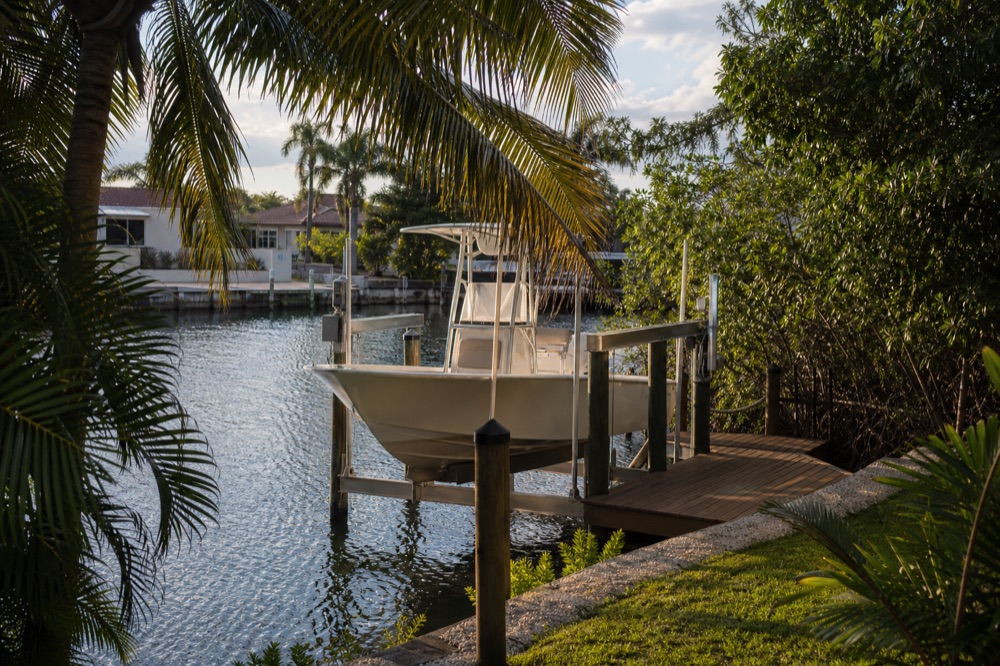
- Leave it on the lift. Genuinely debated, and the right answer is rig-specific. Follow the storm guidance from your lift’s manufacturer for your model: storm position, strap use, and whether the canopy or its panels come off, and confirm your approach with your insurer. Don’t improvise, and don’t take a stranger’s rule of thumb over the manufacturer’s.
Whatever you choose, strip the boat: canvas, electronics you can remove, loose gear, and anything on deck. More detail in the boat lift playbook.
Fuel, power, and people
- Fuel everything early: vehicles, cans, generator. Stations run dry and lose power.
- Test the generator now, outdoors only. Never in a garage, lanai, or anywhere enclosed or near a door, window, or vent: carbon monoxide in generator exhaust is invisible, odorless, and deadly.
- Charge devices and battery banks, and get a battery radio.
- Locate and label the breakers that feed your lift, dock outlets, dock lighting, and fish lights. You’ll be shutting them off in the final stretch, and you don’t want to be hunting through a panel with a flashlight.
- Cash, medications, pet supplies, water, and your evacuation plan, including where you’d go and when you’d leave.
What you’re deliberately leaving for the last day
Don’t try to finish everything at 72 hours. A short list belongs at the end: the final loose-item walk, killing power at the breaker, and one last round of photos of the secured state. That’s covered in the 24-hour checklist, and if you’re leaving town, the compressed version is in evacuating? lock down the waterfront.
Once it’s over and it’s safe, we inspect, repair, and rebuild storm-damaged docks, lifts, seawalls, and pilings across Southwest Florida with our own crew, never subbed out, and we write detailed estimates you can hand to an adjuster. Start at our dock repair page or call (239) 397-3400 for a free on-site estimate.