
Post-Storm Boat Lift Triage: Don't Hit the Switch First
Why running your boat lift is the last thing you should do after a storm, and the cable, pulley, beam, and motor checks that come before power ever goes back on.
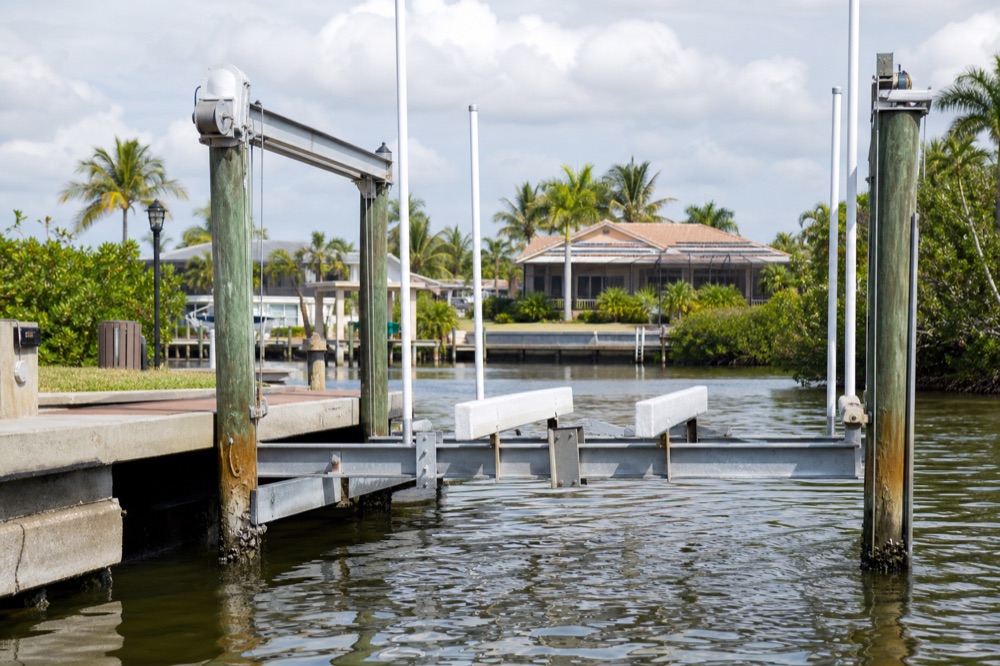
Key takeaways
- Do not press the up or down button first. Power stays off at the breaker until a licensed electrician has verified any lift equipment that got wet.
- Inspect cables, pulleys, beams, bunks, and pilings visually from dry land with the power off, a lift that ran fine before the storm can be loaded wrong now.
- A submerged lift motor is a replacement conversation, not a dry-it-out conversation; salt water attacks windings and bearings from the inside.
- Never load test a storm-hit lift yourself. A cable or gearbox that lets go under a boat's weight is the most dangerous failure on a waterfront property.
- If your boat rode out the storm on the lift, leave it there until the lift has been inspected: lowering it is also a load.
There’s one instinct to fight harder than any other after a storm, and it’s the one that walks you out to the lift and puts a thumb on the up button just to see if it still works. Don’t. A boat lift is a powered machine holding thousands of pounds over water, and the button tells you nothing useful. It either does nothing, or it does something you can’t undo.
Here’s the order to work through instead, all of it with the power off and both feet on solid ground.
Why shouldn’t you run the lift first?
Because the button is a load test, and you have no idea yet what the lift is carrying it with. Storm forces move things that are supposed to stay put: a cable jumps a pulley groove, a beam takes a hit from debris, a bunk shifts, a piling loosens, a motor takes on water. None of that is visible from the switch box, and all of it fails the same way: suddenly, under load.
If there’s a boat on the lift, the stakes go up sharply. A parted cable or a failed gearbox drops several thousand pounds with no warning and nothing worth being near. Power stays off at the breaker until an electrician has cleared it and the structure has been looked at. If a breaker tripped during the storm, leave it tripped: that’s information, not a problem to reset away. Full detail is on our post-storm electrical safety page.
What should you inspect on a boat lift after a storm?
Cables, pulleys, beams, bunks, and the lift pilings: visually, from the dock or seawall, with the power off.
Cables. These are the highest-consequence part. Look for broken strands standing out from the lay of the cable, flattened or kinked sections, rust bleeding where there wasn’t any before, a cable gone slack that should be tight, and uneven spooling on the drum. Most important: check that every cable still sits in its pulley groove. A cable that has jumped its sheave will chew itself apart on the first run. Our guide on cable replacement warning signs covers the tells.
Pulleys and sheaves. Cracked, seized, bent, or missing. Check that each one still turns freely and sits square in its bracket.
Beams and cradle. Sight down the I-beams. Any bend, twist, or sag that wasn’t there before means the frame took a hit. Look for shifted, cracked, or missing bunks, and for hardware backed out or sheared.
Lift pilings. Same standard as the dock pilings: plumb, in line, no wobble, no fresh cone of washed-out bottom at the waterline. A lift is only as strong as what it’s bolted to.
Everything else that moves. Guide poles, stops, straps, remote antenna, and any accessory that could have shifted into the travel path. If your lift has a canopy, note whether the frame is straight and whether panels or fabric are still fastened, a loose panel becomes a sail, and a bent canopy frame can foul the boat on the way up.
Any one of these is a hard stop, the lift stays out of service until it’s repaired:
- A cable with broken strands, a kink, or one that’s off its pulley
- Slack in a cable that should be under tension, or a cradle sitting visibly out of level
- A bent, twisted, or sagging I-beam
- A lift piling that leans, moves, or has fresh scour around it
- A motor, gearbox, or switch box that shows a waterline or salt crust
What if the motor got wet?
A submerged lift motor is a replacement conversation, not a dry-it-out conversation. Salt water gets into windings, bearings, and brake components, and corrosion keeps working from the inside long after the housing looks dry.
The dangerous part is that a salt-flooded motor often does run at first. It spins up, sounds close enough to normal, and then seizes or drops its brake later: sometimes with a boat in the air. Look for a waterline or salt crust on the motor housings, gearboxes, and switch box, and note it. Then stop, and let a professional handle it. Nothing about this is a homeowner repair.
If your lift ran before the storm and won’t now, resist the urge to troubleshoot it live; the general causes are covered in our lift troubleshooting guide, but a post-storm no-run gets an inspection first.
When is it safe to load test the lift?
When a professional does it. That’s the whole answer. A load test on a storm-hit lift means putting full weight on components that may already be compromised, and the failures involved, a cable parting, a gearbox letting go, a beam buckling: are sudden and violent. There’s no cautious DIY version.
The safe sequence is: power stays off, electrician verifies and clears the circuit, contractor inspects cables, pulleys, drive gear, beams, and pilings, repairs happen, and then the first run is done deliberately with nobody underneath and no one in the water. If your boat rode out the storm up on the lift, it stays up until that sequence is done: lowering it is a load cycle too.
When should you call?
Call if a cable is damaged or off its pulley, if a beam or bunk has moved, if a lift piling leans, if any motor or control gear was underwater, or if the lift simply won’t run. Call also if it all looks fine and the storm was serious: lift damage hides in the same places dock damage does, below the waterline and inside sealed housings.
We install, service, and repair boat lifts across Cape Coral, Fort Myers, Naples, and the rest of Southwest Florida, with our own crew, since 2008. We’ll inspect the cables, drive gear, frame, and pilings and give you a straight repair-or-replace answer, quoted free on-site. See our boat lifts page or call (239) 397-3400.