
Post-Storm Seawall Triage: What to Check and How Urgent
The yard-side signs that a seawall took real damage, what to look for at the water when it's safe, and why the weeks after a storm matter more than the day of.
Key takeaways
- The most important post-storm seawall clues are in your yard, not on the wall: new holes, soft spots, and sunken pavers mean soil is escaping through or under the wall.
- Check the cap for new or widened cracks and for any gap opening between the cap and the soil behind it; a rotating cap means the wall is being levered outward.
- Sight down the wall from the corner of your lot. Any new lean, bow, or panel that's out of line with its neighbors is urgent.
- Damage from surge often shows up weeks later as the soil behind the wall keeps washing out through openings the storm created, a wall that looks fine now can move later.
- Stay off the cap and out of the water while inspecting; a compromised wall can fail without warning and the ground behind it may be undermined.
Of everything on a waterfront lot, the seawall is the one that lies to you. A dock tells you it got hurt: boards missing, pilings leaning. A seawall can take serious structural damage from surge and look exactly the same afterward, because most of what happened is behind it or below it.
So the post-storm seawall check works differently. You start in the yard, you read the wall for movement rather than cosmetics, and you keep watching for weeks, because this is the one asset where the damage report comes in late.
Where do you start, the wall or the yard?
The yard. The ground behind your seawall is the best early-warning system you have, because the classic Southwest Florida failure mode isn’t the wall breaking: it’s the soil escaping through it.
Walk the strip between your house and the wall and look for:
- New holes or sinkholes, however small. A hole the size of a coffee can matters.
- Soft or spongy ground that gives underfoot where it used to be firm
- Sunken pavers, patio slabs, or pool deck dropping out of level
- A dip or trough forming along the seawall line, parallel to the wall
- Standing water sitting behind the wall long after everything else drained
Any of those means material is moving out from behind your wall, through an open joint, a cracked panel, a failed seal, or under the toe. Our guide on erosion and sinkholes behind a seawall explains what’s happening underneath.
What do you check on the wall itself?
The cap, the joints, and the wall’s line, in that order, from a safe distance. Stay off the cap while you do it. If the ground behind the wall is undermined, the edge is the worst place to stand.
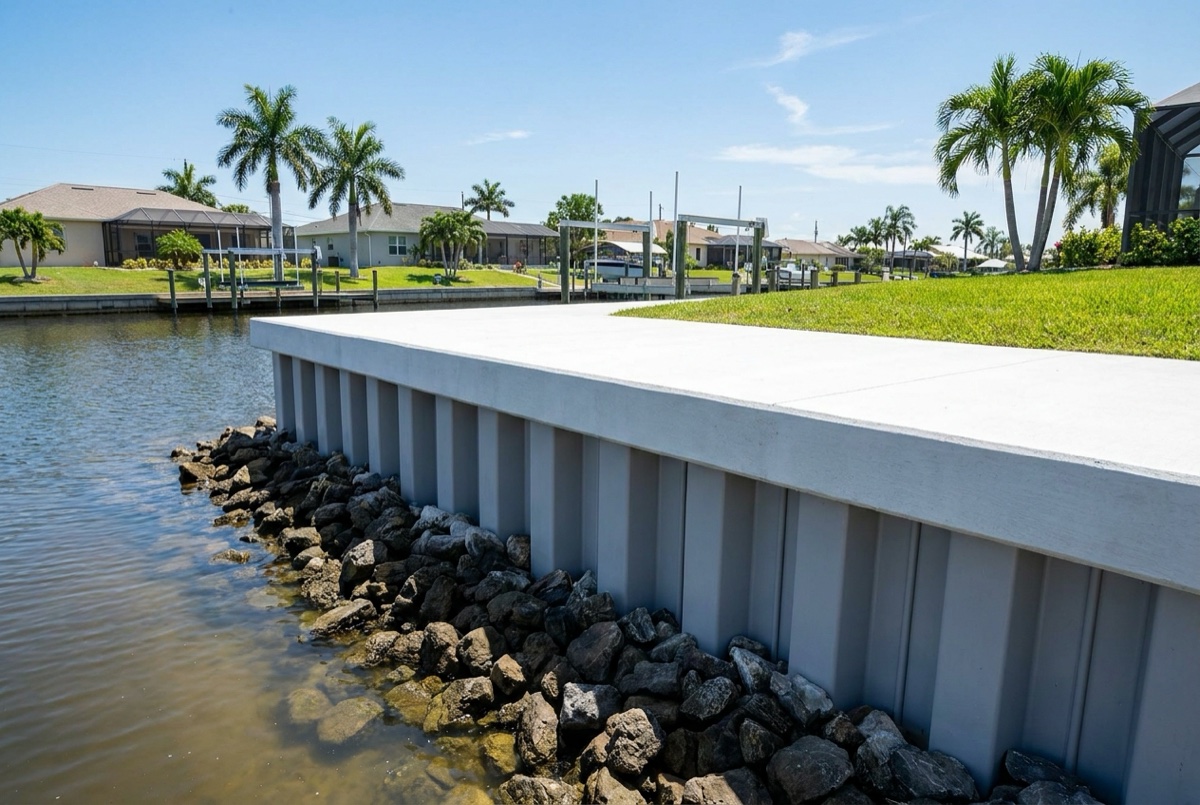
The cap. That’s the concrete beam running along the top. Look for cracks that are new or wider than you remember, sections of cap sitting out of line with the sections beside them, and, the important one: a gap opening between the cap and the soil behind it. A cap pulling away or tilting forward means the top of the wall is being levered outward.
The joints. Seawall panels sit side by side with joints between them. New gaps, daylight, or sand streaming through a seam means the wall is no longer moving as one unit and your yard has a route to the canal.
The line. Go to a corner of your lot and sight down the face of the wall like you’d sight down a board. Any new lean toward the water, any bow in the middle, any panel out of line: that’s the top of the list. A wall leans because the tiebacks (the steel rods and buried anchors holding it back) have let go, and a leaning wall is actively moving. See signs your seawall is failing for the full picture.
The weep holes. These small drains near the base relieve water pressure behind the wall. Note any that are blocked, and any that are pushing out sediment rather than water.
What can you check at the waterline?
Very little, safely, and only from dry land. What you’re looking for is toe scour: the base of the wall is set into the canal bottom, and surge plus the outrush behind it can carry that material away, leaving the wall’s foot with less holding it.
On a calm day with reasonably clear water, standing back from the edge, you may be able to see a trench, undercut, or shadow running along the base. That’s a qualitative look, not a measurement, and the absence of a visible trench proves nothing: post-storm canal water is usually too turbid to see through. Do not get in the water to check. Confirming toe condition takes an underwater inspection, which is part of what we do. Where scour is the ongoing problem, rip-rap placed at the toe is often part of the fix.
Why do the weeks after the storm matter so much?
Because seawall damage is progressive. A joint that opened during surge doesn’t close again. Every tide cycle pulls a little more sand out through it. A panel cracked below the waterline keeps admitting water and losing soil. The wall you inspected on day two and cleared can be visibly settling by week six.
So build a habit for the next couple of months: walk the same strip of yard weekly, photograph the same spots from the same angles, and pay attention to anything that’s changing rather than anything that’s merely imperfect. Change is the signal.
Here’s how we’d rank what you find:
| What you see | Urgency |
|---|---|
| New lean, bow, or panel out of line | Call now, the wall is moving |
| New sinkhole or soft ground behind the wall | Call now: soil is actively leaving |
| Cap separating from the soil, or a rotating cap | Call now |
| New or widened cap and panel cracks | Inspect soon, before the next system |
| Open joints, sediment at weep holes | Inspect soon, and monitor weekly |
| Cosmetic staining, minor surface spalling | Note it, raise it at your next inspection |
When should you call?
Call right away for anything in the top three rows. Call for an inspection anyway if the storm was significant, even with a clean-looking wall, the toe and the below-water panels are where the story usually is, and neither is visible from your yard.
If the wall is beyond repair, rebuilding is permitted work; our guide on rebuilding a dock or seawall after a hurricane covers how permitting fits into recovery. We handle it in-house either way.
We’ve built, repaired, and replaced seawalls across Cape Coral, Fort Myers, Naples, and Charlotte Harbor since 2008, with our own crew. We’ll inspect the cap, panels, tiebacks, and underwater toe and tell you straight whether it’s a repair or a replacement, quoted free on-site. See our seawalls page or call (239) 397-3400.