
Types of Boat Lifts Explained: Which Is Right for Your SW Florida Dock?
The four boat lift styles SW Florida owners actually choose between, compared head-to-head by canal width, boat weight, seawall-vs-dock, and salt-water corrosion.
Key takeaways
- The four real-world lift styles SW Florida owners pick from are four-post (cradle), elevator/rail, cantilever, and piling-mount/davit — and the right one is decided by canal width, boat weight, and whether you have a seawall or a dock.
- The four-post cradle lift is the regional workhorse — it handles most center consoles and bay boats and is what we install on the majority of canal-front homes.
- Elevator (rail) lifts solve narrow canals and seawall-only sites with no dock, but their underwater rollers foul with barnacles and need more cleaning.
- Cantilever and davit lifts are light-duty solutions — great for kayaks, small skiffs, and PWCs ($3,000–$5,000), wrong for anything heavy.
- Every lift on the salt should be marine-grade aluminum with 316 stainless cable and a sealed marine motor, or the Gulf will eat it.
Walk any canal in Cape Coral or Naples and you’ll see the same boat on different lifts — and the lifts don’t all look alike. That’s because there’s no single “boat lift.” There are a handful of distinct styles, each engineered for a different combination of canal width, boat weight, and what you’re mounting to. Pick the wrong one and you’ll fight it for years: a lift that’s too light, rollers that won’t stop barnacling, or a footprint that crowds a skinny canal.
This is the straight-talk version. We’ll define each of the four real-world lift styles owners actually choose between on the Southwest Florida coast, compare them side by side, and give you a “best for” verdict tied to the things that genuinely decide it — canal width, boat weight, seawall versus dock, and the salt water that wants to eat all of it.
What is a boat lift, and what are the four real types?
A boat lift is a powered (or sometimes manual) cradle that raises your boat out of the water when you’re not using it, so the hull, lower units, and running gear never sit in the salt. The four types SW Florida owners actually pick from are the four-post (cradle) lift, the elevator (rail) lift, the cantilever lift, and the piling-mount or davit lift.
Everything else you’ll read about — bunk lifts, sling lifts, beamless lifts — are variations on how the boat is held on top of one of those four. The four styles below are the real decision. Here’s what separates them.
What is a four-post (cradle) lift — and why is it the SW Florida workhorse?
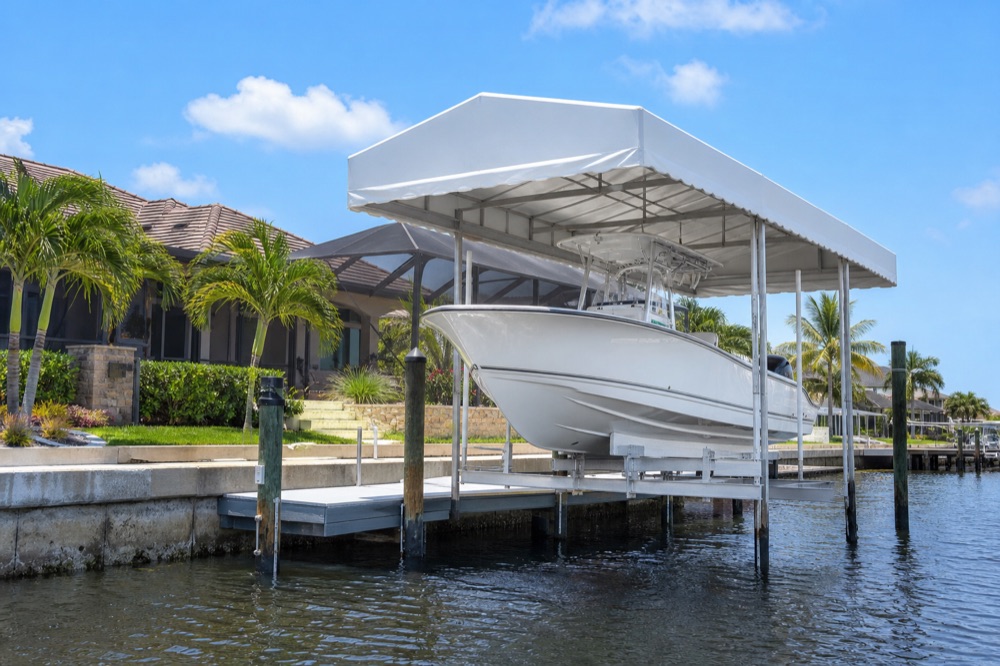
A four-post lift is mounted on four pilings, with two cables on each side that raise and lower a cradle the boat sits in. It’s the most common lift on Southwest Florida canals because it’s strong, stable, and scales from a small skiff all the way up to a heavy offshore boat.
The boat rides on the cradle — either on bunks (carpeted or composite runners under the hull) or on adjustable beams — and a sealed marine motor winds two or four cables to lift it straight up. Because the load is spread across four pilings, a four-post lift handles weight and storm surge better than any other style. It’s what we install on the majority of dock-front homes from the Caloosahatchee down to Marco Island.
Four-post lifts shine when you have:
- A standard residential canal with room for a lift on the dock side
- A boat in the 7,000–24,000 lb range (most center consoles, bay boats, and cruisers)
- Existing or new pilings we can set to the right depth for your canal bottom
The one thing a four-post lift needs is space and four sound pilings. On a very narrow canal, or a seawall with no dock, that’s where the next style earns its keep.
What is an elevator (rail) lift, and when does it win?
An elevator lift — also called a rail lift — mounts off a single structure (often the seawall) and raises the boat straight up along a guided vertical rail instead of on four free-standing pilings. It’s the answer for narrow canals and seawall-only sites where a four-post lift simply won’t fit.
Because the whole mechanism stacks vertically against the seawall or a minimal piling set, an elevator lift has a small footprint and barely intrudes into the canal — a real advantage when your neighbor’s lift is already eating half the waterway, or when local rules limit how far you can extend toward the channel. It’s also a clean solution for a boat lift on a seawall with no dock.
Here’s the honest trade-off: an elevator lift’s rollers and lower rail components live in or just above the water. In our salt, that means barnacles and marine growth foul them faster than the submerged parts of a four-post lift. They work beautifully for tight canals, but plan on more regular cleaning to keep the rail and rollers running smooth — especially through the warm-water months when growth is fastest. If you go this route, it’s worth reading our notes on boat lifts in shallow water and low tide, since rail lifts and shallow bottoms interact in ways a four-post doesn’t. Style is only half the decision. A lift on the river and a lift in a canal are not the same problem, and boat lifts in Fort Myers is where we work that contrast out street by street.
What is a cantilever lift — and is it strong enough for my boat?
A cantilever lift uses a pivoting arm-and-frame design that swings the boat up and out of the water in one motion, rather than hoisting it straight up on cables. It’s a light-duty lift — excellent for small, light boats and wrong for anything heavy.
Cantilever lifts are simple, often manual or lightly powered, and they’re popular for small skiffs, jon boats, kayaks, and paddle craft on protected water. The pivoting action means fewer cables and a lower price point. But the same geometry that makes them simple also limits how much weight they can carry safely, and they don’t love big tide swings or surge. For most Southwest Florida center consoles and bay boats, a cantilever lift is undersized — this is a small-boat tool, not a workhorse.
If you’re lifting a personal watercraft or a small tender, you’re often better served by a dedicated jet-ski lift, which is purpose-built for that weight class and runs $3,000–$5,000.
What is a piling-mount or davit lift — and where does it fit?
A piling-mount or davit lift uses cantilevered arms or davits bolted to a piling, the seawall, or the dock to hoist a smaller boat or PWC up and over. It’s a compact, low-cost lift for light loads in spots where a full four-post or elevator lift is overkill.
Davit-style lifts are the most space-efficient of the bunch. Because they don’t need a four-piling field, they’re handy for PWCs, dinghies, kayaks, and small skiffs — and for squeezing a lift into a corner of a dock or onto a seawall where nothing else fits. Like the cantilever, the catch is capacity: davits are for light boats. Push them past their rating and you’re asking for a bent arm or a dropped hull. For anything in true center-console territory, you’re back to a four-post or elevator lift.
How do the four boat lift types compare?
Here’s the quick decision table. Capacity numbers are the ranges we actually spec; light-duty styles vary by model, so we confirm the rating on site.
| Lift type | Best for | Typical capacity | Mounts to | Salt-water note |
|---|---|---|---|---|
| Four-post (cradle) | The everyday workhorse — most center consoles, bay boats, cruisers | 7,000–24,000 lb+ | Four pilings | Most durable; submerged parts still need anode protection |
| Elevator / rail | Narrow canals & seawall-only sites with no dock | Light to mid (model-dependent) | Seawall or minimal pilings | Rollers/rail foul with barnacles — clean more often |
| Cantilever | Small skiffs, jon boats, kayaks on protected water | Light-duty | Pilings or shoreline | Simple, fewer cables; not for heavy boats or big surge |
| Piling-mount / davit | PWCs, dinghies, kayaks, tight corners | Light-duty | Single piling, seawall, or dock | Smallest footprint; capacity is the limit |
A few rules of thumb the table can’t capture:
- Wide canal, normal boat? Four-post, almost every time.
- Skinny canal or seawall with no dock? Elevator (rail) lift, with cleaning built into your routine.
- PWC, kayak, or small tender? A jet-ski lift or davit — don’t overspend on a four-post.
- Big offshore boat? Four-post with proper cross-bracing for surge load.
How does Southwest Florida salt water change the choice?
This is where local knowledge matters more than any catalog. Every lift style here lives in a brutal environment — saltwater canals, summer storm surge through hurricane season (June through November), relentless UV, and marine borers and barnacles that attack anything in the water. The lift style affects how hard the salt hits it, but the spec is what determines whether your lift lasts decades or seasons.
No matter which type you choose, everything we install is built for this coast:
- Marine-grade aluminum frames that won’t rust like steel
- 316 stainless cables and hardware — the grade that survives salt
- Sealed marine motors rated for our salt air and humidity
- Sacrificial zinc anodes on submerged metal to take the galvanic corrosion instead of your lift
Elevator lifts demand the most attention because their moving parts sit lowest in the water. Four-post lifts are the most forgiving. But all of them need the right metal and a little upkeep — and they all need pilings driven to the correct depth for your canal bottom and a seawall that’s sound enough to mount to or sit beside. If your seawall is leaning or spalling, that gets addressed first, because a lift is only as solid as what it’s anchored to.
Which boat lift is right for your dock?
It comes down to four questions, and we answer all of them on site: How wide is your canal? What does your boat weigh fully loaded — hull, engines, fuel, water, gear? Do you have a dock, or just a seawall? And how shallow does it get at low tide? Get those right and the lift style usually picks itself.
For most Southwest Florida canal homes, that’s a four-post cradle lift sized to your loaded weight — our full breakdown is in what size boat lift do I need, and the real numbers are in our boat lift cost guide. For tight canals and seawall-only setups, it’s an elevator lift. For the small stuff, a davit or jet-ski lift.
We’ve been building lifts on this coast since 2008 with our own local crew — never subbed — and we handle permitting in-house across all 18 cities we serve, from Cape Coral and Fort Myers to Naples, Punta Gorda, and Venice. The best way to land on the right type is to have someone who installs all four look at your actual canal. Explore everything we build on our boat lifts page, book a free on-site estimate seven days a week in Cape Coral or anywhere on the coast, or call (239) 397-3400.