
Fixed vs. Floating Dock for Shallow Water & Big Tide Swings
When the water gets skinny at low tide or the bottom is too soft for pilings, a floating dock can beat a fixed one. Here's how to match the dock to your bottom and tide.
Key takeaways
- A floating dock rides the surface, so it keeps a constant boarding height even when the tide swings two feet or more — a fixed dock can't.
- Choose floating where the water is under about 3 ft at low tide or the bottom is too soft/muddy to anchor pilings well; choose fixed for stability, rougher open water, and boat lifts.
- Fixed docks are the right call almost anywhere you want a boat lift, because lifts need driven pilings to mount to.
- Floating docks are the easy-boarding, low-freeboard choice for kayaks, paddleboards, and jet skis launched off a slick ramp.
- Either way, both need a free on-site look at your canal depth, bottom, and seawall before you commit.
On a Southwest Florida canal, the right dock isn’t about which style looks best in a brochure — it’s about your bottom and your tide. Two homes a few hundred feet apart can need completely different docks: one sits over four feet of water on a firm bottom, the next dries out to ankle-deep mud at low tide. Get the match wrong and you end up with a beautiful dock you can’t comfortably use half the day.
This guide cuts straight to the decision. A fixed dock stands on driven pilings at one set height. A floating dock rides the surface on sealed pontoons, rising and falling with the water. Both are great docks — they just shine in different water.
What’s the difference between a fixed and floating dock?
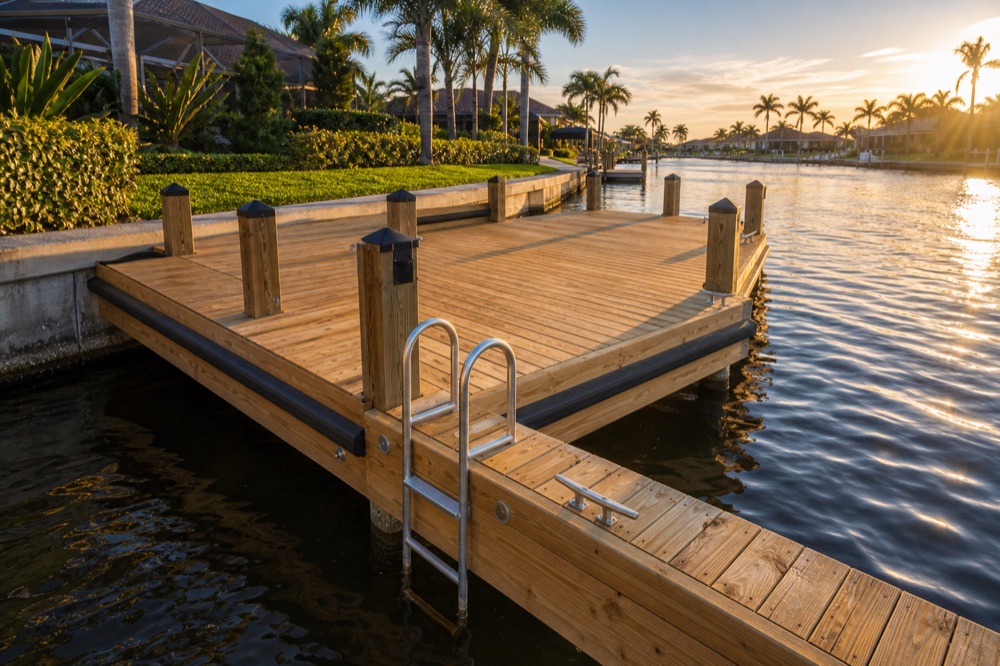
A fixed dock is built on pilings driven into the canal bottom, so its deck stays at one elevation no matter what the tide does. A floating dock sits on buoyant pontoons and rises and falls with the water, held in place by guide pilings or anchors so your step-off height stays constant.
That single difference — fixed height versus floating with the tide — drives everything else. A fixed dock is rock-solid underfoot and gives you a stable platform for a boat lift. A floating dock trades some stability for a deck that’s always level with the water, which is exactly what you want in skinny water or a big tidal swing.
When is a floating dock the better choice?
Choose a floating dock when the water is very shallow at low tide or the bottom is too soft to hold pilings well. In those conditions a floating dock keeps working when a fixed one becomes awkward to board.
A floating dock earns its keep in a few specific situations on our coast:
- Very shallow water — roughly under 3 ft at low tide. A fixed dock’s deck stays put while the tide drops out from under your boat, so you’re stepping up to the dock from a grounded hull. A floater drops right down with the water and stays level with your gunwale.
- Soft, mucky bottoms. Some canals and back bays have deep silt where driving solid pilings for a fixed dock is tougher and pricier. A floating dock can be anchored or set on lighter guide pilings instead.
- Big tide swings. Around Charlotte Harbor, the Caloosahatchee, and the back-bay creeks, a couple of feet of swing is normal. A floating dock gives you the same boarding height all day, which is safer for kids, dogs, and anyone carrying a cooler.
- Easy boarding and low freeboard. Floating decks sit just inches above the water — a natural fit for stepping into a low boat, and ideal for launching kayaks, paddleboards, and jet skis off a slick ramp. More in our floating dock for kayak, paddleboard, and jet-ski launch guide.
When is a fixed dock the better choice?
Choose a fixed dock when you want maximum stability, plan to add a boat lift, or face rougher open water. Its pilings give you a planted, immovable platform that a floating dock can’t match.
Fixed docks are still the workhorse of SW Florida waterfronts for good reason:
- Boat lifts. This is the big one. A boat lift or jet-ski lift mounts to driven pilings — it can’t bolt to a floating deck. If keeping your hull out of the salt is a priority (and on a saltwater canal, it should be), you want fixed pilings.
- Rougher, more open water. On a wide basin, river mouth, or a fetch that builds chop, a fixed dock stays solid while a floating one moves with the waves.
- Heavy loads and gear. Golf-cart access, a tiki hut, water and power runs, a fish-cleaning station — a fixed dock carries weight and fixtures without flexing.
- Storm planning. Both types need a real hurricane-season plan from June through November, but fixed structures on properly driven pilings give you a known, engineered baseline to prep around.
Fixed vs. floating: how to match the dock to your site
Here’s the quick decision table we walk owners through at the estimate.
| Your situation | Better fit |
|---|---|
| Under ~3 ft of water at low tide | Floating |
| Soft, mucky bottom (hard to anchor pilings) | Floating |
| Big daily tide swing, want constant boarding height | Floating |
| Launching kayaks, paddleboards, or a jet ski off a ramp | Floating |
| You want a boat lift | Fixed |
| Firm bottom, adequate depth, open/choppy water | Fixed |
| Heavy fixtures: tiki hut, golf cart, power and water | Fixed |
| Maximum long-term stability underfoot | Fixed |
Plenty of homes don’t have to pick just one. A common SW Florida setup is a fixed main dock with a boat lift, plus a small floating section off the side for kayaks, the dinghy, and easy low-tide boarding — best of both worlds.
Do floating docks hold up in SW Florida salt water?
Yes, when they’re built for it. The catch is that any floating dock lives in the splash zone, so the float material and hardware have to be marine-rated or the salt will win.
We build for this coast either way. Fixed or floating, the spec is marine-grade aluminum framing, 316 stainless cable and hardware, and capped composite decking like TimberTech or Trex that shrugs off UV, salt, and heat — with CCA-treated framing where treated wood is the right call. Floating sections add one chore: cleaning barnacles and algae off the pontoons now and then, since anything sitting at the waterline grows a beard down here. It’s routine maintenance, not a dealbreaker.
Bottom line
Match the dock to your bottom and your tide. If your water goes skinny at low tide, your bottom is soft, or you want a deck that’s always level with your boat, a floating dock is likely your answer. Want a boat lift, rock-solid stability, or you’re on rougher open water? Go fixed. Somewhere in between, there’s almost always a smart hybrid.
The right call comes from looking at your actual canal — depth at low tide, bottom type, seawall, and how you use the water. We give free on-site estimates seven days a week across Cape Coral, Punta Gorda, and the rest of Southwest Florida. Explore what we build on our custom docks page or floating docks page, or call (239) 397-3400 and we’ll help you match the dock to your water.