
Adding Power, Water, and Lights to a Boathouse
A boathouse is the perfect place to add shore power, a wash-down spigot, lighting, and fans — here's what's worth adding, and why marine-grade wiring and permits matter over salt water.
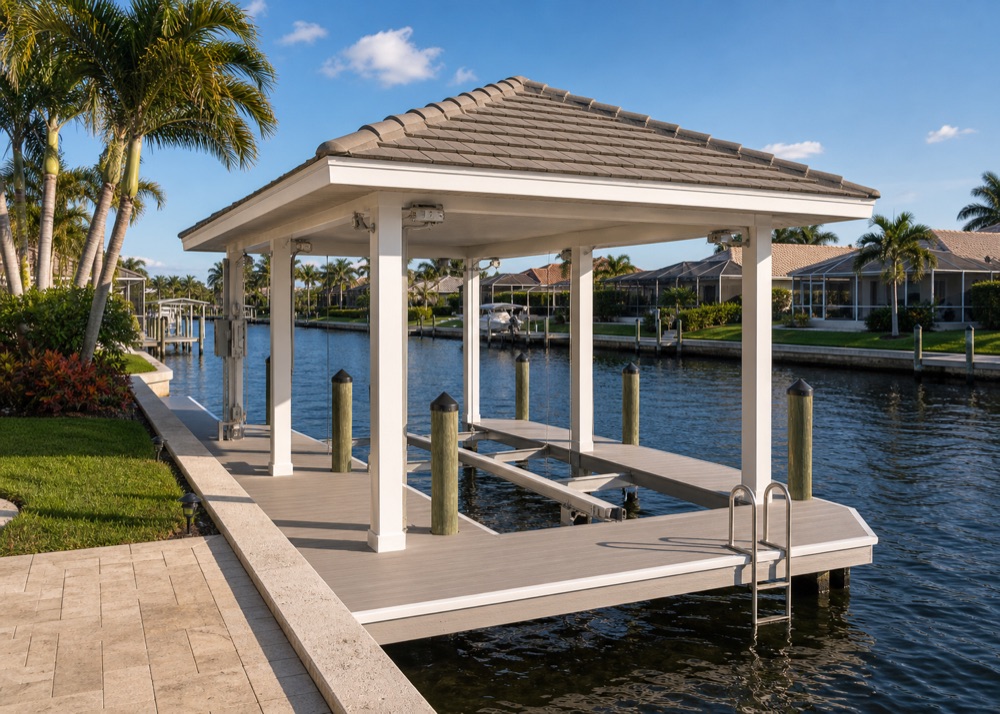
Key takeaways
- The four upgrades worth planning into a boathouse are GFCI-protected shore power (for the lift, tools, and chargers), a fresh-water wash-down spigot, layered lighting (overhead plus accent), and ceiling fans for shade-and-breeze comfort.
- Every circuit near the water must be GFCI-protected and wired marine-grade — tinned copper, sealed weatherproof boxes, 316 stainless fasteners — because salt air corrodes ordinary wiring fast.
- Run power and water during the build, not after; chasing conduit and supply lines through a finished boathouse costs far more than roughing it in up front.
- Boathouse electrical and plumbing are permitted and inspected work in Southwest Florida — we handle permitting in-house and pull the right licensed trades.
- A simple bug-and-shock check: if you ever feel a tingle in the water near your dock, kill the power and call a pro — that's a wiring fault, not normal.
A boathouse does more than keep the sun and rain off your boat. Done right, it’s a fully wired, plumbed outdoor room on the water — the place you rinse the salt off after a run to Charlotte Harbor, plug in the lift, and tie up under good light after a sunset cruise. The shell is the big build, but the power, water, and lighting are what make it genuinely useful day to day.
If you’re in the planning stage and wondering what can I actually add to my boathouse, this is the short list that earns its keep — and the reasons marine-grade work and a permit aren’t optional on a saltwater canal.
What’s worth adding to a boathouse?
The four upgrades that pay off for almost every owner are shore power, a wash-down spigot, layered lighting, and fans. Together they turn a covered slip into a working part of your waterfront.
- GFCI shore power to run the boat lift, power tools, a pressure washer, and onboard battery chargers.
- A fresh-water spigot for rinsing salt off the hull, gear, and yourself.
- Overhead and accent lighting so the slip is safe and usable after dark.
- Ceiling fans to move air and keep bugs down in the shade.
You don’t have to do all of it at once — but you do want the runs in place during the build.
Why does boathouse wiring have to be marine-grade?
Because salt air destroys ordinary electrical. The constant humidity, salt spray, and UV on a Southwest Florida canal corrode standard wire, connectors, and boxes in a fraction of their normal life — and corroded wiring near water isn’t just a maintenance headache, it’s a safety risk.
Marine-grade work means a few specific things:
- Tinned (marine) copper wire that resists corrosion inside the insulation.
- GFCI protection on every circuit, which cuts power instantly if current leaks toward ground or water.
- Sealed, weatherproof enclosures and in-use covers rated for wet locations.
- 316 stainless fasteners — the same grade we use on cable and hardware — so mounting points don’t bleed rust.
This is the same philosophy behind everything we install over salt water, from sealed marine lift motors to 316 stainless cable. The cheap version always fails first, and out here it fails fast.
What lighting options work best in a boathouse?
Think in layers: a few bright overheads for tasks, plus softer accent lights so the structure looks good and the dock edges are visible at night. Marine-rated LED is the standard now — it sips power, runs cool, and handles the salt-air environment far better than older fixtures.
| Light type | What it’s for |
|---|---|
| Overhead LED downlights | Loading gear, cleaning fish, working on the boat after dark |
| Accent / soffit lighting | Architectural glow, marking the structure for boaters |
| Step and piling lights | Lighting the walkway and dock edge so no one missteps |
| Underwater fish lights | Drawing bait and fish to the slip (a separate add we love) |
Warm-white tones flatter the structure and attract fewer bugs; cooler light is brighter for tasks. We usually blend both. If you want the full breakdown of fixtures and color temperature, our saltwater dock lighting guide covers it, and a boathouse is a natural anchor point for whole-dock dock lighting. Many owners add underwater fish lights at the same time, since the wiring is already going in.
Should I run power and water during the build or after?
During the build — every time. Roughing in conduit, a small sub-panel, and a water supply line while the framing is open is straightforward. Retrofitting them into a finished boathouse means fishing lines through closed structure and patching afterward, which costs far more for the same result.
A smart approach even on a budget:
- Run a dedicated, properly sized circuit from your house panel out to the boathouse during construction.
- Pull conduit with a pull-string for any fixtures you might add later — fans, more lights, a second outlet.
- Stub in a fresh-water line with a frost-free, hose-bib spigot near where you’ll wash down.
- Decide on fan blocking and fixture boxes now, while the ceiling is open.
Do this and adding the actual fixtures later is a quick, clean job instead of a demolition project.
A wash-down spigot: small add, big payoff
A single fresh-water spigot at the boathouse is one of the highest-value, lowest-cost upgrades you can make. Rinsing salt off your hull, lower units, reels, and deck the moment you’re back in the slip is the simplest way to fight corrosion in this climate — the same salt that eats wiring eats your boat and gear. Add a hose reel and a wand and your post-trip routine drops to a few minutes, right at the water.
Why permits and licensed trades matter here
Electrical and plumbing on a boathouse are permitted, inspected work in Southwest Florida, and the codes around water are stricter than for a typical backyard outlet — GFCI requirements, conductor types, bonding, and clearances all come into play. This is not a weekend DIY project, both because of the rules and because the consequences of a mistake are serious near water.
Here’s a safety point worth knowing: if you ever feel a tingle or shock in the water around your dock, that’s current leaking from a wiring fault, and it’s dangerous. Kill the power and call a marine-qualified electrician. Proper GFCI protection is designed to trip before that ever happens — which is exactly why it’s required.
We handle the entire permitting process in-house and bring in the right licensed electricians and plumbers, so the work is scoped, built to code, and signed off as part of the project — not left for you to coordinate.
Build it once, build it right
The best time to think about power, water, and lights is before your boathouse is built — and ideally with the structure, the boat lift, and the utilities all scoped together so nothing’s an afterthought. We’ve built and wired waterfront structures across Southwest Florida since 2008, with our own local crew, marine-grade materials, and in-house permitting on every job.
Planning a boathouse for your canal in Cape Coral, Naples, or anywhere along the coast? Start on our boathouses page, then book a free on-site estimate — seven days a week — and we’ll map out the power, water, and lighting that fit your slip. Call (239) 397-3400.