
Cost to Replace a Seawall Cap (and Why the Cap Fails First)
What drives the cost of a seawall cap replacement on a Southwest Florida canal, why the cap almost always fails before the panels, and how to tell if your wall is a cap-only candidate.
Key takeaways
- The seawall cap is the concrete beam across the top that ties all the panel tops together and carries dock loads and foot traffic; it almost always fails before the panels do.
- Caps fail first from salt spall and rebar rust — salt drives into the concrete, rusts the steel inside, and the swelling rust cracks and breaks the cap apart.
- A cap-only rebuild on sound panels costs far less than a full seawall replacement because the wall below stays in place.
- Your panels are likely keepers if they're straight, intact, and not losing your yard; bowing, cracked-through panels, or sinkholes point to full replacement.
- Florida Lifts & Docks gives free on-site cap assessments seven days a week across 18 Southwest Florida cities.
Walk enough Southwest Florida seawalls and you’ll notice the same thing breaks first: not the wall, the cap. Hairline cracks turn into spider webs, chunks of concrete flake off the edge, rust stains bleed down the face, and eventually a piece lets go underfoot — while the wall actually holding your yard out of the canal stays perfectly sound.
That’s good news for your wallet. The cap is the single most-replaced component on a seawall, and on a sound wall it’s the cheapest serious fix you can make. Here’s what a cap is, why it fails first on a salt canal, and what drives the cost of replacing it.
What is a seawall cap?
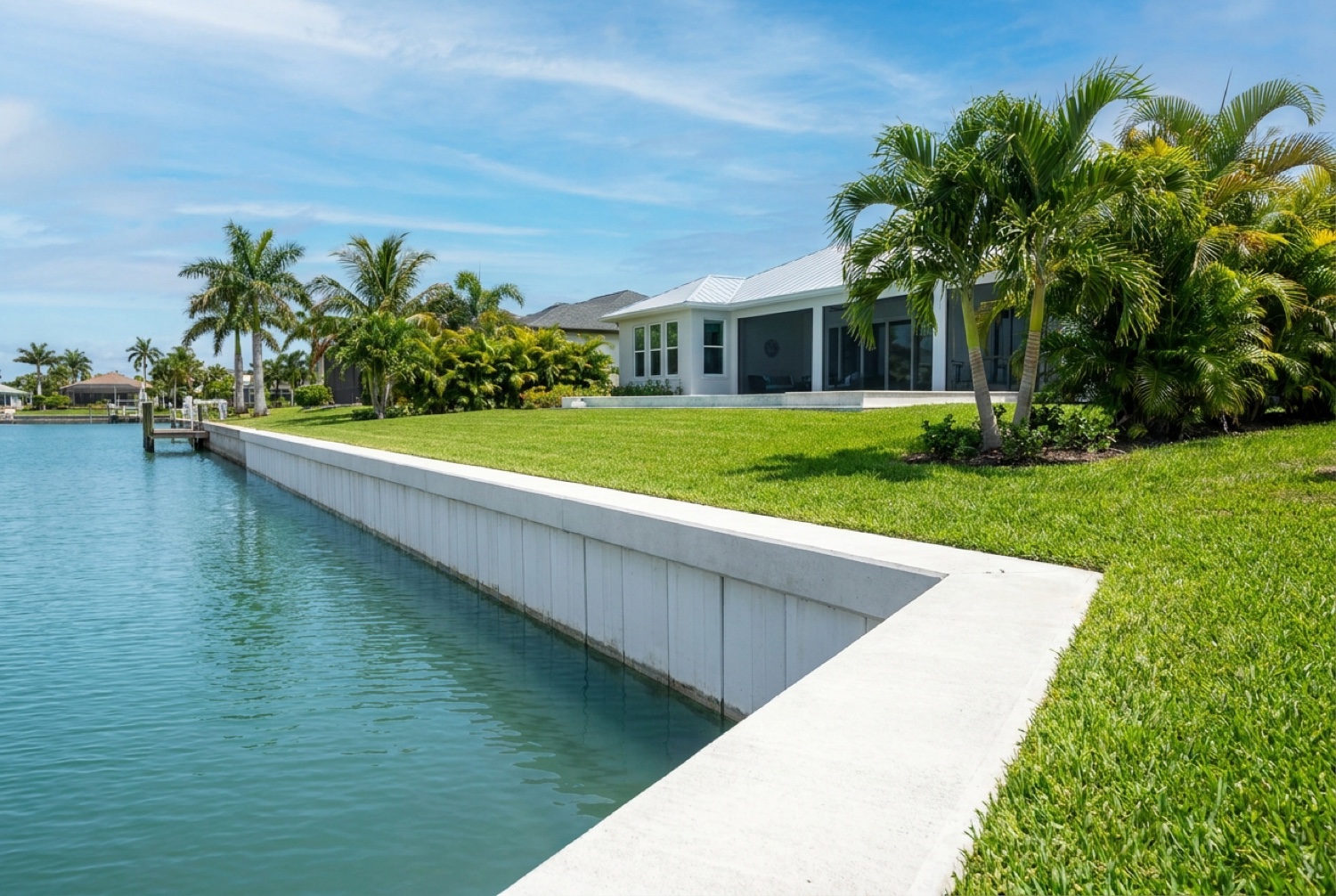
The seawall cap is the continuous concrete beam that runs along the very top of your wall, tying all the panel tops together into one rigid edge. It’s the part you stand on, tie off to, and build your dock on.
Below it are the panels — the vertical sections that hold back the soil pressure behind your yard. The cap locks those panel tops in a straight line, spreads the loads that hit the top of the wall, and gives you a clean, walkable edge. Think of the panels as the wall and the cap as the beam that crowns it. When people say their “seawall is crumbling,” nine times out of ten they’re describing the cap.
Why does the seawall cap fail first?
The cap fails first because it takes every kind of abuse at once while sitting in the harshest spot on the structure — everything that’s hard on concrete happens right there at the top. Here’s what’s working against it on a Southwest Florida canal:
- Salt spall. The big one. Salt spray off the canal — plus brackish water from storm surge and high tides — drives chloride into the concrete and eats into the slab from the surface inward.
- Rebar rust. Steel rebar runs inside the cap. Once salt reaches it the steel rusts, and rust takes up far more space than the original metal. That expanding steel pushes the concrete apart from the inside, cracking and breaking off chunks — spalling.
- Foot traffic and dock loads. The cap is where you walk, where your dock attaches, and where lift and piling loads transfer. That constant weight finds any weakness the salt has created.
- Sun and heat. Relentless UV and the daily heat-cool cycle open up micro-cracks that give salt an even faster path to the rebar.
The panels, by contrast, spend most of their life buried in soil or underwater — shielded from spray, sun, and foot traffic — so they don’t get attacked the same way. That’s why a wall can have a wrecked cap sitting on panels with decades of life left. We cover the full warning-sign list in signs your seawall is failing.
What does a seawall cap replacement cost?
A cap-only rebuild on sound panels costs far less than replacing the whole wall — often a fraction of it — because the crew never has to disturb the structure below. We quote it free on-site once we confirm the panels are keepers.
A full replacement means driving new panels or sheet pile, excavating, and rebuilding from the canal bottom up. A cap rebuild skips almost all of that: remove the failed beam, treat or replace the rebar, form it up, and pour a fresh cap on the wall you already have. Less demolition, less equipment, less time — and you keep the part of the wall that’s still doing its job.
| Cap-only rebuild | Full seawall replacement | |
|---|---|---|
| What’s done | New concrete cap on existing panels | New panels/sheet pile from the bottom up |
| Disturbs the wall below | No | Yes |
| Relative cost | Far lower | Far higher |
| Typical trigger | Spalled, cracked, or crumbling cap; sound panels | Bowing, cracked-through panels; yard washing out |
| Timeline | Shorter | Longer |
We don’t publish a flat cap price because no two walls are the same. The number moves with these factors:
- Cap length. Cost scales with the linear feet you’re capping — a short residential run versus a long lot or a corner.
- Cap height and width. A taller, thicker beam takes more forming, more rebar, and more concrete.
- Access. A clean backyard is cheaper than a tight side-yard or a cap with a dock, lift, or landscaping in the way.
- Rebar condition. Salvageable steel is one job; badly rusted steel that needs replacing adds labor.
- Tie-ins. Working around an attached dock, boat lift, or piling adds time.
How do I know if my panels can keep the cap?
Look at the panels below the cap, not the cap itself. If they’re straight, intact, and not letting soil escape into the canal, they’re very likely sound enough to carry a new cap — that’s the whole question.
When we assess a wall for a cap-only job, here’s what we check:
- Are the panels straight, or bowing toward the water? A straight wall is winning its fight with the soil. One bowing outward is losing — a full-replacement signal, not a cap fix.
- Are there cracks running through the panels themselves? Surface wear is fine; cracks splitting the panels are not.
- Is your yard washing out? Sinkholes, voids, or a sunken strip along the wall mean soil is escaping — usually through failed joints or compromised panels, a bigger job than the cap.
- What shape are the joints in? Soil sneaks out through the gaps between panels long before the panels give, so a cap rebuild sometimes pairs with sealing those joints.
If the bones are good and only the top is shot, you’re a strong cap-only candidate. If the panels are bowing or losing your yard, a new cap on a failing wall is good money after bad. For the bigger decision, see seawall repair vs. replacement, and for lifespans by wall type, how long a seawall lasts in Southwest Florida.
Don’t wait for hurricane season
A failing cap rarely gets better on its own — and on a Gulf coast canal it gets tested hard from June through November, when storm surge and wave action put the most load on the top of your wall. Catching it as a cap-only job, before the damage works down into the panels or behind the wall, is the difference between an affordable fix and a full rebuild.
If your cap is cracking, spalling, or rusting, get eyes on it before it spreads. Florida Lifts & Docks has built and rebuilt seawalls across Southwest Florida since 2008 with our own local crew — never subbed out — and we handle permitting in-house. Learn more on our seawalls page, or if your shoreline might suit rip-rap at the toe, we’ll tell you straight. We give free on-site estimates seven days a week from Cape Coral to Punta Gorda and Naples. Call (239) 397-3400 and we’ll come look at your wall.