
How Long Does a Seawall Last in Southwest Florida?
Realistic service-life ranges for vinyl, concrete, and aluminum seawalls on SW Florida salt canals — and the variables that add or steal years.
Key takeaways
- On SW Florida salt canals, expect roughly 30–50 years from vinyl, 30–50-plus from quality concrete, and 25–40 from aluminum — install quality decides where you land.
- The biggest lifespan variable isn't the material; it's the anchoring system (tiebacks and deadmen) and drainage you never see.
- Toe scour from boat wakes is the silent killer — rip-rap at the base absorbs that energy and extends the wall's life.
- Age alone doesn't mean replacement; a sound 40-year-old wall can outlast a cheaply built 15-year-old one.
- A mid-life tune-up — weep holes, cap, tiebacks, toe protection — adds years for a fraction of a full rebuild.
A seawall is the only thing standing between your yard and the canal, so it’s fair to want a number on how long it’ll do that job. The honest answer is a range, not a single figure — two walls built the same year on the same Cape Coral canal can be decades apart in real life depending on how they were built and what’s protecting them.
Here’s what we actually see across Southwest Florida’s salt canals — Caloosahatchee feeders, the Cape Coral spreader system, Charlotte Harbor basins, and the tidal cuts down in Naples and Marco Island — broken down by material, then the variables that add or steal years.
What is a seawall, and what is its lifespan?
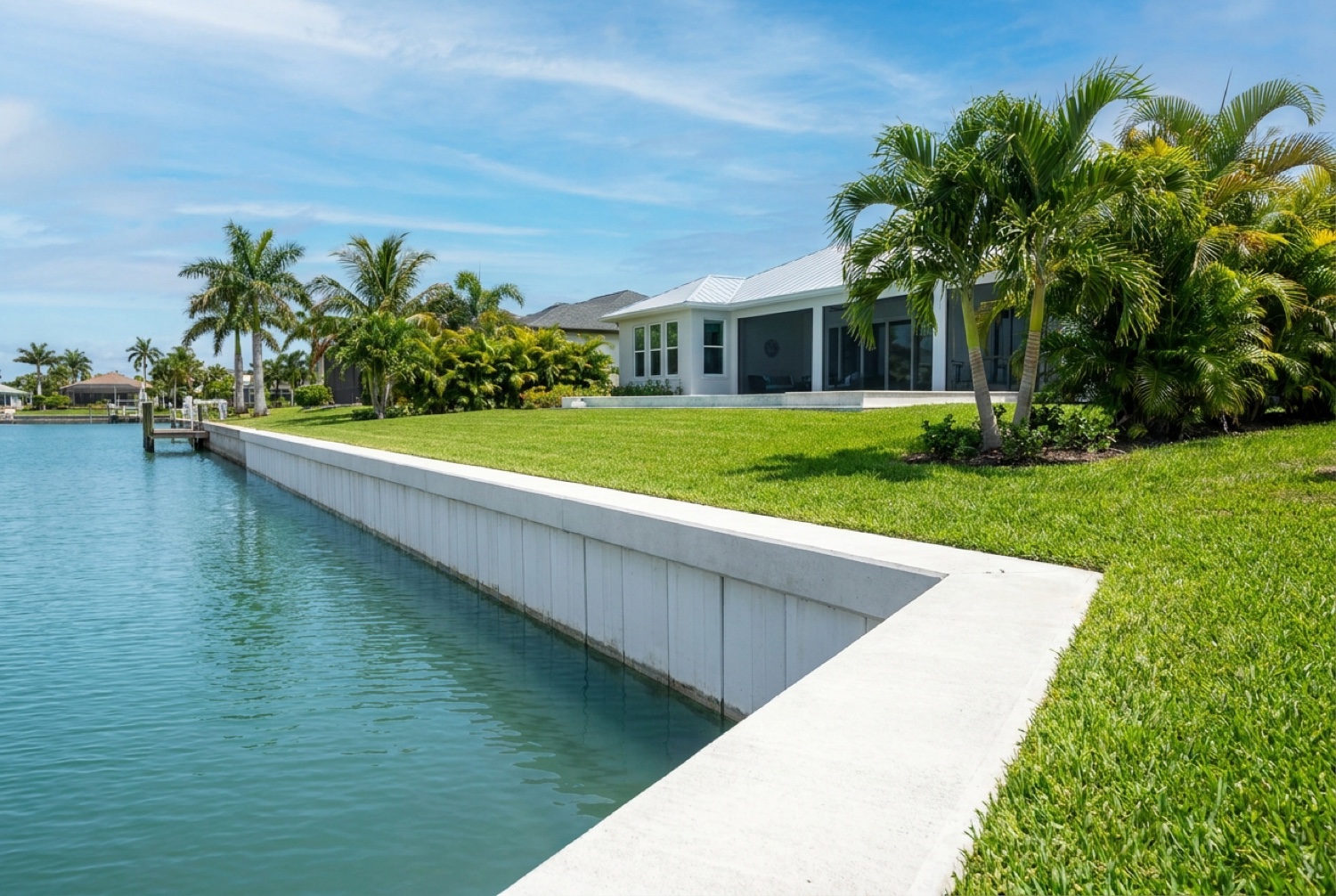
A seawall is the vertical retaining structure that holds your shoreline soil in place against the water. On a SW Florida salt canal, a well-built wall lasts roughly 25 to 50-plus years depending on the material and how it was installed.
The wall itself is only part of the system. Behind it sits an anchoring network — tiebacks (rods running back into your yard) connected to deadmen (buried anchors) — that resists the constant pressure of soil and groundwater pushing toward the canal. When people say a seawall “failed,” it’s often that hidden system that gave out first, not the panels you can see.
How long does each seawall material last?
On a salt canal, plan on 30–50 years from vinyl, 30–50-plus from quality concrete, and 25–40 from aluminum — assuming a proper install. Those ranges are wide on purpose: the install and the site move the number more than the material does.
| Material | Typical service life (salt canal) | Why |
|---|---|---|
| Vinyl (composite sheet pile) | 30–50 years | Never rusts, rots, or feeds marine borers; immune to the salt that eats other materials |
| Concrete | 30–50+ years | Massive and rigid; longevity depends on rebar cover and anchoring quality |
| Aluminum | 25–40 years | Light and corrosion-resistant, but constant salt exposure shortens its run |
A few things worth knowing:
- Vinyl is the go-to on SW Florida canals precisely because salt water, UV, and marine borers — the worms and crustaceans that bore into anything organic underwater — simply don’t bother it.
- Concrete can last the longest of all when it’s built right, but cheap concrete with thin rebar cover spalls and rusts from the inside out far sooner than its potential.
- Aluminum is a legitimate option where weight matters, but in constant immersion it generally won’t match vinyl or concrete on years. Our vinyl vs. concrete seawall guide digs into the two most common choices.
What variables actually decide how long a seawall lasts?
More than the material, lifespan comes down to install quality and what’s happening at the parts you can’t see. Get these right and you land at the top of the range; ignore them and even good material fails early.
- Install quality. Proper embedment depth, correct panel alignment, and a sound cap tying it all together. A rushed install on a salt canal is the most expensive wall you’ll ever buy.
- Tiebacks and deadmen. The anchoring system carries the real load. Undersized, too few, or corroded anchors let the wall bow and lean long before the panels would have failed — see our tieback and deadman guide.
- Drainage and weep holes. Water has to escape from behind the wall. Without working weep holes, pressure builds after every summer downpour and pushes the wall toward the canal. Clogged weep holes are one of the most common — and most fixable — causes of early failure.
- Toe protection. The base takes a beating from boat wakes and tide, and scour there undermines the whole structure from the bottom up. Granite rip-rap at the base absorbs that energy and is one of the cheapest ways to add years to a sound wall.
- Exposure. A protected finger canal sees calmer water and smaller wakes; open basins, harbor frontage, and the main Caloosahatchee channel deal with steady traffic and harder storm hits, and an identical wall there ages faster.
- Storms. Hurricane season runs June through November, and surge plus debris loading is the hardest test a wall faces. A wall built and anchored for surge holds; a marginal one is where storms expose the weakness.
How do you maximize a seawall’s lifespan?
The biggest gains come from things you control: drainage, anchoring, toe protection, and not waiting until something visibly fails. Catching a small issue early is what separates a 30-year wall from a 50-year one.
A mid-life tune-up — usually in the 15-to-25-year window, or after a hard storm season — is the move. It’s not a replacement; it’s targeted maintenance on a wall that’s fundamentally sound. A typical tune-up includes:
- Clearing or replacing weep holes so water drains and pressure can’t build behind the wall
- Rebuilding or re-capping the cap if it’s cracking or spalling, on top of sound panels
- Re-tensioning tiebacks or adding anchors where the original system is undersized
- Backfilling and compacting soil lost behind the wall before voids turn into sinkholes
- Adding rip-rap at the toe to stop ongoing scour
That work costs a fraction of a full rebuild and can push a wall well past its expected service life. Knowing when to do it comes down to watching for the early warning signs — our signs your seawall is failing guide covers exactly what to look for, and if you’re past the tune-up stage, the repair vs. replacement breakdown helps you make the call.
When age finally catches up
Eventually every wall reaches the end of its run — panels crack and bow, the cap crumbles past repair, or the anchoring system can’t be saved. At that point a tune-up is throwing good money after bad, and a full replacement is the smart spend. A properly built replacement with the right material, anchoring, and drainage resets the clock for decades.
If you want to know where your wall actually stands — 20 more years or time to plan a rebuild — get someone who builds these for a living to put eyes on it. Florida Lifts & Docks has built and rebuilt seawalls across Southwest Florida since 2008, with our own local crew (never subbed out) and in-house permitting. See our seawalls page, explore your options in Cape Coral, Punta Gorda, and Naples, or grab a free on-site estimate seven days a week. Call (239) 397-3400.