
Do Tiki Huts Add Value to Your Home? Resale & ROI for Waterfront Properties
Whether a tiki hut is wasted money or real equity on a Southwest Florida waterfront home — how a permitted, properly-built hut affects buyer appeal and resale.
Key takeaways
- A quality tiki hut adds value on Southwest Florida waterfront the way a finished outdoor living space does — it makes the property show better and sell faster, especially when it sits on or near the dock.
- The single biggest factor is whether the hut is permitted and on file. A permitted, insurable structure is an asset; an unpermitted one is a liability a buyer's agent and inspector will flag.
- A dock-top hut adds more appeal than a backyard one because it turns the water itself into the destination — the highest-demand feature on a canal-front home.
- The features that move buyers most are a built-in bar, marine-rated lighting that makes the hut usable after dark, and ceiling fans for the summer.
- You won't recoup a tiki hut dollar-for-dollar like a kitchen, but on the right waterfront lot it pays you back in lifestyle now and faster, stronger offers at resale.
If you own a canal-front or Gulf-access home in Southwest Florida and you’re weighing a tiki hut, the question underneath the fun is a practical one: is this money you’ll see again, or is it money down the canal? It’s a fair worry. A tiki hut isn’t a kitchen or a bathroom, and you’ve probably heard you never get outdoor projects back.
Here’s the honest answer, grounded in how waterfront homes actually sell on this coast. A tiki hut — a thatched-roof, open-air chickee shelter that gives you covered outdoor living without walls — does add value when it’s built right. Not always as a clean dollar-for-dollar line item, but in the two ways that matter most when you list: it makes the property show better and sell faster. The catch is in the words quality and permitted. A hut built right is an asset; a hut built wrong is a liability a buyer will use against you.
Why does a tiki hut add more value on the water?
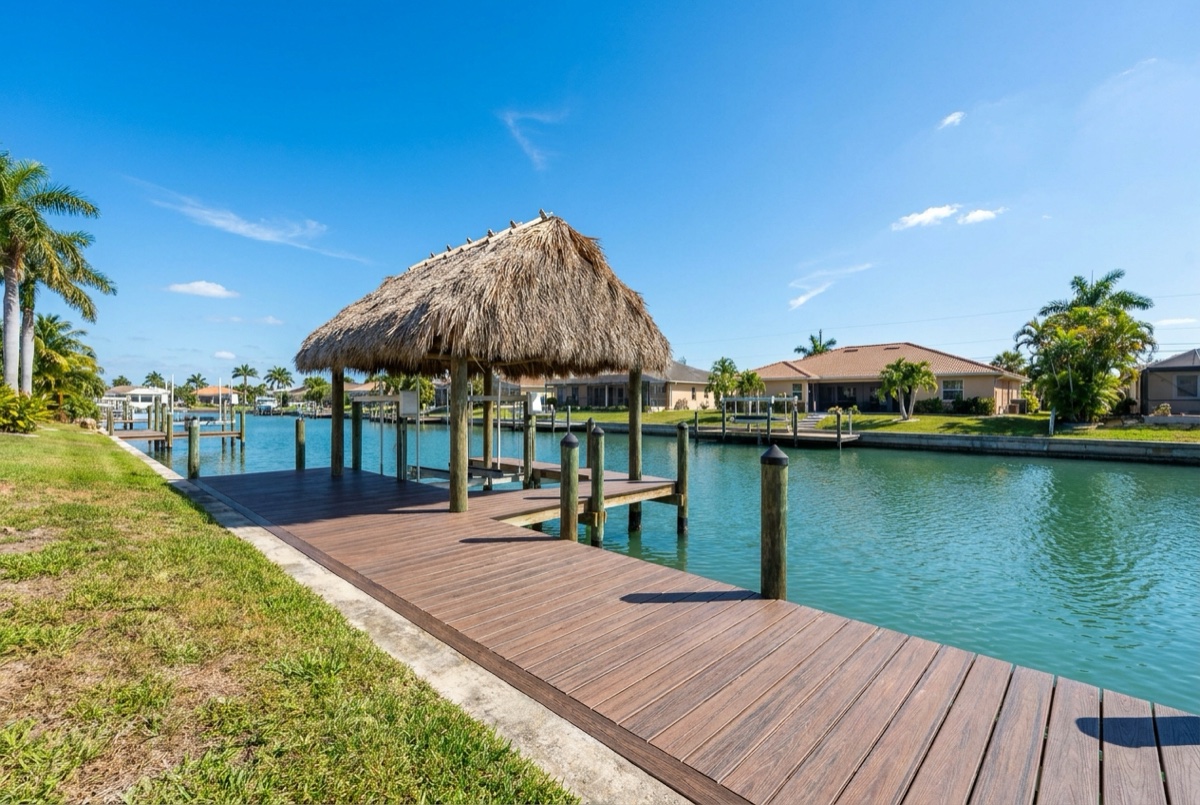
A tiki hut adds more value on a waterfront lot than it ever would inland because it sits on the feature people are already paying a premium for — the water. The closer the hut is to the dock, the more it turns that water into a destination instead of just a view.
In Southwest Florida, buyers don’t pay canal-front and Gulf-access prices for the house alone. They pay for the lifestyle — the boat, the sunset, the breeze off the Caloosahatchee or Charlotte Harbor. A tiki hut is the physical expression of that lifestyle, and it tells a buyer walking the property exactly how they’ll live there.
That’s why a dock-top tiki hut carries the most appeal. A hut on your custom dock — over the water, steps from the boat — is the showpiece. A backyard hut is still a plus, but it competes with every screened lanai on the street. A dock-top hut competes with almost nothing.
How does a permit change whether a tiki hut helps or hurts?
The permit is the single biggest factor in whether a tiki hut helps or hurts your resale. When a Florida home sells, the buyer’s inspector and agent look for open or missing permits, and an unpermitted structure on the water becomes a negotiating chip — not in your favor. A buyer can ask you to:
- Go back and permit it after the fact, on your dime and your timeline
- Tear it down before closing
- Drop the price to cover the risk they’re inheriting
There’s an insurance angle too. In a coastal market where carriers already scrutinize wind exposure, a permitted structure built to code is one a buyer can insure without a fight; an undocumented one raises questions nobody wants during a 30-day close. That’s why we handle permitting in-house — so when you sell, the hut is a documented, insurable asset, not a problem to explain. (Starting from scratch on the rules? See do you need a permit for a tiki hut in Florida.)
Which tiki hut features add the most buyer appeal?
The features that move buyers most are the ones that make the hut usable in real Southwest Florida conditions — heat, humidity, sun, and long evenings. A bar, good lighting, and fans turn a pretty roof into a place people gather.
| Feature | Why buyers respond to it |
|---|---|
| Dock-top location | Puts the destination on the water — the top driver of appeal |
| Built-in bar | Reads as “entertaining happens here,” not just shade |
| Marine-rated lighting | Makes the space usable after dark, which doubles its hours |
| Ceiling fans + electric | Beats the summer humidity; signals a finished, wired build |
| Quality thatch + sound framing | Signals the whole structure was built right, not patched together |
If you only add two things, make them lighting and a bar. Proper dock lighting turns a daytime shade structure into a sunset destination — and on this coast, the evening is when the water is at its best. A built-in bar tells every buyer that this is where the gatherings happen.
Will you get your money back when you sell?
Not dollar-for-dollar — and that’s normal for outdoor projects. A tiki hut behaves like a pool or an outdoor kitchen: it rarely returns 100 percent of its cost as a single appraised line, but it makes the home more desirable, which is its own kind of return. You’re really buying two returns at once:
- Lifestyle now. Shaded mornings, dry afternoons during hurricane-season downpours, and long evenings on the water — every day you own the home.
- Equity later. A property that stands out, shows better, and closes faster than the comparable house without it.
The mistake is treating a tiki hut as a pure financial bet. Built well and permitted, on the right lot, it’s a lifestyle upgrade that happens to protect and often lift your resale position. And it only holds that value if it’s built for where it lives. Over saltwater, the structure has to survive UV, salt spray, marine borers in the pilings, and storm surge through the June-to-November hurricane season. A dock-top hut on CCA-treated framing, with 316 stainless hardware and pilings driven to the right depth for your canal bottom, ages gracefully; one thrown up with the wrong materials starts looking tired fast — and a tired structure subtracts from a sale. The hut is only as sound as the dock and pilings it stands on. (More on building over water in can you build a tiki hut over a dock.)
The bottom line for your waterfront home
A tiki hut isn’t a renovation you’ll recoup line-for-line, and anyone who promises that is selling you something. But on a Southwest Florida waterfront lot — built on or beside the dock, permitted, and finished with lighting and a bar — it’s one of the few outdoor projects that genuinely improves both your daily life and your resale story, making the home unmistakably the waterfront home on the street.
Want to know what the right hut for your property would look like — and what it would cost? We’ve built for waterfront owners across Southwest Florida since 2008 with our own local crew and in-house permitting, never subcontracted. See our tiki huts page, or call (239) 397-3400 for a free on-site estimate seven days a week across Cape Coral, Naples, Punta Gorda, and the rest of the coast.