
Do Floating Docks Work in Saltwater Tidal Canals? A Southwest Florida Reality Check
People hear "floating dock" and picture a lake product. Here's the honest verdict on how marine-grade floating docks actually perform in SW Florida's salt, tide, current, and wakes.
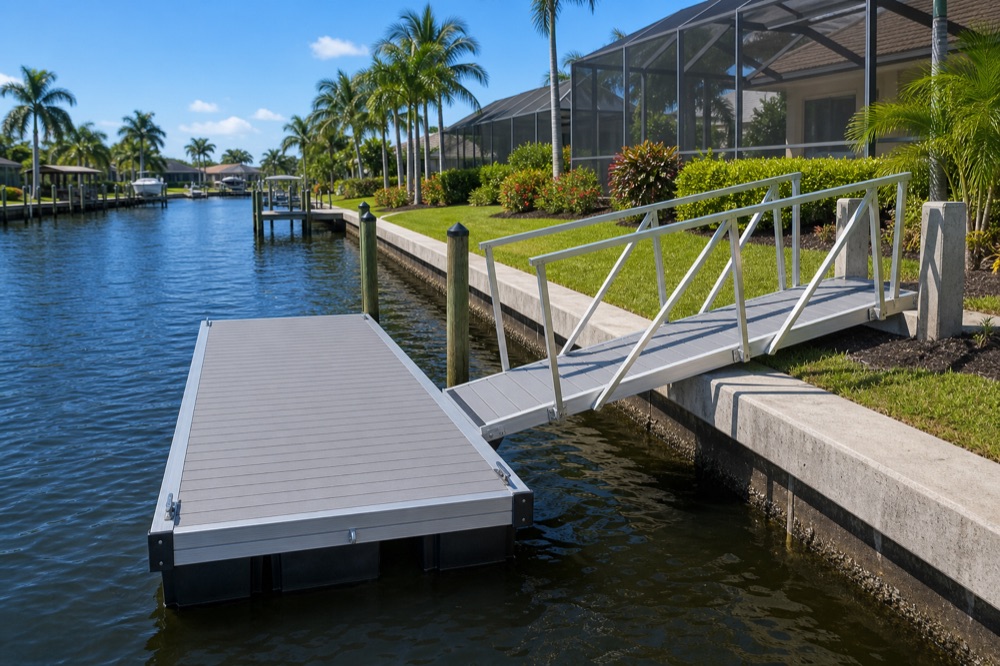
Key takeaways
- Yes, floating docks work in saltwater tidal canals when they're built for it. The difference is the float: a marine-grade HDPE pontoon shrugs off salt and UV, while a cheap lake float does not.
- A floating dock keeps your deck at the same height above the waterline through the full 2–4 ft tide swing common on SW Florida canals, so step-aboard access never changes.
- Good fit, a sheltered finger canal with light current and modest boat traffic. Use caution on open, exposed basins with heavy wakes, where a fixed dock or a heavily anchored system is the smarter call.
- Barnacle and algae growth adds real weight to floats over time, so float spec and a periodic clean matter in salt water; this is a maintenance item, not a deal-breaker.
- Placement is shaped by seagrass beds, manatee zones, and the roughly 1,000 sq ft state dock-exemption threshold, all of which we work through during in-house permitting.
If you’ve spent any time on a Southwest Florida canal, you’ve probably heard someone wave off the idea of a floating dock with a quick “those are for lakes.” It’s the number one objection we hear, and it’s a fair instinct. The floating docks most people picture are the flimsy plastic platforms sold at big-box stores for a quiet northern pond. Drop one of those in the Caloosahatchee or a Cape Coral finger canal and the salt, sun, current, and barnacles would make short work of it.
But that’s a product problem, not a floating-dock problem. A floating dock built for a marine environment is a different animal entirely, and on the right canal it can outperform a fixed dock. So here’s the honest, local answer to the question everyone actually asks: do floating docks work in saltwater tidal canals? Yes, when they’re built for salt water and matched to the right kind of canal. Here’s how to tell whether yours is one of them.
What is a “marine-grade” floating dock, and why does it matter here?
A marine-grade floating dock is a deck that rides on sealed pontoons, or floats, engineered specifically to live in salt water and brutal UV. The floats are the whole ballgame. Everything else can be the same quality you’d build into a fixed dock; it’s the float that separates a lake toy from a coastal structure.
The standard in salt water is marine-grade HDPE (high-density polyethylene). HDPE floats are thick-walled, UV-stabilized, foam-filled or air-chambered, and chemically inert, so salt water doesn’t corrode them and Florida sun doesn’t make them brittle the way it does cheap plastic. They don’t rot, rust, or absorb water. That’s the part the “lakes only” crowd misses: the failure they’re imagining comes from a cheap big-box pond float, not from a properly specced marine pontoon.
We build the rest of the structure to match the salt:
- Marine-grade aluminum framing that won’t rust under the deck
- 316 stainless hardware, cleats, and anchoring connections
- Capped composite decking (TimberTech or Trex) that stays cooler underfoot and won’t splinter or rot
- HDPE floats sized with enough freeboard for your real-world load
Put those together and you have a dock that belongs in salt water. For a deeper look at how the float materials stack up, see our guide on the best floating dock material for salt water.
How does a floating dock handle Southwest Florida tide swings?
This is where a floating dock genuinely shines on the Gulf coast. A floating dock rises and falls with the water, so the deck stays at the same height above the waterline no matter the tide. Step-aboard never changes.
Our canals here typically see a 2 to 4 foot tide swing between high and low, and on some waterways closer to Charlotte Harbor or during wind tides it can be more. On a fixed dock set for high water, that swing means you’re climbing down to a boat that’s dropped three feet below the deck at low tide. Set it for low water and you’re stepping up at high tide, or worse, water’s washing over the boards.
A floating dock sidesteps the whole problem. The floats track the tide minute by minute, so the gap between your deck and your gunwale is the same at 6 a.m. dead low as it is at high noon. For loading kids, coolers, groceries, and gear, that consistency is a real, daily quality-of-life win, and it’s the single biggest reason owners on big-swing waterways choose floating. It’s also why a floating section is such a popular launch point for kayaks, paddleboards, and jet skis. We cover that side in fixed vs. floating docks in Florida.
The catch is that the dock has to be free to move that full range without binding, which comes down to the guidance system holding it.
What keeps a floating dock in place in current and wakes?
A floating dock is held in position by either pilings with guide brackets or an anchored mooring system, and that connection is what lets it slide vertically with the tide while staying put horizontally. Get the guidance right and the dock is stable; get it wrong and it wanders, binds, or bangs.
There are two common approaches:
- Piling guides. Pilings are driven and the dock rides up and down them on roller or slide brackets. This is the most stable setup for SW Florida tidal canals and the one we lean toward where the bottom allows it. The pilings take the lateral load from current and wakes; the dock just glides on them.
- Anchored systems. Chains, cables, or pile anchors hold the dock from below. These work well in deeper or soft-bottom spots where driving guide pilings is impractical, but they need to be engineered with enough scope and tension to keep the dock from surging in chop.
Current and boat wakes are the real-world test. On a calm finger canal, a properly guided floating dock barely moves. On a busy stretch where center consoles throw a steady parade of wakes, the dock works harder, the connections take more cyclic load, and the anchoring has to be beefed up to keep things tight and comfortable. None of that is a problem on the right canal; it just means the anchoring spec is not one-size-fits-all. We get into the details in how floating docks are anchored.
Don’t barnacles and salt wreck the floats?
They try. Anything that sits in Southwest Florida salt water grows barnacles, algae, and slime, and floats are no exception. The good news: this is a maintenance item, not a failure mode, and marine-grade HDPE handles it far better than cheap plastic.
Two things to understand about biofouling on floats:
- Weight. Barnacles and growth add weight to the underside of the floats over time, which slowly reduces freeboard (how high the deck sits). This is why we size floats with margin to spare, so even with a season of growth your dock still rides where it should.
- Cleaning. A periodic clean keeps the buildup, and that extra weight, in check. HDPE’s smooth, inert surface makes growth easier to knock off than it would be on a rougher material, and there’s no surface for the salt to corrode underneath.
It’s the same reality every waterfront owner here lives with, whether it’s a seawall, pilings, or a boat bottom. Plan for it and it’s a non-issue. Our floating dock maintenance guide walks through keeping floats clean and the deck from getting slick.
Good fit or bad fit? A frank verdict by canal type
Here’s the part most companies won’t put in writing, because a floating dock isn’t right for every site. The honest answer depends almost entirely on how sheltered your water is and how much wake and current it sees.
| Your canal | Floating dock verdict | Why |
|---|---|---|
| Sheltered finger canal, light traffic | Great fit | Calm water, modest wakes, big tide-tracking payoff |
| Shallow or soft-bottom canal | Strong fit | Floats avoid the deep-piling problem; deck stays usable at low tide |
| Moderate-traffic residential canal | Good fit with proper anchoring | Works well; anchoring spec’d for the wake load |
| Open, exposed basin with heavy wakes | Use caution | Constant chop and surge stress the system; a fixed dock is often calmer |
| Deep, wide-open gulf-access water, big boats | Often better as fixed | High loads and exposure favor driven pilings |
The short version: a sheltered finger canal is close to an ideal home for a floating dock, and a shallow or soft-bottom site where deep pilings are a fight is where floating really earns its keep. An exposed basin that takes a beating from boat traffic and weather is where we’ll often steer you toward a fixed custom dock instead, or pair a floating section with a fixed structure so you get the best of both.
This is also where a seawall and a floating dock have to play nicely together. The attachment between your floating system and the seawall or shoreline has to handle the dock’s full vertical travel, so we look at the seawall condition on-site before we ever spec the floats.
How do seagrass, manatees, and the 1,000 sq ft rule shape placement?
Before any of the build details matter, where and how big your dock can be is shaped by Florida’s marine resource rules, and a floating dock is held to the same standard as a fixed one. A floating dock is still a structure over sovereign submerged land, so it goes through the same permitting, seagrass review, and manatee-zone considerations as a piling dock.
A few realities that drive placement on SW Florida canals:
- Seagrass beds. Healthy seagrass under and around a proposed dock can limit where and how it’s built, because shading and prop scour are regulated. Where seagrass is a factor, layout and even float draft come into play. We cover this in seagrass surveys for dock permits.
- Manatee zones. Much of our coast sits in or near manatee-protection areas, which affect access, speed zones, and sometimes structure details. Rules vary by county, and we work them into the permit. See manatee zones and dock permits.
- The roughly 1,000 sq ft exemption. Florida provides a state exemption for private residential single-family docks under a size threshold, commonly around 1,000 square feet, in certain waters. Staying within that threshold can streamline the process, while a larger structure can trigger additional review. The exact thresholds and conditions depend on your specific waterway and county, which is exactly the kind of thing we sort out before we draw anything.
We’ve handled in-house permitting across 18 SW Florida cities for decades, so we know which canals are tight on seagrass, which sit in manatee zones, and how to keep a floating dock both compliant and useful. You won’t be chasing agencies; that’s our job.
So, are they worth it on a saltwater canal?
For the right site, absolutely. A floating dock built with marine-grade HDPE floats, aluminum framing, 316 stainless hardware, and capped composite decking holds up to SW Florida salt and sun, tracks the tide so step-aboard is effortless, and can be the smarter, lower-cost choice in shallow or soft-bottom water where deep pilings are a struggle. The “floating docks are just for lakes” line simply doesn’t apply to a dock that’s actually built for the coast.
The honest caveat is exposure. On open, wake-battered water, a fixed dock or a heavily engineered system usually serves you better, and we’ll tell you that straight rather than sell you something that’ll frustrate you. The only way to know which side of the line your canal falls on is to look at it: your water depth, tide range, current, traffic, bottom, seawall, and the seagrass and manatee picture.
That’s exactly what a free on-site estimate is for. We bring our own local crew (we never sub the work out), handle permitting in-house, and give honest verdicts seven days a week across Cape Coral, Naples, Fort Myers, and the rest of the coast. See what we build on our floating docks page, or call (239) 397-3400 and we’ll come tell you whether your canal is a floating-dock canal.