
Floating Dock vs. Fixed Dock in Florida: Which Is Right for Your Waterfront?
Most SW Florida homeowners default to a piling dock — but in shallow or fluctuating water, a floating dock can be the smarter call. Here's how to choose by fit, not by habit.
Key takeaways
- A fixed (piling) dock sits on driven posts at a set height; a floating dock rides on sealed pontoons and rises and falls with the water. The right choice is a fit question, not a "which is best" question.
- Fixed docks win on deep gulf-access canals, high-load boats, and resale; floating docks win in shallow soft-bottom water, fluctuating water levels, and easy step-aboard access for kayaks, paddleboards, and jet skis.
- Fixed single-slip docks here typically run $22,000–$30,000 and captain's walks $32,000–$44,000; floating dock pricing is quoted free on-site and depends on size, float type, and anchoring.
- A floating dock keeps your deck the same height above the waterline at every tide, which matters most on waterways with big swings or storm surge.
- Both still require permits and proper anchoring or pilings; we handle permitting in-house and give free on-site estimates 7 days a week.
Walk almost any canal in Cape Coral or Fort Myers and you’ll see the same thing: piling docks, one after another. So when most Southwest Florida homeowners start planning a dock, they assume a fixed piling dock is simply the dock, and the only real decisions are size and decking. That’s a fair default — but it’s not always the right one.
The truth is that floating dock vs. fixed dock isn’t a contest to crown a winner. It’s a fit question. The best dock for your waterfront depends on how deep your water is, how much your tide swings, what you’re putting on it, and what your canal bottom is made of. On a deep gulf-access canal, a fixed dock is usually the obvious answer. But in shallow, soft-bottom, or fluctuating water, a floating dock can outperform a piling dock you’d otherwise default to. Here’s how to tell which one belongs at your seawall.
What’s the difference between a floating dock and a fixed dock?
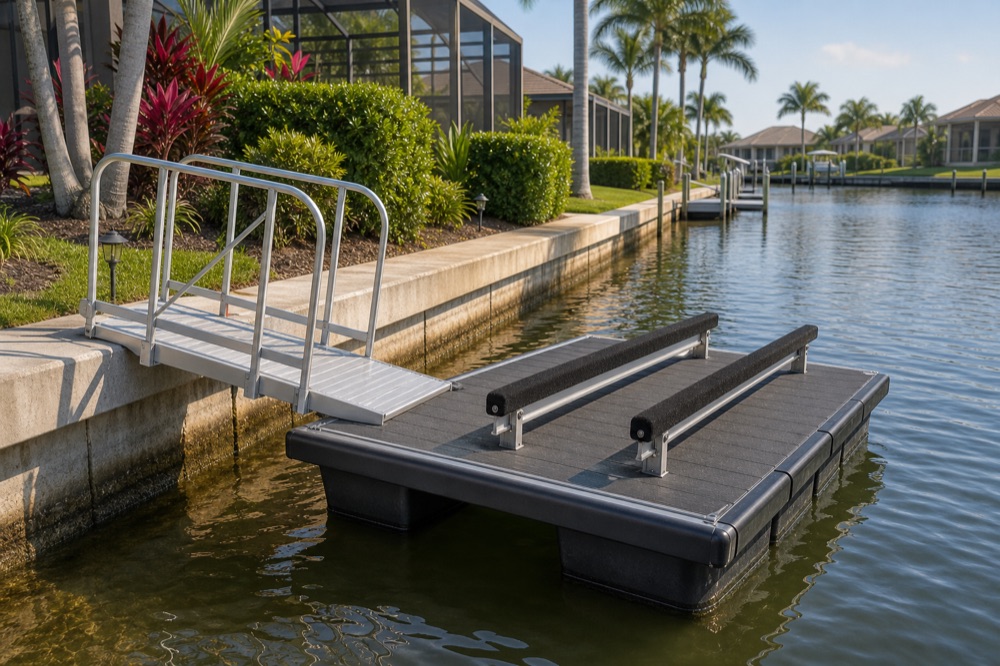
A fixed dock is built on pilings driven into the canal bottom, so the deck stays at one set height no matter what the water does. A floating dock rides on sealed pontoons and rises and falls with the water, keeping the deck the same distance above the waterline at every tide.
That single structural difference drives everything else. Because a fixed dock is locked to its pilings, its deck height is a compromise — set high enough to clear storm tides, it can leave you reaching down to your boat at low tide. A floating dock sidesteps that entirely: step-aboard height stays constant whether the tide is slack high or sucked out to the flats.
Two quick definitions you’ll see throughout this guide:
- Fixed dock (piling dock): A static platform on driven posts — wood, concrete, or composite pilings — with framing and decking on top. The standard SW Florida canal dock.
- Floating dock: A buoyant platform on HDPE or encapsulated floats, held in place by pilings (with sliding guides), anchors, or a gangway tied to your seawall or land.
Both are real docks. Both can be built to last in salt water. They just solve different problems.
How does each handle tides and water levels?
A fixed dock keeps the deck at one elevation while the water moves under it; a floating dock keeps the deck at one height relative to the water by moving with it. If your waterway swings a lot, the floating dock keeps your access constant — which is the whole point.
Most Southwest Florida canals don’t have dramatic tides compared to the Carolinas or the Northeast, but the swing is real, especially on gulf-access systems tied to the Caloosahatchee or Charlotte Harbor. Add seasonal rainfall, wind tides, and the storm surge that comes with hurricane season from June through November, and the water level you design around isn’t a single number — it’s a range.
- Fixed dock: Predictable and rock-solid in everyday conditions. The trade-off is that one fixed deck height can never be perfect at both high and low water, so you accept a little reaching at one end of the tide.
- Floating dock: Self-adjusting. Boarding height, fender position, and the step down to your boat stay the same all day. In big-swing water or on shorelines prone to surge, that consistency is the headline benefit.
This is also why a floating dock can be reassuring in a storm. Instead of being overtopped by surge, a properly anchored floating dock rides up with the water — provided the anchoring system is engineered to let it travel without breaking free.
Which handles bigger boats and heavier loads?
For large, heavy boats and serious lift loads, a fixed dock on driven pilings is the stronger foundation. Floating docks excel at lighter, frequent-access uses — kayaks, paddleboards, jet skis, smaller boats, and a stable place to swim, fish, or tie up.
If your plan includes a sizable boat lift — say a 16,000 lb lift for a cruiser or a 24,000 lb-plus offshore rig — that load wants the deep, fixed anchorage that driven pilings provide. Lift pilings have to resist huge vertical and lateral forces, and a fixed dock integrates with them naturally.
Floating docks aren’t weak — modern HDPE float systems carry plenty of distributed weight for people and gear — but they’re at their best as a launch-and-access platform rather than the mount for a heavy lift. A very common SW Florida setup is the best of both: a fixed dock and lift for the main boat, plus a floating section off the seawall for the kayaks and the jet ski. If a personal watercraft is the priority, it’s worth weighing a jet-ski lift versus a floating dock for how you actually launch.
How long does each last in Florida salt water?
Both can last for decades when they’re built with the right materials — the salt, sun, and marine borers of the Gulf coast punish anything that isn’t. Lifespan comes down to spec and maintenance far more than to floating versus fixed.
The Southwest Florida environment is brutal on dock hardware. UV bakes deck boards and fasteners, marine borers attack untreated wood below the waterline, and salt corrodes anything that isn’t rated for it. That’s why everything we build is spec’d for it:
- Marine-grade aluminum framing that won’t rust
- 316 stainless cable and hardware throughout
- Capped composite decking (TimberTech / Trex) that shrugs off UV and stays splinter-free
- CCA-treated framing and properly rated pilings below
- Sealed marine motors on any integrated lift
For a floating dock specifically, the floats matter most over the long haul — sealed HDPE pontoons resist barnacles and waterlogging better than older foam-filled designs. For a fixed dock, the piling material drives longevity, which is why the wood vs. concrete vs. composite pilings decision is worth getting right up front. Either way, an annual rinse and inspection keeps both kinds of dock going strong.
Floating vs. fixed: side-by-side comparison
Here’s the quick reference. Remember that “better” depends on your water, not on the dock type itself.
| Factor | Fixed (piling) dock | Floating dock |
|---|---|---|
| Deck height vs. water | Constant elevation; varies with tide | Constant relative to water; rises and falls |
| Best water depth | Medium to deep | Shallow and fluctuating |
| Soft / mucky bottom | Harder — pilings can be tough to set | Easier — anchors instead of deep pilings |
| Heavy boats & big lifts | Excellent | Better as a light-load / launch platform |
| Step-aboard access | Compromise at one tide extreme | Easy and consistent all day |
| Storm surge behavior | Predictable; can be overtopped | Rides up with water if anchored right |
| Kayak / paddleboard / jet ski | Workable | Ideal |
| Resale familiarity | High — the regional standard | Growing, but less expected by buyers |
| Cost | $22,000–$30,000 single-slip (typical) | Quoted free on-site by size & float type |
What does each cost, and how do permits work?
A fixed dock’s price is well-defined by size and decking; a floating dock’s price depends heavily on float type, size, and how it’s anchored, so it’s quoted on-site. Both require permits, and we handle that paperwork in-house.
For fixed docks in Southwest Florida, here are the ranges we actually quote:
| Fixed dock type | Typical installed cost |
|---|---|
| Single-slip dock | $22,000–$30,000 |
| Captain’s walk | $32,000–$44,000 |
| Multi-slip dock | $46,000–$62,000 |
| Estate dock | $68,000+ |
Floating docks vary too much by float system, length, and anchoring method to publish a single range honestly, so we quote them free on-site. Counterintuitively, a floating dock can come in lower than a fixed dock when your bottom is so soft or shallow that driving good pilings becomes the expensive part of the job — skipping heavy piling work is where the savings show up. On a clean, deep canal with solid bottom, a fixed dock is often the simpler build. The full cost picture for piling docks is in our custom dock cost guide.
On permitting, the rules are the same for both: docks on SW Florida waterways require permits, and depending on the waterway, your city, county, or the state may be involved, including reviews tied to seagrass and manatee protection. We handle the entire permitting process in-house so it’s scoped into your project from day one instead of landing on your plate later.
Which dock fits your water? A decision matrix
Pick based on your waterway, not the neighbors. Here’s how the choice usually shakes out across the three water types we see most in Southwest Florida.
- Deep gulf-access canal (good bottom, room for a real boat). Go fixed. You’ll likely want a lift for the main boat, pilings set cleanly, and the resale familiarity buyers expect on these canals. Add a floating section off the seawall if you also want easy kayak and jet-ski access.
- Shallow, soft-bottom, or fluctuating water (flats, back canals, low-tide reaches). Lean floating. When the bottom won’t hold deep pilings easily or the water swings, a floating dock gives you constant access without fighting the muck — exactly the scenario covered in fixed vs. floating in shallow-water canals.
- High-wake basin or busy boating water. It depends on load. A fixed dock takes constant wake without flexing, but a well-built, properly anchored floating dock with the right freeboard can ride it comfortably and keep boarding easy. This one truly is a site call — boat size and anchoring decide it.
If you’re mostly launching kayaks, paddleboards, or a personal watercraft and want a stable, low step-down to the water, a floating dock is hard to beat regardless of canal depth. If you’re protecting and storing a serious boat, a fixed dock and lift is the proven foundation.
The honest answer for most homeowners is simpler than it sounds: stand on your seawall, look at your water depth and your tide line, and think about what you’ll actually use the dock for. A piling dock is the right default on plenty of SW Florida canals — but it isn’t automatic, and a floating dock deserves a real look before you assume it isn’t for you.
Not sure which way to go on your waterfront? That’s exactly what a free on-site visit is for. We’ll read your water depth, canal bottom, tide swing, and how you boat, then tell you straight which dock fits. Explore options on our floating docks page or custom docks page, see what we build across Cape Coral and the rest of the coast, and call (239) 397-3400 for a free on-site estimate, seven days a week.