
Floating Dock for Kayaks, Paddleboards & Jet Skis: The Easy-Launch Solution
How a low-freeboard floating launch makes getting on the water safe and easy for paddlers and jet-ski owners — even through a four-foot SW Florida tide swing.
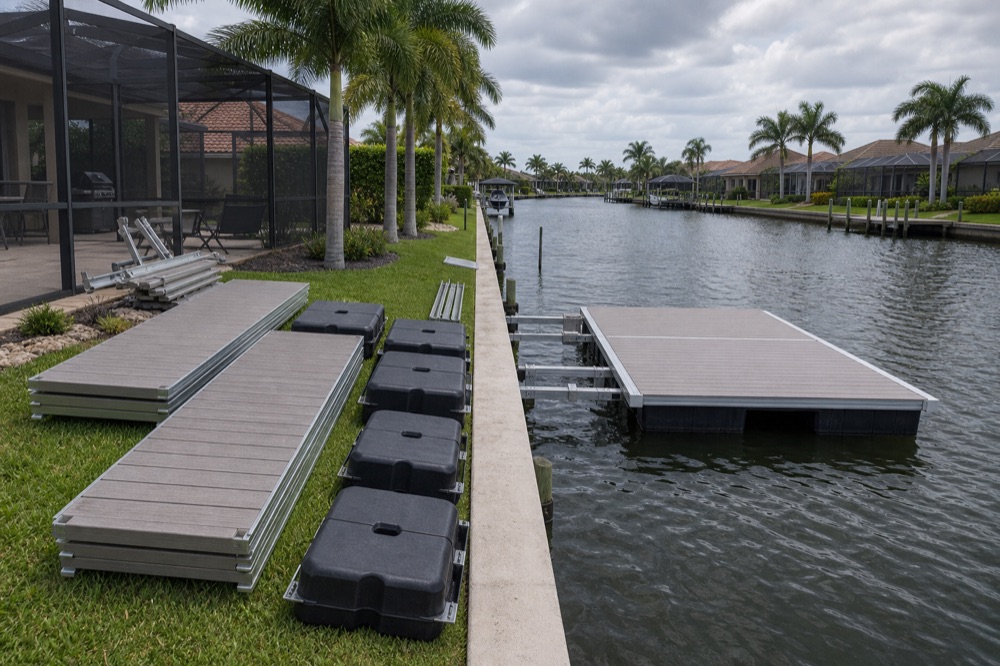
Key takeaways
- A floating launch sits just inches above the water, so you step into a kayak instead of climbing down to it — and it stays at that height through every tide.
- V-notch and roller-bow modules let you launch a kayak or paddleboard solo without lifting it; drive-on PWC floats let a jet ski roll up out of the water.
- The low, stable entry is what makes a floating launch genuinely safer for kids, older paddlers, and anyone aging in place.
- You don't need a full boat dock — a compact floating launch off a seawall or existing dock gives you safe water access for a fraction of the footprint.
If your idea of a good morning on the water starts with a kayak, a paddleboard, or a jet ski — not a 26-foot center console — you don’t need a full boat dock. You need a safe, easy way to get on the water, and a fixed dock often fights you on exactly that. On a Southwest Florida canal the tide can swing several feet, so at dead low you’re perched two to four feet above the water, lowering a paddleboard by hand and hoping you don’t go in after it.
A floating launch solves that. It rides on the surface and stays just inches above the waterline all day, so you step into your kayak instead of climbing down to it. Here’s how these launches work, and why so many SW Florida paddlers and jet-ski owners choose one over a traditional dock.
What is a floating dock for kayaks and paddleboards?
A floating launch is a low-freeboard, buoyant platform that sits only a few inches above the water and rises and falls with the tide. That low height is the whole point: it puts the deck right at water level so getting in and out is a step, not a climb.
“Freeboard” is the distance from the water up to the deck. A fixed dock is built high to clear storm tides, leaving a lot of it at low water; a floating launch keeps freeboard nearly constant no matter what the tide does in the Caloosahatchee or your canal off Charlotte Harbor — and that consistency is what makes it easy and safe.
How does a floating launch handle the tide when a fixed dock doesn’t?
It floats, so it tracks the water. As the tide rises and falls, the platform moves with it and your step-in height never changes. On a fixed dock the gap to the water changes hour by hour — fine for a heavy boat on a lift, but for a paddler lowering a kayak by the grab handle it’s the difference between an easy launch and a sketchy one.
- Fixed dock at low tide: a two-to-four-foot drop, an unstable launch, and a real fall risk.
- Floating launch at low tide: the same few-inch step you had at high tide.
- After a storm surge: the float rides up with the water instead of being overtopped.
That’s why for pure water access, paddlers almost always prefer a float. We break the trade-offs down in floating dock vs. fixed dock in Florida.
What designs make launching a kayak or paddleboard easier?
Two features do most of the work: a v-notch entry and roller-bow modules. Both let you launch and recover without lifting the boat — you slide it instead. A v-notch is a tapered cutout that cradles the hull, so you sit down in a stable, centered kayak and push off. Roller modules add low rollers at the launch edge: set the bow down, slide the boat into the water, then haul it back up the same way.
Other features we build in:
- Grab rails or assist posts to steady yourself sitting down and standing up
- A non-slip deck that stays grippy when wet and salty
- A smooth, low edge for stepping on and off a paddleboard
One person can use a launch like this alone, without wrestling the boat over a tall dock edge.
Can you launch a jet ski from a floating dock?
Yes — with a drive-on PWC float. You idle the jet ski straight up onto a set of rollers, and it rides up out of the water and parks there, no trailer and no lift required.
A drive-on float keeps the hull out of the salt between rides — less growth, less corrosion, a cleaner machine — and it’s fast: pull up, roll on, walk away. For owners who’d rather not commit to a powered lift, it’s a clean middle ground. To weigh the two, read jet-ski lift vs. floating dock; when a powered lift wins, that’s our jet-ski lifts specialty.
| Launch option | Best for | Out of the water? |
|---|---|---|
| Kayak/SUP floating launch (v-notch + rollers) | Paddlers who want easy solo entry | Boat slides up onto the deck |
| Drive-on PWC float | Jet-ski owners avoiding a lift or trailer | Hull rolls up onto rollers |
| Jet-ski lift | Long-term storage, max hull protection | Fully suspended above the water |
Why is a floating launch the safer, more stable choice for kids and aging in place?
Because the entry is low and consistent, the most fall-prone moment — getting in and out — happens right at water level every time, with no tall edge to climb and no moving target as the tide shifts.
That low, predictable step is what makes a floating launch friendly for kids learning to paddle, grandparents who still want to get on the water, and anyone aging in place in a waterfront home. You’re not asking a 70-year-old to lower themselves down a ladder into a wobbling kayak — just to take one short step onto a stable platform. Add grab assists and a non-slip deck and you’ve built lasting independence on the water.
How is a floating launch attached and anchored?
It’s held captive while still floating — usually with pile guides that let it slide up and down with the tide, or a hinged gangway off a seawall or fixed dock. Either way it can’t drift but is free to rise and fall.
You don’t need a sprawling structure. A compact float can tie into your existing seawall or hang off an existing custom dock — safe water access without the footprint or cost of a full boat slip (see how floating docks are anchored). Everything we build is specced for the Gulf coast: marine-grade aluminum framing, 316 stainless hardware, and capped composite decking that shrugs off UV, salt, and barnacles through hurricane season from June to November.
Ready to get on the water the easy way?
A floating launch is the simplest, safest way to make a Southwest Florida waterfront work for paddlers and jet-ski owners — no climbing, no trailer, no fighting the tide. Florida Lifts & Docks has built them since 2008 with our own local crew (never subbed out), in-house permitting, and free on-site estimates seven days a week across 18 SW Florida cities.
See what we can build on our floating docks page, or call (239) 397-3400 for a free on-site look at your seawall, your canal, and the easiest way to get you on the water.