
How Are Floating Docks Anchored? Do You Still Need Pilings?
The four ways a floating dock stays put — guide piles, deadweight, cable, and helical anchors — and why your canal's bottom and tide range decide which one is right.
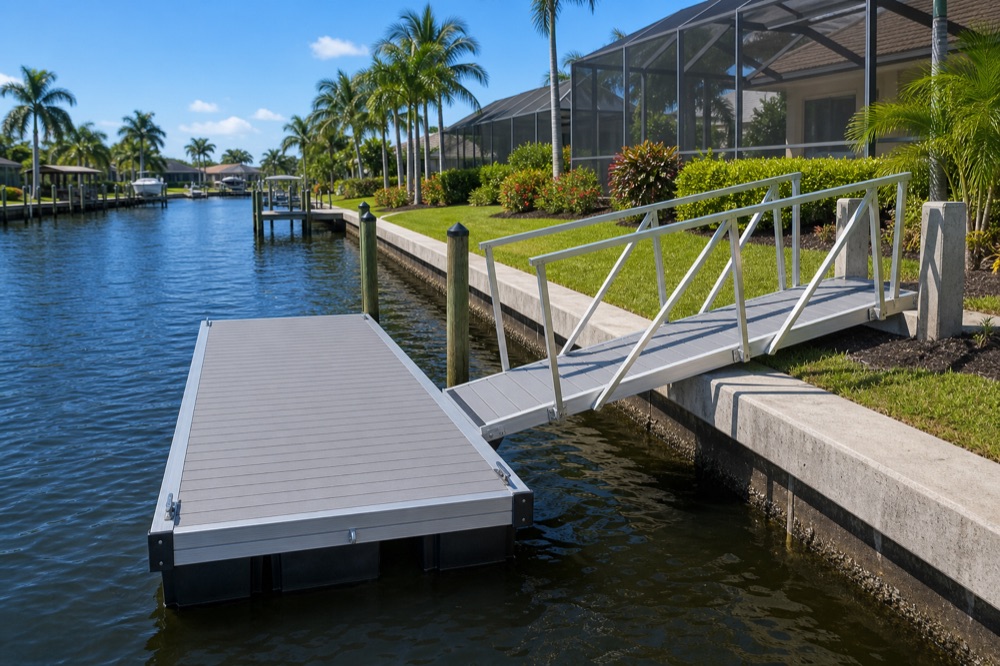
Key takeaways
- "Floating" describes how the deck rides the water, not how it's anchored — most SW Florida floating docks still use pilings, just as vertical guides rather than load-bearing supports.
- Guide-pile anchoring (the dock collars slide up and down on fixed pilings) is the go-to method on tidal saltwater canals because it controls drift, current, and wakes while still riding the tide.
- Deadweight and cable anchoring avoid driving piles but allow more sway, so they suit calm, protected, or deep water where pile-driving is impractical.
- Helical/stiff-arm systems work where the bottom is too soft or too deep to drive standard pilings.
- The right method depends on bottom type, water depth, and tide range — which is exactly why a local builder makes the call on-site, not from a catalog.
There’s a common belief on Southwest Florida canals that a floating dock means “no pilings.” It’s an understandable assumption, and it’s usually wrong. A floating dock still has to be held in place, and on a tidal saltwater canal the best way to do that almost always involves pilings — just used differently than on a fixed dock.
So how does a floating dock actually stay put? There are four real methods, and the right one comes down to your bottom type, water depth, and tide range.
What does it mean for a dock to “float,” and why does that matter?
A floating dock is a deck built on sealed pontoons or floats that ride directly on the water’s surface, rising and falling with the tide. That’s the whole idea: the deck stays at a constant height above the water no matter what the tide is doing.
But riding the surface freely is also the problem. Left alone, a floating dock would drift across the canal, swing in current, and slam your seawall on every wake. Anchoring is what keeps the dock floating in one place instead of floating away. Every method below solves that differently.
How does guide-pile anchoring work, and why is it the SW Florida default?
Guide-pile anchoring means the floating dock is fitted with rollers or collars that slide up and down fixed pilings driven into the canal bottom. The dock rides the tide vertically but cannot drift, swing, or move sideways.
This is the method we reach for most often on Southwest Florida’s saltwater canals, and the reason is our tides and traffic. Our canals see real tidal swings off the Caloosahatchee and Charlotte Harbor, current near the passes, and constant wakes. Guide piles handle all three at once:
- Tide: the dock rises and falls smoothly on the piles, so it’s always at deck height even on a big swing.
- Current and wind: the piles hold the dock laterally, so it doesn’t sail across the canal.
- Wakes: the dock can move up and down to absorb a wake without yanking on its anchors.
The pilings here aren’t load-bearing the way they are under a fixed dock — they’re not holding the deck up, they’re holding it in place. Pile depth still matters, though: they have to be driven deep enough to resist storm-surge loads and tall enough that the dock can’t ride up off the top during a surge. (More on that in how deep should dock pilings be driven.)
When do deadweight and cable anchoring make sense instead?
Deadweight anchoring uses heavy concrete blocks on the bottom, connected to the dock by chain or rod, to hold it down and in place. Cable (or chain) anchoring runs lines from the dock corners out to anchors or seawall points. Both avoid driving pilings — and both allow more movement than guide piles.
That extra movement is the trade-off. With no vertical guide, the dock sways and shifts more — fine in calm, protected water but rough on a busy tidal canal. We consider these when:
- The water is too deep to drive standard pilings economically.
- The site is calm and protected, with little current or boat traffic.
- You want a simple, relocatable dock — a kayak or paddleboard launch in a quiet basin, for example.
For a dock meant to hold a boat against wind and wake on an open canal, these systems usually allow more motion than you’ll want long-term.
What about helical anchors and stiff-arm systems on soft, mucky bottoms?
Helical anchors are steel shafts with screw-like plates turned down into the bottom until they hit firm, load-bearing soil. A stiff-arm system uses rigid arms from a fixed structure or seawall to hold the dock at a set distance while still letting it rise and fall. Both answer a specific Southwest Florida problem: bottoms too soft to hold a driven piling.
Plenty of our canals and back-bay shorelines have soft muck or silt over many feet before you reach anything solid, and a standard piling driven into that can keep settling. Helical anchors screw past the soft layer into competent soil and develop real holding power. Stiff-arms are useful when you’re tying a floating dock to an existing seawall and want to fix the gap without relying on the bottom at all. Either way, the deciding factor is what’s actually under the water at your site.
Which anchoring method is right for my canal?
Here’s the short version of how the choice gets made. The method follows the conditions — not the other way around.
| Anchoring method | Pilings? | Best for | Watch-out |
|---|---|---|---|
| Guide piles (rollers/collars) | Yes | Tidal saltwater canals, current, wakes | Needs piles driven to proper depth/height |
| Deadweight (concrete blocks) | No | Calm, protected, or deep water | More sway; heavy, less precise |
| Cable / chain | No | Quiet basins, light-duty launches | Allows drift; not for open canals |
| Helical / stiff-arm | Sometimes | Soft, mucky, or deep bottoms | Specialized install |
In plain terms: a big tide swing on an open canal with current points to guide piles nearly every time; a soft muck bottom that won’t hold a pile points to helical anchors or a heavier deadweight design; and deep, calm water where pile-driving is impractical points to deadweight or cable.
This is exactly why we don’t quote anchoring off a menu. Two homes three lots apart can have completely different bottoms, depths, and exposure. We confirm the right method with a free on-site look at your bottom, your depth at low tide, and how hard the current and wakes hit your stretch of water.
So — does floating really mean no pilings?
No. On Southwest Florida’s tidal saltwater canals, the most dependable floating docks usually do still use pilings — as vertical guides that let the dock ride the tide while staying locked against current, wind, and the relentless wakes of our waterways. The deck floats; the pilings keep it honest. Where the bottom or depth makes driving piles impractical, deadweight, cable, or helical systems fill the gap. Everything we build is sized for salt — marine-grade aluminum, 316 stainless hardware, and pilings driven for our conditions — so it holds through hurricane season, not just the calm months.
Want to know which anchoring method fits your canal? Start with our floating docks page, compare your options in floating dock vs. fixed dock, and book a free on-site estimate seven days a week across Cape Coral, Naples, Fort Myers, and the rest of the coast. We’ve built SW Florida waterfront since 2008 with our own local crew — call (239) 397-3400.