
How Many Dock Lights Do I Need? Spacing for a Dock You Can Actually See
A practical sizing guide to dock lighting — spacing rules of thumb, where piling-cap and step lights are mandatory, and how to light a dock without dark gaps or glare.
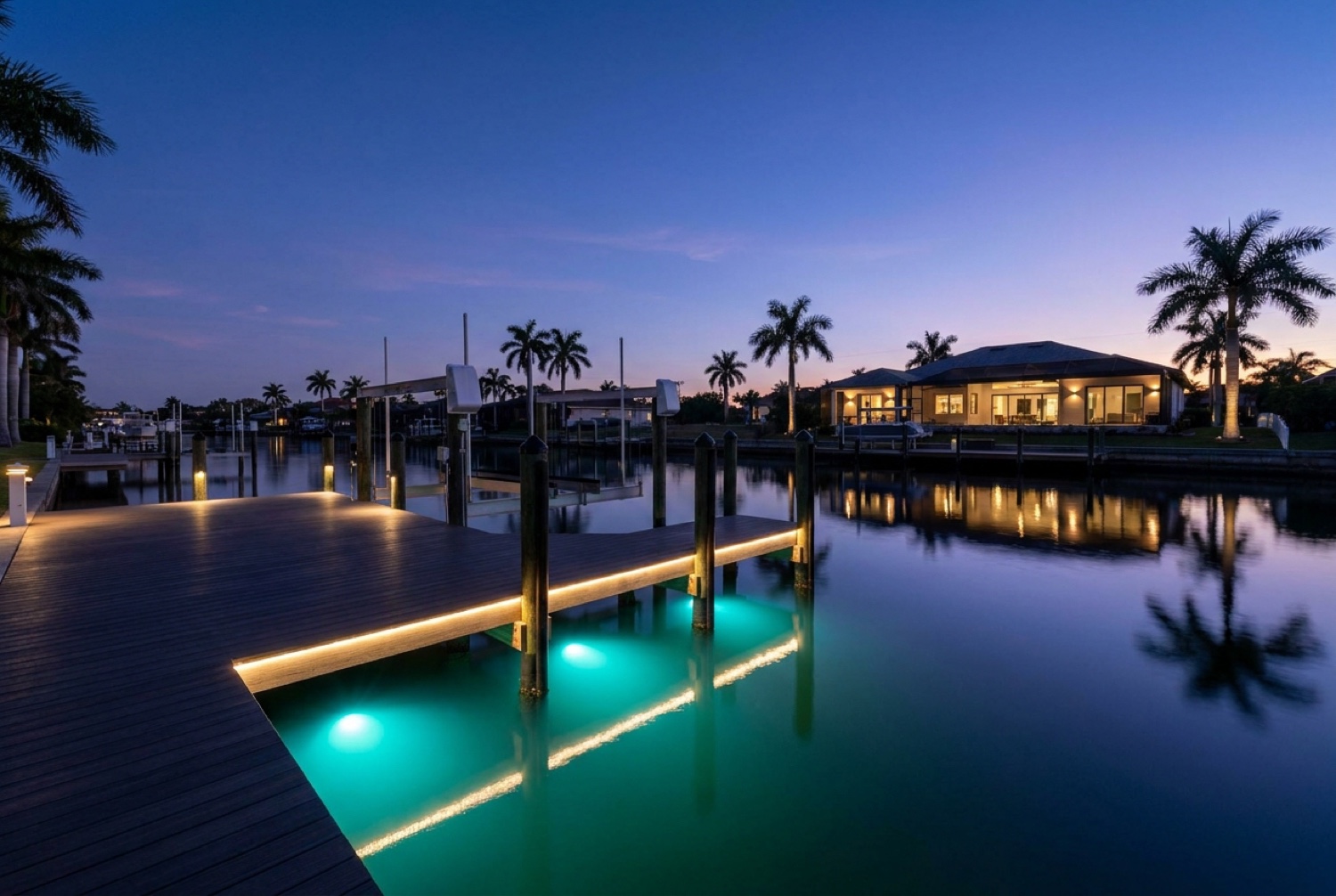
Key takeaways
- A solid starting rule is one path light every 6 to 10 feet, one cap light on every corner and lift piling, and one step light on every step.
- A single-slip dock with a lift typically needs 8 to 14 fixtures; a captain's walk 14 to 22; a multi-slip dock 22 or more.
- Step, corner, and lift-walkway lights are mandatory for safety; everything else is about filling dark gaps and setting the mood.
- Avoid glare by aiming light down at the deck with low, shielded, warm-to-neutral fixtures — overlapping soft pools beat a few bright spotlights.
Most people ask the wrong question first. It isn’t “what kind of dock lights should I get” — it’s how many, and where do they go, because a beautiful fixture in the wrong spot still leaves you stepping into a black hole at the edge of the deck. Get the count and placement right and the fixtures almost choose themselves.
Here’s how we think about lighting a Southwest Florida dock — the spacing rules of thumb, the spots where lights are genuinely mandatory, and a quick way to estimate your own number before we ever come out to measure.
What counts as a “dock light,” and why placement matters more than wattage
A dock light is any low, marine-rated fixture that lights the surface you walk on or the edge you could fall off. The main families are path and deck lights (along walkways), piling-cap lights (on top of corner and lift pilings), and step lights (recessed into risers). Placement, not brightness, is what makes a dock safe and good-looking.
The reason placement beats wattage is simple: one bright floodlight creates a glare bubble that wrecks your night vision and leaves everything beyond it darker than before. A row of modest fixtures with overlapping pools lets you see the whole dock evenly and keeps the canal view intact. Think more lights, lower output, aimed down — not few lights, blasting bright.
How far apart should path and deck lights be?
Space path and deck-level lights 6 to 10 feet apart so their pools of light overlap with no dark gap in between. That’s the single most useful number to remember.
A few adjustments for SW Florida docks:
- Tighten to ~6 feet on narrow captain’s walks, near the water’s edge, and anywhere decking is wet and slick from tide or rain.
- Stretch toward ~10 feet only on wide, open decks where lower fixtures still throw enough overlap.
- Stagger fixtures on a wide dock rather than lining one rail, so light reaches the middle of the deck.
- Mind the salt. Closer spacing also means each fixture works less hard, runs cooler, and shrugs off our humidity and salt air better over the long haul.
If you can stand at one fixture and not clearly see the deck at the next one, they’re too far apart.
Where are dock lights actually mandatory?
Light every step, every corner, every change in level, and the entire walkway out to your boat lift. These are the spots where people get hurt in the dark, so they come first on any plan — even a minimalist one.
Non-negotiable locations:
- Every single step. One recessed step light per riser, every time. Steps are the number-one place a guest misjudges footing at night.
- Every corner and dock edge. A piling-cap light on each outside corner draws the boundary so nobody walks off the side into a saltwater canal.
- The lift walkway. The path you use to board and work your boat lift at night needs continuous light end to end — this is where you carry coolers and rods with both hands full.
- Transitions. Where land meets dock, or a fixed dock meets a finger or floating dock, light the seam so the level change reads clearly.
Everything beyond these is about ambiance and filling gaps. These four are about not ending up in the water.
A quick count by dock type
Use this to ballpark your number. Real counts depend on your exact layout, but these ranges hold up well on local canals.
| Dock type | Path / deck lights | Piling-cap lights | Step lights | Typical total |
|---|---|---|---|---|
| Single-slip dock + lift | 4–8 | 3–4 | 1–2 | 8–14 |
| Captain’s walk | 8–14 | 4–6 | 2–3 | 14–22 |
| Multi-slip dock | 12+ | 8+ | 3+ | 22+ |
A few notes on reading the table:
- Single-slip is the typical canal home — a straight run out to one lift. Most land in the low double digits.
- A captain’s walk wraps the slip on three sides, so you’re lighting a lot more perimeter and more corners.
- Multi-slip and estate docks scale fast because every additional finger adds corners, a walkway, and its own lift.
A worked example: a single-slip dock with a lift
Say you’ve got a 40-foot walkway from the seawall out to a 10,000 lb lift, one set of stairs down from the yard, and a small platform beside the lift.
- Walkway: 40 feet at one light every ~8 feet = 5 path lights.
- Steps: a 3-step stair = 3 step lights (one per riser).
- Corners and lift: outside corners of the platform plus the two outboard lift pilings = 4 cap lights.
That’s 12 fixtures — squarely in the single-slip range. Run them on a dusk-to-dawn timer or photocell so the dock lights itself every night, and put any underwater fish lights on the same low-voltage system if you’re adding them.
How do I avoid dark gaps and glare at the same time?
The fix for both problems is the same: more low, shielded fixtures aimed down at the deck, instead of a few bright ones aimed out. Even, overlapping pools kill dark gaps; downward-shielded light kills glare.
Practical rules:
- Aim light at the surface, not at eye level. Recessed deck lights and capped pilings that wash downward give you footing without blinding anyone or flattening the canal view.
- Go warm-to-neutral, not harsh blue-white. Cooler light reads as glare and scatters in humid air, so a softer color temperature is easier on the eyes and the view.
- Layer it. Steps and corners for safety, path lights for movement, a few accent cap lights for mood — three light heights doing three jobs.
- Spec for salt. Marine-grade, sealed, low-voltage fixtures on 316 stainless hardware are what survive a SW Florida canal; bargain fixtures corrode and start dropping out within a season or two.
Get those right and you end up with a dock that’s genuinely usable after dark — no black edges, no spotlight in your eyes, just an even glow from the yard all the way to the boat.
Want a count dialed in for your exact dock? We design and install dock lighting across the SW Florida coast and give free on-site estimates seven days a week — we’ll walk your dock, mark every fixture, and price it on the spot. See the full system on our dock lighting page, browse layouts in Cape Coral, or call (239) 397-3400.