
How Many Fish Lights Do I Need? Sizing Your Dock's Setup
One ambush spot or a lit ribbon down the whole seawall? Here's how dock length, water depth, and lumen output decide your fish-light count and spacing.
Key takeaways
- Most SW Florida docks need one fish light per 15 to 20 feet of seawall; a single-slip dock usually runs 1 to 3 fixtures, a captain's walk 3 to 5, and an estate seawall 5 or more.
- Your goal sets the count, one fixture builds a single honey hole, while evenly spaced lights make a continuous lit ribbon down the whole edge.
- Deeper water and tannic, tea-colored canals call for more output per fixture and tighter spacing so the pools of light still overlap.
- A typical high-output green LED throws roughly a 15 to 20 ft pool in our stained water, so space fixtures so their pools just touch and put one near the lift for night loading.
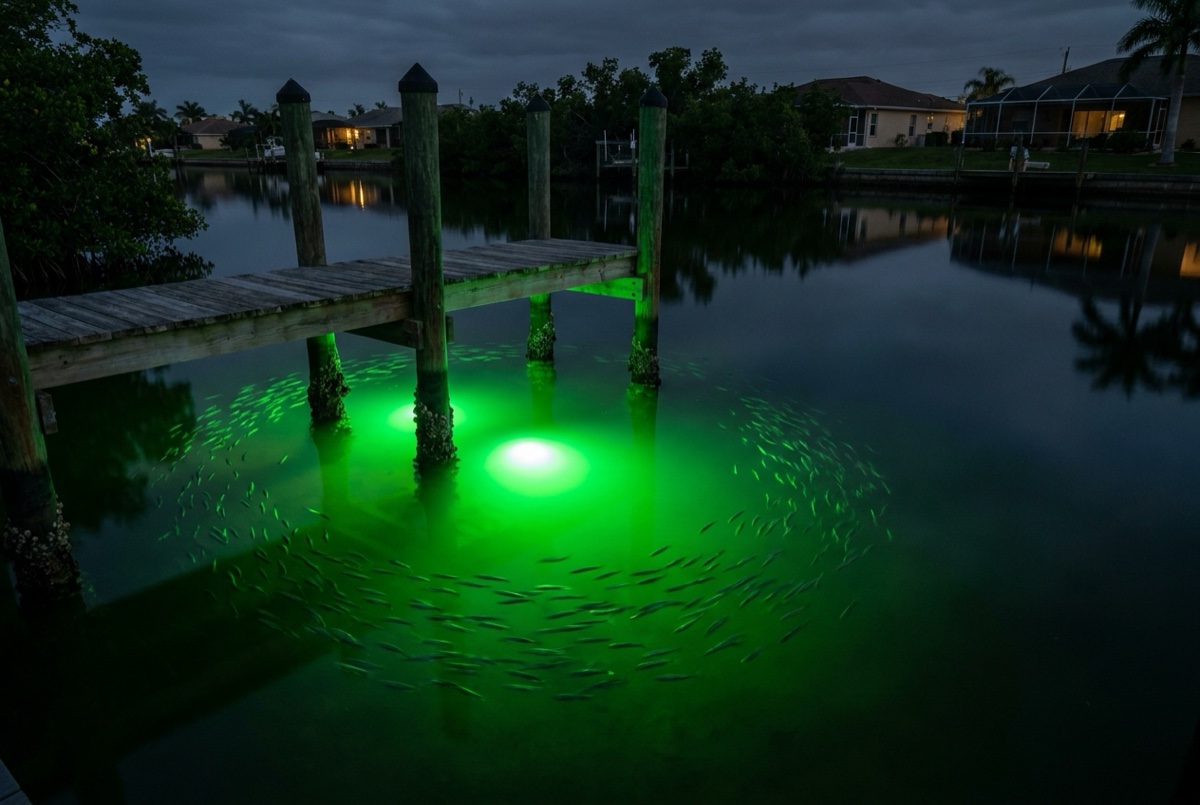
Picture two outcomes off the same seawall. In one, a single emerald pool glows in the dark water and bait stacks in a tight ball you can sight-cast all night. In the other, the whole canal frontage is a continuous lit ribbon, fish rolling end to end. Both are great, they just need very different numbers of fish lights. So the most useful question to settle before you buy isn’t color or brand, it’s how many do I actually need?
It depends on three things you can measure, your dock length, your water depth, and what you want the light to do, plus how much output each fixture puts out. Here’s how those add up to a fixture count and a spacing plan, with ranges we actually install on canals from Cape Coral to Charlotte Harbor.
What is a fish light, and what decides how many you need?
A fish light is a submerged, marine-rated LED fixture mounted to your dock or seawall that builds a food chain at dusk, light draws plankton, plankton draws baitfish, and that bait ball pulls in snook, tarpon, trout, and redfish. (The full chain is in our underwater fish lights guide.)
The number you need comes down to four levers:
- Dock or seawall length. The more linear feet of water’s edge you want lit, the more fixtures it takes.
- Water depth. Deeper water absorbs more light, shrinking the pool each fixture throws.
- Lumen output per fixture. A brighter light covers more water, so output and count trade off.
- Your goal. One ambush honey hole needs one light; a glowing ribbon needs a row of them.
Get those four right and the count almost calculates itself.
How many fish lights for the size of my dock?
The simplest rule of thumb is one fish light for every 15 to 20 feet of seawall or dock edge you want lit. That spacing keeps the pools of light just touching so there’s no dark water in between.
Here’s how that shakes out by dock type on a typical SW Florida canal:
| Dock / seawall | Edge to light | Typical fish lights |
|---|---|---|
| Small dock or single honey hole | one spot | 1 |
| Single-slip dock + lift | ~20–40 ft | 1–3 |
| Captain’s walk (wraps the slip) | ~50–70 ft | 3–5 |
| Long / estate seawall | 80+ ft | 5+ |
A few notes on reading it:
- A single-slip dock is the standard canal home, a straight run to one lift. One light makes a honey hole; two or three light the whole slip and both sides of the lift.
- A captain’s walk wraps the slip on three sides, so you’re lighting far more perimeter, and that’s where counts climb.
- A long estate seawall is really a frontage decision, you’re spacing lights down the whole edge for a continuous ribbon, so it scales with footage.
Does the goal change the count, one ambush spot vs a lit ribbon?
Yes, and this is the biggest lever of all. Your goal decides the count more than your dock length does. One fixture builds a single, concentrated ambush spot; a row of evenly spaced fixtures builds a continuous glowing ribbon down the whole edge.
Match the count to what you actually want:
- One reliable honey hole to fish. A single high-output fixture on the deeper edge, placed where you cast from. Plenty for a lot of owners.
- Fish a longer stretch, or both sides of the lift. Two to three lights, so bait stacks at more than one spot and night loading is easy.
- A showpiece ribbon along the whole seawall. Fixtures spaced evenly down the full frontage so the glow never breaks, the look that makes a plain seawall the best seat on the canal.
There’s no wrong answer, just be clear which one you’re after before you size it, because a honey-hole plan and a ribbon plan space very differently.
How do depth and lumens change the spacing?
Deeper, darker water means each fixture lights a smaller pool, so you tighten the spacing or step up the output. Shallow, clearer water lets one light spread farther, so you can stretch the spacing and use fewer fixtures.
This is where SW Florida water matters. Our canals run tannic and tea-colored, that brownish stain from the mangroves and runoff, and stained water eats light fast. The specifics:
- A typical high-output green LED throws roughly a 15 to 20 foot pool in our stained water. That’s the number behind the spacing rule, set fixtures so those pools just touch.
- Deeper edges and murkier canals shrink the pool, so favor more output per fixture and spacing closer to 15 feet.
- Shallower, Gulf-influenced water near the passes (parts of Sanibel or Marco Island) lets the glow travel, so you can lean toward 20 feet or a touch more.
- Color does real work, too. Green penetrates tannic water farthest, which is why it stacks the most bait and why we default to it, full breakdown in our green vs aqua vs white guide.
Do brighter lights mean fewer fixtures?
Partly. A higher-lumen fixture throws a bigger pool, so one strong light can do the work of two weak ones. But lumens fade quickly in stained water, and there’s a practical ceiling, past a point, adding a second fixture spreads the glow better than cranking one brighter. That’s why spacing matters as much as raw brightness.
So don’t over-spec a single monster light and call it a seawall plan. For one honey hole, a strong fixture is the right move. For real coverage, the goal is even, overlapping pools, several well-placed high-output lights beat one blinding one every time. (When it comes time to power them, every fixture runs low-voltage off a transformer, walked through in our wiring guide.)
Where do the lights actually go once I know the count?
Knowing how many is half the job, placement is the other half. A few rules that pay off no matter the count:
- Favor the deeper edge. Bait and gamefish hold where there’s depth and an ambush line, so put fixtures on the deeper side or the seawall drop.
- Space for overlap. Set lights so their pools just touch, no dark water between them, to avoid a string of bright dots with black gaps.
- Put one near the lift. A fixture by your boat lift makes night loading easier and pulls bait right where you can reach it.
- Aim at your cast or your view. Position at least one light where you actually fish from or where you’ll watch the show.
These tie straight back to count, more fixtures let you light both the lift and a separate honey hole; fewer means you pick the one spot that matters most. It’s the same backbone as the rest of your dock lighting, one sealed, low-voltage system on a dusk timer.
Want the count and spacing dialed in for your exact seawall? Florida Lifts & Docks has installed marine-rated fish lights across Southwest Florida since 2008, our own local crew, never subbed, with in-house permitting and free on-site estimates seven days a week in Cape Coral, Naples, and the rest of the coast. We’ll read your water, mark every fixture, and price it on the spot. See the full setup on our fish lights page or call (239) 397-3400.