
How to Power and Wire Fish Lights on an Existing Dock (SW Florida)
The safe, code-correct way to power underwater fish lights on a dock that's already built — why it's always low-voltage, never 120V at the water, and why salt makes it a marine job.
Key takeaways
- Fish lights run on low-voltage only — a transformer steps 120V down to 12–24V on shore, so line voltage never goes anywhere near the salt water; this is the single non-negotiable safety rule.
- Mount the transformer above your highest storm-surge level on a dedicated GFCI-protected circuit, never at the waterline where flooding can reach it.
- The supply cable should be direct-burial type run inside conduit and trenched across the yard, protecting it from shovels, roots, and Florida UV.
- On long seawall runs, voltage drop dims the far fixtures, so heavier-gauge cable or a closer transformer keeps every light equally bright.
- This is a marine-electrical job — water, electricity, and salt together are why it belongs to a crew that wires docks, not a weekend DIY.
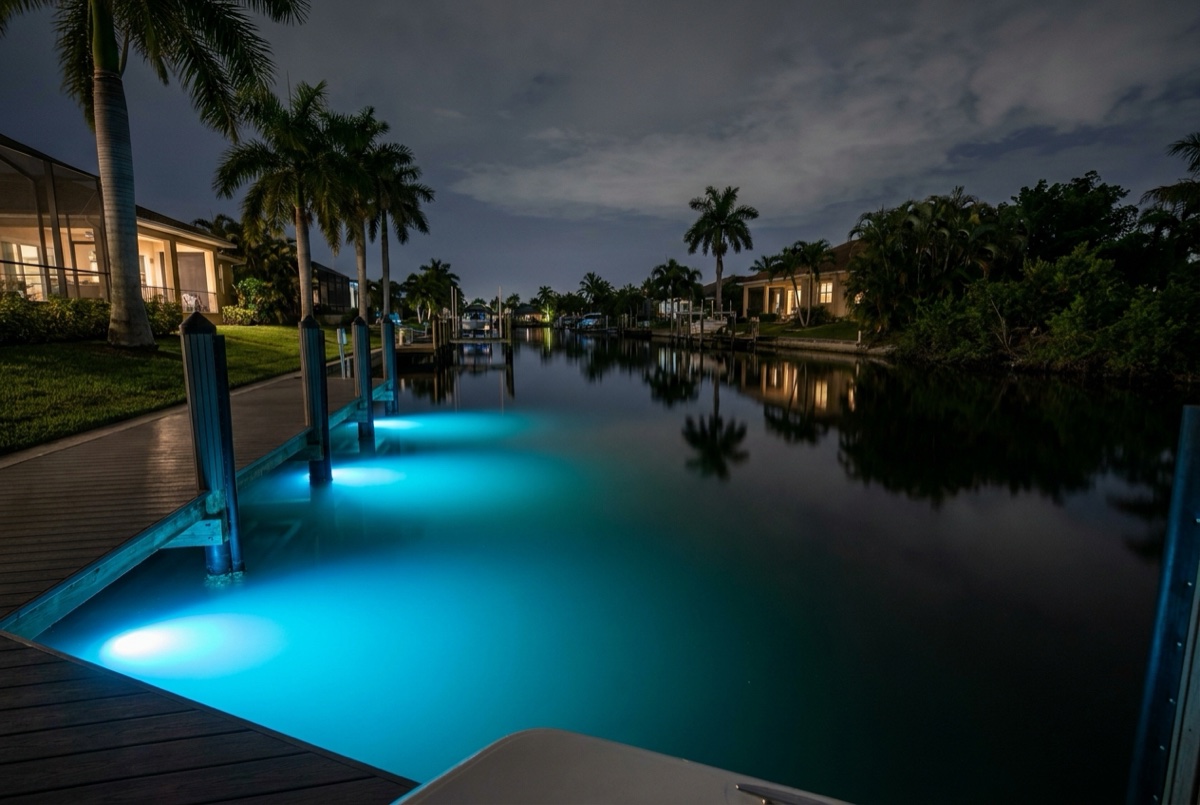
You bought the underwater fish lights, you’ve watched the videos of bait stacking and snook stalking the glow off a Cape Coral seawall, and now there’s one thing between you and the show: power. The dock is already built, the boat’s already on the lift, and you need a bright, reliable light in the water — safely. That last word is the whole job. Fish lights in a saltwater canal put water, electricity, and salt in one place, which is why the wiring has to be done a specific way.
Here’s how powering and wiring fish lights on an existing dock works in Southwest Florida — the low-voltage rule, where the transformer goes, how the cable reaches the water, and why this retrofit belongs to a marine crew, not a Saturday project.
How do you safely power fish lights at the water?
You power them with low-voltage only. A transformer on shore steps household 120V down to a safe 12 or 24 volts, and only that low-voltage cable heads out toward the water. Line voltage never goes near the salt.
This is the single non-negotiable rule of the whole job. Underwater fish lights are marine fixtures built to run on low-voltage fed by a transformer — the same backbone as the rest of your dock lighting. The 120V “house” side stays up by the home on a protected circuit; from the transformer out, everything is low-voltage. That’s what makes it safe to light a fixture sitting in a saltwater canal.
Why does this matter so much here? Our canals are saltwater, which conducts electricity far better than fresh. A shortcut that’s merely sloppy on a freshwater lake is dangerous on a Caloosahatchee or Charlotte Harbor canal — stray current is the cause behind the tingles and shocks swimmers feel near docks, the reason low-voltage and bonding aren’t optional out here.
Where does the transformer go on an existing dock?
The transformer mounts above your highest flood and storm-surge level — on the house wall, the lanai, or high on a piling — on a dedicated, GFCI-protected 120V circuit. It never goes down at the seawall.
Two things make a transformer location right:
- High and dry. Surge from a summer storm or a hurricane between June and November can put water over your seawall and across the yard. The transformer has to live above that line to survive the season — bolting it low is asking for it to drown.
- On its own GFCI circuit. A dedicated, GFCI-protected circuit gives clean, safe power, keeps a ground fault from becoming a shock, and means the lights won’t trip every time your boat lift motor kicks on.
Because the transformer needs a real 120V supply, the first question on any retrofit is where the nearest reliable power lives. A GFCI outlet or shore-power pedestal near the seawall makes it easy; if the closest power is back at the garage, we pull a new circuit toward the dock.
How is the cable run from the transformer to the water?
With direct-burial low-voltage cable run inside conduit. We trench from the transformer toward the seawall so the cable is protected the whole way, then bring it up at the waterline to each fixture.
A buried-in-conduit run isn’t just tidy — it protects the cable from what kills exposed wire in a Florida yard:
- Shovels and irrigation. A buried, conduit-protected line survives the next time someone digs a planting bed or sets a sprinkler head.
- Roots and UV. Conduit keeps tree roots off the cable, and burial shields it from the Florida sun that chalks and cracks exposed insulation.
One trench can usually carry both your fish-light feed and your above-water dock lights, since they share the same low-voltage backbone — far cheaper than digging twice, which is why many owners bundle the two. (If you’re doing both, our guide on adding lighting to an existing dock covers the rest.)
Why does cable size matter on a long seawall run?
Because of voltage drop. The farther low-voltage power travels down a wire, the more it loses, so a fixture at the far end of a long run can glow noticeably dimmer than one near the transformer.
On a short dock this rarely bites. But SW Florida properties often have long seawalls with fixtures spread across 60, 80, even 100-plus feet, and that distance eats voltage. The fixes are straightforward when planned for:
| Run length | The problem | The fix |
|---|---|---|
| Short run, few fixtures | Minimal drop | Standard-gauge cable |
| Long seawall, many fixtures | Far lights dim | Heavier gauge, or transformer closer to the lights |
Sizing the gauge to the run — and sometimes placing the transformer mid-dock — is how every fixture ends up equally bright. We also wire the transformer to a photocell or smart timer, so the lights come on at sunset and shut off automatically: a dusk-to-dawn photocell senses darkness and powers them on by itself, while an app controller lets you run them only on the nights you fish.
Why is this a job for a marine crew?
Because you’re combining the three things that demand respect at once: water, electricity, and salt. A marine crew wires docks for a living, knows the code for GFCI protection and bonding, and seals every connection against the salt that eats ordinary fittings.
The hardware spec is the standard we hold on every project — 316 stainless fasteners, marine-rated fixtures, and weatherproofing at every junction. A connection that’s fine in a dry garage corrodes open in a season at the waterline. Done right, a fish-light system is safe, bright, and lasts for years; done wrong, it’s a shock hazard in your own canal. (More on stray current near docks in our guide on tingles and shocks in the water.)
Light up the water the right way
Powering fish lights on an existing dock is very doable — but it’s a marine-electrical job, not a hardware-store afternoon. Get the low-voltage rule, the transformer placement, the buried cable, and the gauge right, and you’ll have snook hunting your seawall for years. The smart move is a quick on-site look at your power, dock, and seawall, and a real plan.
We install underwater fish lights and full dock lighting across Cape Coral, Naples, Fort Myers, and the rest of the SW Florida coast — with our own local crew, never subbed, and free on-site estimates seven days a week. Call (239) 397-3400 and let’s light up the water.