
How to Prep a Jet Ski on a Lift for a Hurricane in Florida
A focused, 30-minute PWC checklist for Southwest Florida hurricane season — trailer it if you can, and if you can't, exactly how to position, strap, and protect your ski on the lift.
Key takeaways
- The safest move is the simplest one — trailer the ski and put it in a garage or dry storage, off the water and out of the surge entirely.
- If you can't trailer it, the position depends on your lift — raise a piling-mounted lift high to clear surge and floating debris, and follow your lift maker's storm guidance for a dock- or seawall-mount.
- Ratchet-strap the ski down to the bunks or port from both bow and stern, kill the lift power at the breaker, and strip every loose cover and cushion.
- Post-Ian, SW Florida owners plan for surge first — debris in the water and a rising tide do as much damage to a stranded PWC as the wind does.
In Southwest Florida, hurricane season is part of owning a personal watercraft. The season runs June 1 through November 30, and a jet ski is small enough, light enough, and exposed enough that it deserves its own storm plan — not just whatever you do for the big boat. The good news: a personal watercraft (PWC) — a Sea-Doo, WaveRunner, or Jet Ski sitting on a small lift or floating port — is also the easiest thing on your dock to protect, and you can get it done in about 30 minutes.
Here’s what to do when a storm is headed for the Gulf, starting with the single best move.
What’s the safest thing to do with a jet ski before a hurricane?
Trailer it and store it on land. If you have a trailer and a garage, a carport, or dry storage, pull the ski off the lift and get it out of the water entirely. Nothing you do on the lift beats simply removing the ski from the surge zone.
A jet ski trailers easily, which is its big advantage over a 26-foot center console. Drop it on the trailer, strap it down, and park it enclosed and inland. That takes the ski out of the two things that wreck PWCs in a storm: rising water and floating debris. If you can do this, you’re done — skip the storm-position section below.
If you can’t trailer it, where should the lift be — high or low?
It depends on your lift type, and you have to know which kind you own. A piling-mounted lift and a dock- or seawall-mounted lift call for different moves.
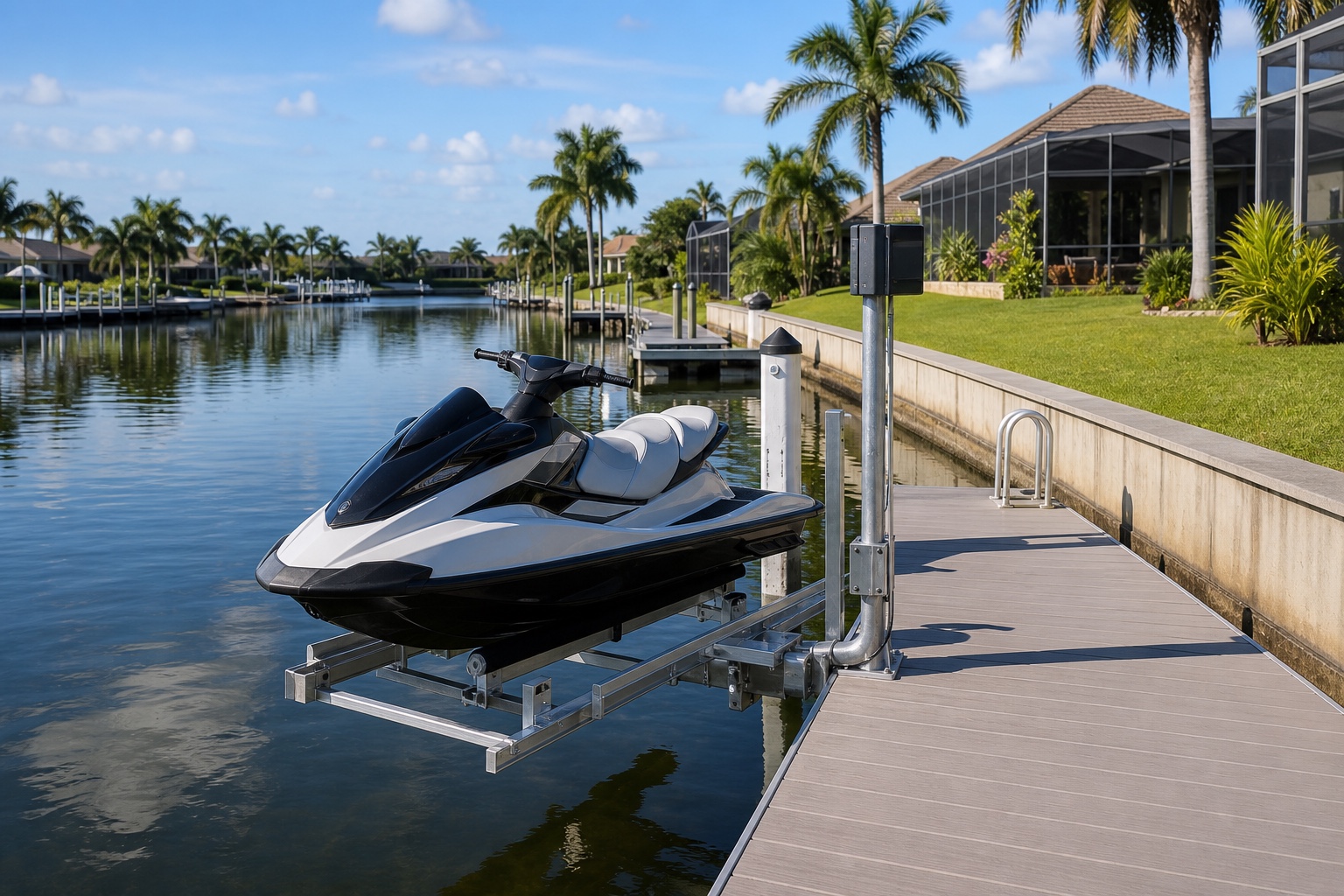
- Piling-mounted lift: Raise the ski high, near the top of its travel, to clear the ski above expected storm surge and the floating debris that rides on it. Water at deck level is full of dock boards, branches, and trash — you want the hull above all of it.
- Dock-mounted or seawall-mounted lift: These often sit lower with less travel, so “just raise it high” may not apply. Follow your lift manufacturer’s storm guidance for your model and set it to the recommended storm position. Don’t freelance a position the lift wasn’t designed for.
- Floating drive-on port: A floating port can’t lift the ski above anything. See the dedicated section below.
Surge drives this decision: on our canals off the Caloosahatchee and Charlotte Harbor, the water comes up, sometimes a lot. After Ian, owners across Cape Coral and Fort Myers saw firsthand that the rising tide and the debris it carries do as much damage as the wind. Getting the ski up and out of that water is the whole game.
How do you strap a jet ski down on the lift?
Ratchet-strap the ski to the lift frame at the bow and stern so it physically can’t move. A ski resting loose on the bunks will rock, shift, or float right off if water reaches it.
Use marine-rated ratchet straps, not bungees or rope, which stretch and let the ski work loose. Then:
- Run one strap from the bow eye to a solid point on the lift frame, pulled snug.
- Run a strap from each stern eye so the back end can’t swing.
- Tighten until the ski is firmly seated on the bunks with no slop.
- Pad the straps where they cross the hull so they don’t chafe through, and close the seat, hatches, and glovebox against wind-driven rain.
The point is to make the ski and the lift act like one piece. A strapped-down ski that stays seated comes through far better than one left to bounce.
Do you need to disconnect the power to the lift?
Yes — kill the lift power at the breaker and unplug the remote. You don’t want a surge, a lightning strike, or a soaked motor cycling the lift or shorting out mid-storm. Once the ski is in its storm position and strapped:
- Shut off the lift’s dedicated circuit at the breaker panel, not just the wall switch.
- Unplug the remote or control box and bring it inside, dry.
- If your motor sits low enough to be reached by surge, accept that it may get wet — sealed marine motors handle salt air, but no motor loves being submerged, so de-energizing it first is the safe call.
This takes two minutes and removes a whole category of things that can go wrong while you’re sheltering away from the water.
What about a floating drive-on jet ski port?
A floating port can’t raise the ski above surge, so the job is keeping both the ski and the port from breaking loose. It’s a different problem than a piling lift — and why some owners on shallow, debris-prone canals prefer a piling jet ski lift for storm season.
For a floating port:
- Drive the ski fully on and strap it tightly to the port, bow and stern.
- Check the port’s mooring lines or pile guides — they need enough slack to let the port rise with the tide. A line cinched too short will pull the port under or rip the cleat out as water climbs.
- A properly anchored port rides surge far better than one that isn’t, so confirm it’s rated for storm conditions.
- When in doubt, trailer the ski — an empty port is a much smaller loss than a destroyed ski.
| Setup | Storm move | Why |
|---|---|---|
| Trailer + garage | Pull it, strap it, store inland | Out of surge and debris entirely — the safest option |
| Piling-mounted lift | Raise high, strap, kill power | Clears the ski above surge and floating debris |
| Dock / seawall-mount | Manufacturer storm position, strap, kill power | Limited travel — follow the lift maker’s guidance |
| Floating drive-on port | Strap ski to port, give mooring lines tide slack | Can’t lift above surge; goal is staying put |
Do the structure check before the season, not the night before
Hurricane prep starts in the spring, while crews have availability. Before June, give your setup a once-over — cables and hardware for fraying and rust, bunks for wear, the frame for flex, and the pilings or seawall it’s mounted to for cracks or movement. Our broader hurricane prep checklist for docks, lifts, and seawalls covers the whole waterfront, and the jet ski lift maintenance guide keeps the small stuff from becoming a storm-day surprise. A weak point caught in April is a routine fix; found with a named storm three days out, it may not be fixable at all — which is exactly why we build PWC lifts with marine-grade aluminum, 316 stainless hardware, and sealed marine motors in the first place.
Want a pre-season look at your lift, pilings, and seawall? Florida Lifts & Docks has installed and repaired lifts across Cape Coral, Fort Myers, and Punta Gorda since 2008 with our own local crew — never subbed, permitting in-house. See our jet ski lifts page, or call (239) 397-3400 for a free on-site estimate, seven days a week.