
Jet Ski Lift vs. Floating Dock: Which Is Right for a Saltwater Canal?
The neutral, SW Florida-specific guide to storing a PWC on a saltwater canal — what each option really protects against, and exactly which one to buy for your dock.
Key takeaways
- A jet ski lift fully removes the hull from the water (no barnacles, no salt-soaked impeller) and runs about $3,000–$5,000 installed; a drive-on floating port cradles the hull at the waterline and rises and falls with the tide.
- On SW Florida saltwater canals with brackish growth, a lift is the better long-term call — it keeps the PWC out of the salt 24/7 and almost always wins on hull protection.
- Choose a floating port when you have no shore power, the canal is too shallow or too tight for piling-mounted lift legs, or you want a no-electric, low-cost dry-storage option that handles a 2-ft tide swing automatically.
- Both options solve the real problem — never leave a jet ski floating in a saltwater canal, where growth and corrosion start within days.
- Cost is close at the entry level, but a lift's sealed marine motor and 316 stainless cable are built for the salt and last decades.
If you keep a jet ski or two on a Southwest Florida canal, you’ve got exactly two smart ways to store them: a jet ski lift that hoists the craft fully out of the water, or a floating port that you drive up onto so the hull rests at the waterline. Both beat the one thing you must never do — leave a PWC tied off and floating in a saltwater canal, where barnacles, slime, and corrosion go to work within days.
The trouble is that most of the advice out there is written by a brand trying to sell you their specific product. This guide is neutral. We install both across Cape Coral, Naples, Fort Myers, and up into Charlotte Harbor, and below we’ll define each option, put them head to head on the things that actually matter on a brackish canal, and tell you plainly which one to buy for your situation.
What’s the difference between a jet ski lift and a floating dock?
A jet ski lift lifts the entire hull clear of the water; a floating dock port is a buoyant dry-dock you drive onto that cradles the hull at the surface. The core distinction is simple — one gets the craft fully out of the salt, the other gets it mostly out while staying right at the waterline.
A jet ski lift is a small version of a boat lift. It uses two piling-mounted legs (a cantilever or four-post design) with a cradle or bunks that the PWC sits on. A motor — electric, hydraulic, or a manual hand-crank — raises the whole craft up into the air, completely out of the water. When you want to ride, you lower it, drive off, and you’re gone.
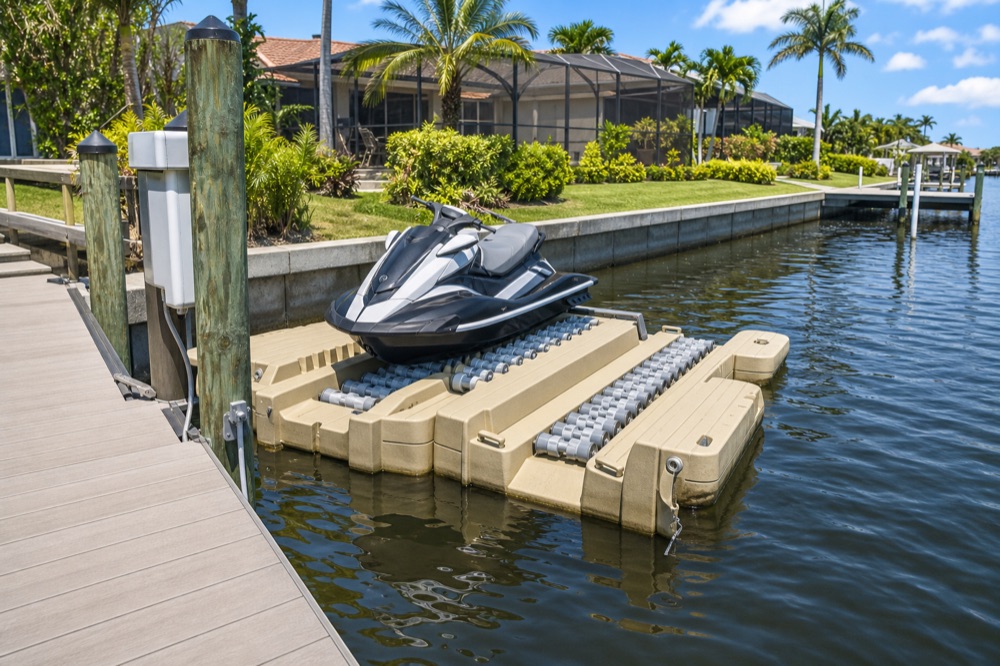
A floating port (sometimes called a drive-on dock or jet ski float) is a hollow, buoyant platform made of HDPE plastic. It sits in the water and is tethered to your seawall or dock. You simply gun the throttle and drive the jet ski up onto it; rollers and the hull’s own momentum carry it up out of the current. The platform floats, so it rises and falls with the tide.
Which protects a PWC better in salt water?
A jet ski lift protects better, because it removes the hull from the water entirely. Nothing below the waterline means nothing for barnacles or salt to attack — the single biggest reason lifts win on our coast.
Southwest Florida salt water is brutal on anything you leave submerged. The brackish water in our canals — fed by the Caloosahatchee, Charlotte Harbor, and the Gulf — grows barnacles and marine slime fast, and dissolved salt corrodes metal and degrades seals around the clock. Here’s how each option handles it:
- Jet ski lift: The hull, pump, intake grate, and impeller all sit in open air between rides. No growth on the bottom, no salt sitting in the pump, no electrolysis on the steering nozzle. This is as clean as PWC storage gets.
- Floating port: The hull is lifted above the surface as it rests on the platform, so the running surface stays mostly dry and far cleaner than a craft left floating. But the platform’s floats and any straps below the waterline are submerged full-time and will pick up growth that needs periodic scrubbing.
For a craft you plan to keep for years, the lift’s “fully out of the water” advantage compounds every single day it sits. It also matters most through hurricane season, June to November, when a craft left in the water is exposed to surge, debris, and chop for months on end — lifted and secured, it rides out far better.
How does each handle SW Florida’s tide swing?
Both handle our tides, but in opposite ways: a floating port follows the tide automatically, while a lift is set once and lifts above the highest water. On a canal with a 1–2 ft daily swing, both work — the question is whether you want automatic or fixed.
Our canals routinely move a foot or two between high and low tide, and storm events push water far higher. That swing is exactly where these two designs differ most.
A floating port is the natural tide-follower. Because it floats, it rides up and down with the water with zero adjustment from you — the drive-on height is the same at high tide and low tide. That’s a genuine convenience, and it’s why floating works so well where water levels move.
A jet ski lift doesn’t follow the tide; it’s mounted to fixed pilings and lifts the craft above the highest normal water line. Once the legs are set for your canal’s range, you never think about it — you raise the craft and it’s clear of the water regardless of the stage. In very shallow canals with extreme low tides, lift design matters, and there are specialty options for that (more in our shallow-water jet ski lift guide).
Jet ski lift vs. floating dock: head-to-head
Here’s the honest side-by-side on the factors that decide it for most SW Florida canal owners:
| Factor | Jet ski lift | Floating port |
|---|---|---|
| Salt / barnacle protection | Excellent — hull fully out of water | Good — hull at waterline, floats stay wet |
| Tidal swing handling | Set once, lifts above high water | Follows the tide automatically |
| Needs power / electricity | Optional (electric, or manual/hydraulic) | None |
| Daily launch convenience | Lower, drive off, done | Drive on/off under throttle |
| Footprint in the canal | Compact, vertical | Sits on the water surface |
| Needs pilings | Yes (mounts to pilings/dock) | No — anchors to seawall or dock |
| Typical installed cost | $3,000–$5,000 | Often a similar entry-level range; quoted free on-site |
The takeaway: a lift edges out the port on long-term hull protection, while a port wins on simplicity, no-power operation, and not needing pilings. Cost lands close at the entry level, so price alone rarely decides it — the deciding factors are usually your power situation, your canal depth, and how much you care about keeping the hull bone-dry between rides.
Choose a lift if… choose a floating port if…
Use this framework, built around real SW Florida conditions, to make the call:
Choose a jet ski lift if:
- You want the maximum hull and pump protection — the craft fully out of the salt 24/7.
- You already have a dock or sound pilings the lift can mount to, or you’re fine adding pilings.
- You have shore power or are willing to add a circuit (or you’re happy with a manual/hydraulic unit).
- You’re keeping the PWC for years and want the longest-lasting setup in our climate.
- You ride often and want a one-button “lower and go” routine.
Choose a floating port if:
- You have no shore power at the dock and don’t want to run electrical.
- Your canal is too shallow, too narrow, or your seawall configuration makes piling-mounted lift legs impractical.
- You want a lower-fuss, no-mechanical-parts option that follows the tide on its own.
- You also launch kayaks or paddleboards and want a stable, walk-up platform (see floating dock for kayak, paddleboard, and jet ski launch).
- You want dry-ish storage without committing to a fixed structure.
For two PWCs, both scale up — double lifts and double-wide floating ports both exist, and we’ll size either to your canal at the estimate.
What about build quality in the salt?
Whichever you choose, the materials decide how long it survives our climate. A unit built for fresh-water lakes won’t last on a brackish Gulf-coast canal.
When we install a jet ski lift, it’s spec’d for salt water from the ground up:
- Marine-grade aluminum frame that won’t rust through
- 316 stainless cable and hardware that stands up to salt air
- Sealed marine motors rated for the marine environment (on powered units)
That’s the difference between a lift that lasts decades and one that seizes in a couple of seasons. The same logic applies to a floating port — we use HDPE platforms built for UV and saltwater service, anchored with corrosion-resistant hardware. Keeping either one in shape is straightforward; our jet ski lift maintenance guide covers the routine, and your choice of electric vs. manual drives how hands-on it is.
The bottom line for a saltwater canal
For most Southwest Florida canal homes, a jet ski lift is the better long-term choice — it pulls the hull completely out of the salt, protects the pump and impeller, and with the right spec it lasts for decades. Go with a floating port when you have no shore power, a shallow or tight canal, or you want a no-electric, tide-following platform that doubles as a launch for kayaks and paddleboards. Either way, get the craft up out of the water; that’s the win.
Not sure which fits your seawall, pilings, and canal depth? That’s exactly what an on-site look settles. We give free on-site estimates seven days a week across Cape Coral, Naples, Fort Myers, and the rest of the coast. See what we build on our jet ski lifts page, explore floating docks, or call (239) 397-3400.