
Hydraulic vs Cable Boat Lifts in SW Florida Salt Water
How piston-driven hydraulic lifts stack up against cable lifts on a saltwater canal — speed, noise, maintenance, storm season, and which one fits your boat.
Key takeaways
- Cable lifts wind 316 stainless cables over a marine motor; hydraulic lifts push the boat up on a pump-driven piston with no cables or pulleys.
- Hydraulic lifts run quieter and faster and have no cables to replace, but trade that for a pump, hoses, seals, and fluid — and a premium price.
- Cable lifts are the SW Florida standard: best value, widest service network, and scalable from a jet ski to a 24,000 lb offshore boat.
- Whichever you choose, the pilings, marine-grade aluminum, 316 stainless hardware, and zinc anodes underneath are what decide how long it lasts.
Most boat lifts on the Southwest Florida coast do the same job two very different ways. A cable lift winds stainless cables over a motor to hoist your boat; a hydraulic lift pushes it up on a piston. Both get your hull out of the salt at the end of a run — the real question is which mechanism you want doing it on your canal, year after year, in an environment that corrodes everything it touches.
Here’s how the two compare on the things that actually matter in Cape Coral, Fort Myers, and Naples: how each one works, what it takes to maintain, how it handles a storm season, and who each really suits.
How does a cable boat lift work?
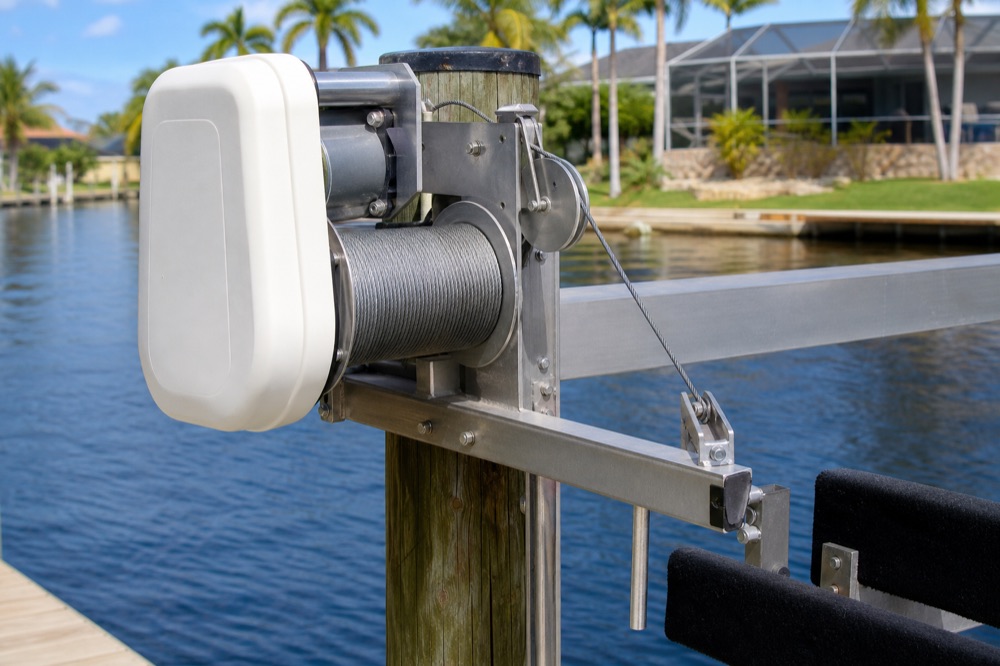
A cable lift uses a sealed marine motor to wind 316 stainless cables over pulleys, raising a cradle that your boat sits on. It’s the standard lift on nearly every Southwest Florida canal.
The motor turns a drive shaft, the cables spool up, and the cradle rises straight out of the water on four pilings. It’s a proven, simple design — strong, easy to service by any lift tech on the coast, and scalable from a jet ski up to a 24,000 lb offshore boat. The cables are the wear item: they live in salt water, and stainless or not, they stretch, fray, and eventually need replacing. (We cover that in cable replacement for saltwater lifts.) The drive itself comes in a couple of flavors, broken down in our boat lift motor types guide.
How does a hydraulic boat lift work?
A hydraulic lift raises your boat with a hydraulic cylinder — a piston driven by a pump — instead of a motor winding cables. There are no cables and no pulleys.
Press the button and a pump pressurizes hydraulic fluid, which drives the piston and lifts the boat. Because it doesn’t rely on cable and pulley, a hydraulic lift tends to run quieter and faster, with a cleaner look and one fewer salt-exposed wear point. What it adds instead is a hydraulic system: a pump, a cylinder, hoses, seals, and fluid. It’s a more specialized, premium build — fewer of them go in on the average canal, and they call for a tech who knows hydraulics when something needs service.
Hydraulic vs cable: how do they compare?
Cable lifts win on price, simplicity, and easy service anywhere; hydraulic lifts win on speed, quiet, and having no cables to replace. Here’s the side-by-side.
| Factor | Cable lift | Hydraulic lift |
|---|---|---|
| How it lifts | Motor winds stainless cables | Pump drives a piston |
| Speed and noise | Standard | Faster, quieter |
| Cables to replace | Yes — a wear item in salt | None |
| Main wear points | Cables, pulleys, motor | Pump, cylinder, hoses, seals, fluid |
| Serviceable by | Any lift tech on the coast | A hydraulic-savvy tech |
| Up-front cost | The regional standard | Premium |
The capacity ranges most owners see quoted — $3,000–$5,000 for a jet-ski lift, $8,000–$13,500 for a 7,000–10,000 lb lift, on up past $22,000 for a 24,000 lb offshore lift — are for cable-style lifts, the regional standard. A hydraulic lift is a specialized build, so we quote it on-site rather than off a chart. Our full boat lift cost guide breaks the cable ranges down.
Which needs less maintenance in salt water?
Neither is maintenance-free — they just wear differently. A cable lift’s cables are the part the salt claims; a hydraulic lift trades cables for seals, hoses, and fluid.
On a cable lift, your routine centers on rinsing and inspecting the cables, watching for fraying and rust bleed, protecting the motor and hardware, and replacing 316 stainless cable on schedule. A hydraulic lift has no cables to chase, but its pump, hoses, and seals have to stay sealed and leak-free — a failed seal or hose is a specialized repair, and hydraulic fluid is something a good install keeps contained well away from the water. Either way, the metal underneath has to be right:
- Marine-grade aluminum framing that won’t rust like steel
- 316 stainless cables and hardware
- Sacrificial zinc anodes on submerged metal to take the galvanic corrosion
Our salt-water maintenance guide walks through the cable-lift routine most owners run.
What about hurricane season and storms?
The lift type matters less than your storm plan. Whether you run cable or hydraulic, the move before a named storm is to follow a plan — often pulling the boat entirely — not to trust any lift to hold a hull through surge.
Through hurricane season (June–November), a cable lift gives you cables to inspect and tension as one more pre-storm check; a hydraulic lift has none, but leans on its cylinder and seals holding under load. Neither is a reason to leave a boat sitting on a lift in a serious surge. Build your decision on our hurricane prep guide for docks and lifts, and make sure the pilings underneath — the part that actually anchors either lift — are driven to the right depth for your canal bottom.
Which boat lift is right for you?
For most Southwest Florida owners, a cable lift is the practical answer — proven, affordable, and serviceable anywhere on the coast. A hydraulic lift suits owners who want the fastest, quietest, cable-free option and don’t mind paying a premium for it.
Choose a cable lift if you want the regional standard: the best value, the widest service network, and a design that scales cleanly from a bay boat to a heavy offshore rig. Lean hydraulic if speed, quiet, a clean look, and never replacing a cable are worth a premium build to you. The honest tie-breaker is your actual canal — boat weight, water depth, tide, and power — which is exactly what a free on-site look sorts out.
We’ve built and serviced both since 2008 with our own local crew — never subbed — and we’ll tell you straight which one fits your dock. Explore everything on our boat lifts page, book a free on-site estimate across Cape Coral, Fort Myers, and Naples, or call (239) 397-3400.