
Rip-Rap Rock: Limestone vs. Granite and What Size You Need
Not all shoreline armor is the same. Here's how Florida limestone, granite, and concrete rubble compare — and how we size the rock to your canal's wave energy.
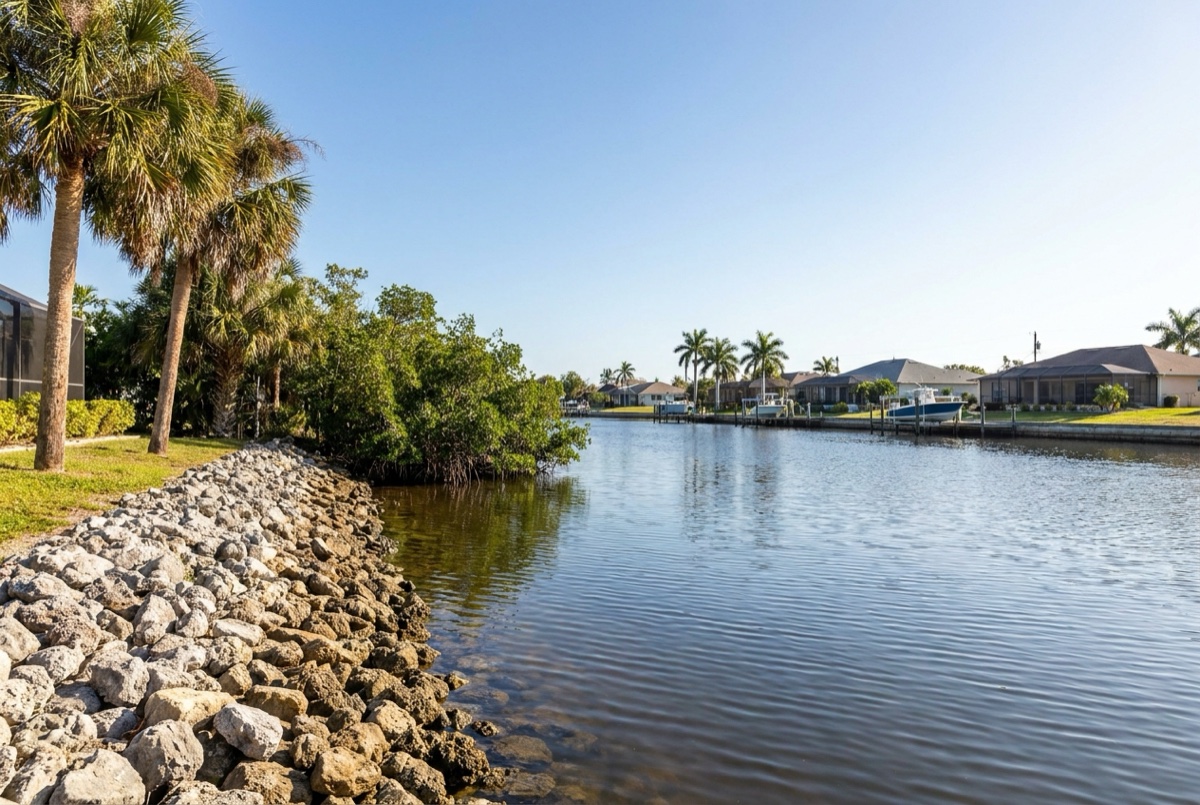
Key takeaways
- Florida limestone is the most common, most affordable rip-rap rock here, but it's softer and can nudge nearby water pH up; granite is denser and far more abrasion- and weather-resistant for high-energy shorelines.
- Rock is sized by wave and wake energy, not by looks: protected canals take smaller stone, while open water on Charlotte Harbor or the Caloosahatchee, ferry routes, and high-wake spots need bigger, heavier armor.
- A revetment is layered, not dumped — large armor stone sits on a bedding layer of smaller stone, which sits on a filter fabric that holds your bank's soil in place.
- Clean concrete rubble is sometimes allowed and economical, but only the right gradation in the right setting; the agencies and the site decide what's permitted.
- The reason a rip-rap quote isn't just "dump rock" is that stone type, stone size, slope, bedding, and fabric are all engineered to your specific bank and water.
When a rip-rap quote isn’t just a flat per-foot number, this is why. Shoreline armor looks simple — it’s a pile of rock — but the right revetment is engineered around two questions most owners never ask: what kind of rock and how big. Get those wrong and storms and boat wakes will slowly take the pile apart. Get them right and you’ve got a shoreline that shrugs off hurricane season for decades.
Here’s how we think about stone type and size across Cape Coral, Fort Myers, Naples, and up into Charlotte Harbor — plus the layers underneath the rock that do half the work.
What is rip-rap rock, and why does the type matter?
Rip-rap is loose, heavy, angular stone placed in a sloped layer to armor a shoreline against erosion. The type matters because different stone has different density, hardness, and weathering behavior in salt water — which changes how long it lasts and how big each piece must be.
The whole system works on one principle: each stone has to be heavy and angular enough that waves and wakes can’t roll it out of place. Denser, harder rock hits that weight in a smaller piece and resists the constant abrasion of sand and salt. Softer rock works fine in calm water but wears faster and has to be larger for the same protective weight.
Limestone vs. granite vs. concrete rubble — which rock is best?
For most Southwest Florida shorelines, Florida limestone is the affordable, widely used default, granite is the premium choice for high-energy water, and clean concrete rubble is a budget option only where it’s permitted and properly graded. The right answer depends on your exposure, not a blanket rule.
| Rock type | Strengths | Trade-offs | Best for |
|---|---|---|---|
| Florida limestone | Affordable, locally available | Softer; abrades faster; nudges nearby water pH up as it weathers | Protected canals, light-to-moderate wake |
| Granite | Dense, hard, excellent abrasion and weather resistance | Costs more; often hauled farther | Open water, high-wake zones, exposed points |
| Clean concrete rubble | Economical, reuses material | Must be rebar/debris-free and graded; not allowed everywhere | Interior settings where the agency permits it |
A few things worth knowing in plain terms:
- Limestone is the rock you’ll see on most local canals — the most economical quarried option, and on a protected canal it holds a bank for a long time. The honest caveats: it’s softer, so it abrades faster under heavy wake and sand scour, and because it’s calcium carbonate it can raise the pH of the water right around it slightly as it weathers.
- Granite is denser and significantly harder. That toughness is why it’s the stone you want where the water works hard — open exposure on Charlotte Harbor or the Caloosahatchee, a fetch-exposed corner lot, or a high-traffic channel. It shrugs off abrasion and the relentless salt-and-UV cycle.
- Concrete rubble can be smart and economical in the right setting, but it’s not a free-for-all. It has to be clean, broken to size, and free of rebar and fines — and whether it’s allowed depends on the waterway and the agency.
How is rip-rap rock size determined?
Rock size is determined by the wave and wake energy your shoreline takes — bigger, heavier stone for open or high-wake exposure, smaller stone for protected canals. It’s a spec, not a guess, and the single most important call in the job.
It’s a balance of forces: waves and wakes try to lift and roll the stone, and the stone’s weight and angular interlock resist it. The more energy your shoreline sees, the heavier each piece has to be. That’s why two lots a mile apart can need very different rock:
- A protected interior canal with light, occasional wakes takes smaller, lighter armor stone.
- A canal mouth, basin, or wide waterway with steady boat traffic steps up a size.
- Open water — a point exposed to a long fetch across the harbor, a Gulf-facing bank, or a high-wake channel — needs the largest, heaviest armor so a storm surge can’t pluck it loose.
Undersize the rock and the first big blow rolls it away, exposing the bank. Oversize it on a calm canal and you’ve wasted money and footprint. The goal is the right gradation — a controlled mix of sizes that interlock tightly — matched to your water.
What goes underneath the rock?
Underneath the visible armor stone are two layers that do half the work: a bedding layer of smaller stone, and a geotextile filter fabric against your graded bank. Without them, your soil washes out and the rock sinks into the mud. This is the part owners never see and competitors love to skip:
- Filter fabric (geotextile) goes directly against the shaped bank. It lets water pass but holds your soil in place, so tide and wave action can’t pump dirt out from behind the rock.
- Bedding stone — smaller, well-graded rock — sits on the fabric, supports the armor stone, and keeps the heavy rock from punching through into the bank.
- Armor stone — the limestone or granite sized to your wave energy — is placed (not dumped) on top at the right slope so the pieces interlock.
Skip the fabric or the bedding and you get the cheap rip-rap you’ve seen failing around the area: a sunken pile with an eroding bank washing out behind it.
Why isn’t a rip-rap quote just “dump rock”?
Because every layer is engineered to your site. The stone type, the size and gradation, the slope angle, the bedding, and the fabric are all chosen for your bank, your water’s energy, and what the agencies will permit — a design decision, not a dump-truck delivery.
A real quote accounts for your exposure, bank height and soil, access, and permitting. To see how that adds up, our rip-rap cost per linear foot guide walks through the numbers. Still deciding between rock and a wall? See our rip-rap vs. seawall breakdown and how long rip-rap lasts in Florida.
We’ve armored Southwest Florida shorelines since 2008 with our own local crew — never subbed — and we handle permitting in-house. If your bank is eroding or your seawall toe is undermined, the right rock spec’d the right way is the answer. Explore everything we do on our rip-rap page, and book a free on-site estimate seven days a week across Cape Coral, Naples, Punta Gorda, and the rest of the coast — or call (239) 397-3400.