
How Long Does Rip-Rap Last in Florida? Lifespan & Upkeep
Good rock on a properly bedded slope lasts decades — often longer than a seawall — because stone doesn't corrode or crack. Here's what drives lifespan and the upkeep it actually needs.
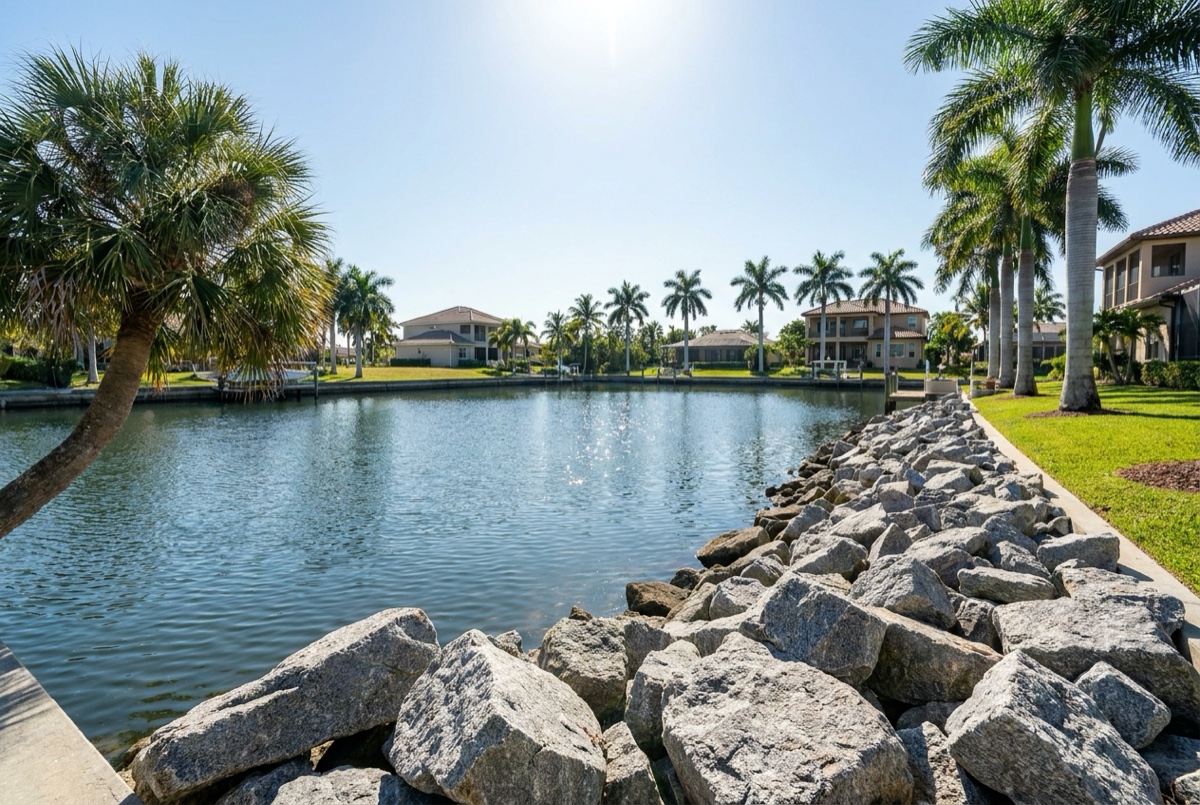
Key takeaways
- Quality rip-rap on a stable, properly bedded slope lasts decades and often outlives a seawall, because stone doesn't corrode like steel or crack like aging concrete.
- The rock itself essentially doesn't wear out — lifespan is determined by what's underneath and around it, namely filter fabric, bedding stone, a buried or cradled toe, and the slope angle.
- The main failure mode isn't the rock breaking down, it's toe scour — current undermining the bottom of the slope so stone shifts and settles.
- A 20-minute walk after every hurricane season catches small shifts early, when topping off a few stones is cheap instead of a rebuild.
- Rip-rap has no caps, tiebacks, or weep holes to fail, which is a big part of why it's so low-maintenance compared with a wall.
When you’re weighing how to protect a Southwest Florida shoreline, lifespan is one of the first questions worth asking — especially if you’re comparing rip-rap against a seawall. The good news is straightforward: quality rip-rap on a stable, properly bedded slope lasts decades, and it routinely outlives a seawall. Stone doesn’t corrode like steel cable and rebar, and it doesn’t crack and spall like aging concrete. It just sits there and does its job.
The catch is that “rip-rap lasts decades” is really a statement about how it’s built, not just about the rock. The stone is essentially permanent; what determines whether your revetment holds for thirty years or slides in three is everything underneath and around it. Here’s what that means on a saltwater canal, in the Caloosahatchee, or along Charlotte Harbor.
What is rip-rap, and why does the rock last so long?
Rip-rap (also called a revetment) is a layer of heavy armor stone placed on a graded slope to absorb wave energy and stop a bank from eroding. Instead of a rigid wall fighting the water, the rock dissipates it.
The rock lasts because it’s chemically inert here. Limestone and granite don’t rust, don’t rot, and aren’t food for marine borers like wood pilings are. UV and salt water don’t touch them. A storm can move undersized stone, but the stone itself isn’t degrading — which is why a revetment’s lifespan is measured in decades, not seasons.
What actually determines how long rip-rap lasts?
Lifespan is decided by the foundation, not the face. Five things drive it:
- Rock quality and size. The stone has to be hard, dense, and large enough that storm surge and wave action can’t roll it. Undersized rock is the most common shortcut, and the one that fails first. (See rip-rap rock size — limestone vs. granite.)
- Filter fabric. A geotextile fabric between the soil and the rock lets water pass but holds the soil in place, so the bank can’t wash out from behind the stones. Skip it or tear it and the slope quietly erodes from the inside.
- Bedding stone. A layer of smaller stone over the fabric seats the armor rock and spreads the load so individual rocks don’t punch through.
- The toe. The bottom of the slope has to be buried or cradled below the waterline so current can’t get under it — the single most important detail for longevity.
- Slope angle and wave exposure. Too steep and gravity does what the water can’t. An exposed lot on open water (think Charlotte Harbor’s fetch) needs bigger rock and a gentler slope than a sheltered finger canal.
Build all five correctly and the revetment becomes a multi-decade shoreline. Cut one and you’ve put a clock on it.
What is the main way rip-rap fails?
The rock almost never fails — the slope under it does, and the usual culprit is toe scour. When current, tide, and storm surge wash out the base of the slope, the stones above lose their footing and slide downhill. Over time the top of the slope thins out and a dip forms right at the waterline.
The other failure modes are build-quality issues, not wear: undersized rock a storm can shift, missing or torn filter fabric that lets the bank erode behind the stone until the surface slumps, and too-steep a slope that creeps down on its own. In every case the rock is fine — it’s the slope that decides the lifespan. That’s also why rip-rap is often used to rescue a wall losing its footing; see using rip-rap to protect a failing seawall toe.
Rip-rap vs. seawall: which lasts longer?
For most Southwest Florida shorelines, a well-built revetment outlasts a wall and costs far less to maintain, because it has fewer things that can fail.
| Rip-rap revetment | Seawall | |
|---|---|---|
| Core material | Armor stone (inert) | Concrete or vinyl panel, steel reinforcement |
| What ages | Slope can shift; rock doesn’t degrade | Cap can crack; panels age; tiebacks/anchor can fail; weep holes clog |
| Typical lifespan | Decades, often longer than a wall | Long, but limited by the weakest engineered part |
| Maintenance | Occasional top-off of stone | Cap repair, weep-hole clearing, tieback monitoring |
| Footprint | Slopes into the water — needs room | Vertical — minimal footprint |
A seawall is an engineered structure, and structures have weak points to age. For the full side-by-side, read rip-rap vs. seawall in Southwest Florida and our seawall repair vs. replacement guide. The honest summary: rip-rap usually wins on lifespan and upkeep; a wall wins when you can’t spare the footprint.
How do you maintain rip-rap so it lasts?
Barely at all — that’s the whole appeal. No caps to seal, no weep holes to flush, no tiebacks to worry about. Your maintenance plan is a yearly walk.
Once a year, ideally after hurricane season (June through November is the window that does the damage here), walk the full run and look for:
- Low or thin spots where the rock layer has gotten sparse
- Stones that have shifted, rolled, or slid down the slope
- Soil washing out between or behind the rocks
- A dip forming at the waterline — the early sign of toe scour
Catch a small shift early and the fix is cheap: top off a few stones and reset the slope. Ignore it for a few seasons and that same spot becomes a section rebuild. After a major storm, walk it again — surge is the one event that can move properly sized rock.
The bottom line on rip-rap lifespan
Quality rip-rap is one of the longest-lasting shoreline protections you can put on a Southwest Florida waterfront. The rock effectively doesn’t wear out, so real durability comes down to the build: right-sized stone, real filter fabric, solid bedding, a buried toe, and a sane slope. Get those right, walk it once a year, and your yard is protected for decades with almost no upkeep.
Whether you’re armoring a bank, rescuing a tired seawall, or just want the longest-lasting option for your lot, we can help. Florida Lifts & Docks has built shorelines across Southwest Florida since 2008 with our own local crew (never subbed) and in-house permitting. See everything we do on our rip-rap page, weigh your wall options on the seawalls page, or get a free on-site estimate seven days a week. Call (239) 397-3400 and we’ll tell you honestly what will last.