
Rip-Rap vs. Seawall: Which Is Right for Your SW Florida Waterfront?
The decision framework for protecting your shoreline — what each option is, the real trade-offs on cost, footprint, lifespan, and wave energy, and how to pick by the water you actually have.
Key takeaways
- A seawall is a vertical retaining wall that holds your waterline in a hard, fixed line; rip-rap is a sloped blanket of armor rock that absorbs wave energy instead of fighting it head-on.
- Rip-rap typically runs less per foot, quoted free on-site, well below a new concrete or vinyl seawall — but it only wins when you have the room, because the slope reaches roughly 10+ ft out into the water.
- Pick by your water, the slope generally fits calm canals, lake lots, and natural banks; a vertical wall fits tight footprints, sharp lot lines, and spots where you need deep water right at the edge.
- The two aren't enemies — a band of rip-rap at the toe of an existing seawall is one of the most cost-effective ways to stop scour and add years to a wall you already own.
- Both can host a dock and boat lift; the right answer depends on your shoreline, your wave exposure, and how you use the waterfront, which is exactly what we confirm at a free on-site estimate.
Protecting a Southwest Florida shoreline comes down to two proven approaches, and they could not be more different in how they work. A seawall stands the line — a vertical wall that holds your bank in a hard, fixed edge. Rip-rap does the opposite — a sloped blanket of heavy armor rock that lets wave energy spend itself climbing the rocks instead of slamming a flat face. Both stop erosion. Both can carry a dock and a boat lift. But the right one for your lot depends almost entirely on the water in front of it.
This is the decision guide for that choice. We’ll define each option, lay the trade-offs side by side, and then give you a real framework keyed to the three shorelines we actually work on across Cape Coral, Fort Myers, Naples, and Charlotte Harbor: tight saltwater canals, open water with real wave exposure, and natural lake or pond edges. By the end you’ll know which way to lean — and when the answer is to use both.
What is rip-rap, and what is a seawall?
A seawall is an engineered vertical retaining wall; rip-rap is a sloped revetment of loose armor rock. One fights the water with a hard edge, the other absorbs it with mass and angle.
A seawall is built from concrete or vinyl panels driven into the bottom, tied back to anchors buried in your yard, and finished with a concrete cap along the top. It creates a clean, near-vertical edge between land and water and holds your waterline exactly where you want it.
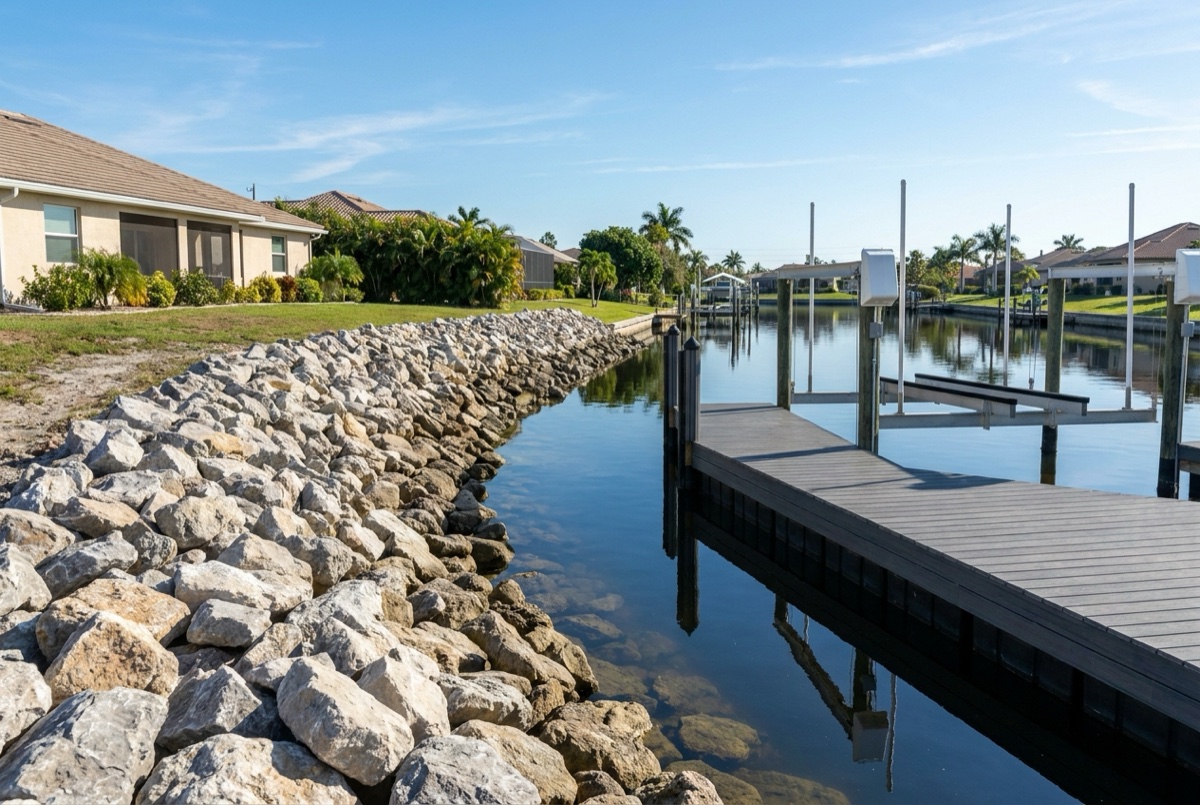
Rip-rap (sometimes called a revetment) is graded stone — typically limestone or granite, sized from a few inches up to large boulders — placed on a prepared slope from the top of your bank down into the water, usually over a filter fabric that keeps soil from washing out through the gaps. The rock is heavy enough that waves can’t move it, and the slope and voids between stones break up wave energy so it never gets a flat surface to hammer. Instead of resisting the water rigidly, rip-rap dissipates it.
That single difference — rigid vertical wall versus flexible sloped armor — drives every trade-off that follows.
How do cost, footprint, and lifespan compare?
Rip-rap is usually cheaper and longer-living per foot, but it needs far more horizontal space; a seawall costs more and has more parts to fail, but it holds your edge in a minimal footprint. Here’s the side-by-side.
| Factor | Rip-rap revetment | Concrete / vinyl seawall |
|---|---|---|
| Typical cost | Lower per foot, quoted free on-site | Higher; quoted free on-site |
| Footprint (waterward) | Sloped — reaches ~10+ ft into the water | Minimal — a near-vertical line |
| Lifespan | Long; no cap, panels, or tiebacks to fail | Decades, with more components that wear |
| Wave energy | Absorbs and dissipates it | Reflects it back into the basin |
| Edge / dockside depth | Sloped, shallow near shore | Clean vertical edge, deeper at the wall |
| Habitat | Rock voids create fish and crab habitat | Hard flat surface, limited habitat |
| Permitting | Often the smoother path in FL | More scrutiny on new vertical hardening |
| Neighbor impact | Gentle on adjacent shorelines | Can deflect wave energy next door |
A few of those lines deserve a closer look, because they’re where owners get surprised.
- Footprint is the deal-breaker or the deal-maker. Rip-rap’s low cost is real, but it’s only a bargain if you can afford to give up waterline. On a narrow canal where every foot of open water matters for turning a boat, that slope can be a non-starter.
- Lifespan favors simplicity. A seawall is a system — panels, cap, tiebacks, weep holes — and in salt water each component is a clock. Rip-rap has none of those parts. It settles and flexes rather than cracking, which is why a well-placed revetment ages so gracefully.
- Wave energy cuts both ways. A vertical wall reflects waves back into the canal, which can stir up chop and push energy toward your neighbor’s shoreline. Rip-rap soaks energy up, so it’s gentler on the whole basin.
Which shoreline do you actually have?
Pick by your water. Sloped rip-rap fits calm canals with room, lake and pond edges, and natural eroding banks; a vertical seawall fits tight lots, sharp lot lines, and anywhere you need deep water right at the edge. Match the tool to the shoreline and the decision usually makes itself.
Saltwater canals. This is most of Southwest Florida, and it’s where footprint rules. On a wide canal with room to spare, rip-rap is a strong, economical choice. On a narrow finger canal where you need a tight edge and clean depth to maneuver and dock, a vertical seawall usually wins — it gives you a hard line and deeper water right where your boat sits. Tidal swings, storm surge during the June-to-November hurricane season, and decades of UV and saltwater exposure all argue for doing it right the first time, whichever you choose.
Open water. Bayfront, riverfront, or lots fronting Charlotte Harbor or the wider Caloosahatchee take real, sustained wave energy and boat wakes. Here, rip-rap’s ability to absorb that energy is a genuine engineering advantage — there’s no flat face for waves to pound and no reflected chop bouncing back. A seawall can absolutely work in open water, but it has to be built heavier to take the load, and it’ll reflect energy rather than kill it. If you have the room, sloped armor rock is often the more resilient long-term answer on exposed frontage. Seawalls and shorelines in Estero, our shoreline page for that village, sets wall, rock and planted bank against the same frontage so you can see which one earns its place.
Lakes, ponds, and natural banks. On freshwater lake lots and gently eroding natural shorelines, rip-rap is frequently the obvious pick. It’s cheaper, it blends into a natural edge, the rock voids build fish and crab habitat, and regulators tend to prefer keeping a shoreline soft and sloped rather than hardening it vertically. If your back yard is slowly washing into the water, a revetment is usually the most cost-effective, lowest-maintenance fix there is.
When should you combine rip-rap and a seawall?
Often — putting rip-rap at the toe of an existing seawall is one of the best ways to stop scour and extend the wall’s life without replacing it. The two approaches work as a team, not just as alternatives.
The most common scenario in Southwest Florida is an aging seawall that’s still structurally sound on top but being undermined from below. Reflected waves dig a trench at the toe of the wall — the bottom edge where it meets the canal floor — and that scour slowly removes the support the wall is standing on. Left alone, it leads to leaning panels, a cracking cap, and eventually failure.
A band of armor rock placed along that toe fixes it directly. The rock:
- Absorbs the wave energy that’s doing the digging, so scour stops
- Physically buttresses the base of the wall against the water
- Adds years — often many — to a seawall you’d otherwise have to replace
- Costs a fraction of a full seawall replacement
So if you’re staring down a failing wall, replacing it isn’t the only path. Before you budget for a teardown, it’s worth having someone look at whether toe rock buys you a decade instead. (If your wall is showing other warning signs, our guide on the signs your seawall is failing is a good gut-check, and seawall repair vs. replacement walks through the bigger decision.)
Can you still have a dock and boat lift?
Yes — both options coexist with full boating access. With a seawall it’s straightforward; with rip-rap we drive pilings through and beyond the rock to reach deeper water, and your dock spans the slope.
A vertical seawall and a dock are natural partners — the wall gives you a clean edge to build off and deeper water right at the face, which makes lift placement simple. Plenty of owners run a boat lift right on the seawall with no separate dock at all.
Rip-rap takes a little more planning but works just as well. Because the slope creates shallow water near shore, we design the dock to span the rock on pilings driven out to where the water is deep enough to float and lift your boat. It’s routine work — rip-rap and a full custom dock with a lift go together on SW Florida shorelines all the time. The key is laying out the dock and the rock together from the start so the access, the depth, and the slope all line up.
So which one should you choose?
There’s no universal winner — there’s a right answer for your specific shoreline. If you have room and want the most economical, lowest-maintenance, most habitat-friendly protection, lean rip-rap, especially on open water, lakes, and natural banks. If you need a tight footprint, a clean edge, deep dockside water, or you’re working a narrow canal, lean seawall. And if you already own a wall that’s getting undermined, the smartest dollar is often rock at the toe rather than a full replacement.
The honest truth is that the choice comes down to details you can only see on-site: how wide your canal is, how much wave energy you take, where your lot lines fall, how deep the water sits, and how you use your waterfront. That’s exactly what we sort out for you.
Florida Lifts & Docks has built and protected Southwest Florida shorelines since 2008, with our own local crew — never subbed — and in-house permitting from start to finish. We’ll walk your waterfront, tell you straight which approach fits, and give you a real number. Explore your options on our rip-rap page and seawalls page, then book a free on-site estimate seven days a week across Cape Coral, Naples, Fort Myers, and the rest of the coast — call (239) 397-3400.