
Jet Ski Lift for a Narrow Canal: Seawall-Mount & Elevator Options
When your canal is too tight or your seawall is right there, a standard two-piling lift won't fit. Here are the seawall-mount and vertical elevator lifts that hang off the wall and keep the channel clear.
Key takeaways
- A seawall-mounted jet ski lift cantilevers off your existing seawall cap — no second row of pilings out in the channel — so it adds almost no footprint and keeps a narrow Cape Coral canal navigable.
- There are two main wall-hung designs: a cantilever lift that bolts to the seawall and swings/pivots the craft up, and a vertical "elevator" lift that raises the cradle straight up the face of the wall — best where you have zero width to spare.
- The whole load of the lifted ski transfers into your seawall cap and the wall behind it, so the wall has to be sound — a free on-site inspection confirms whether your cap can carry it or needs reinforcement first.
- A standalone PWC lift runs about $3,000–$5,000 installed; seawall and any reinforcement work is quoted free on-site since it depends entirely on your wall's condition.
- Reinforce or repair the wall first when you see cracking or spalling on the cap, a leaning or bulging wall, voids or sinkholes in the yard behind it, or rusted, exposed rebar.
If you own on a tight Cape Coral or Gulf-access canal, you know the problem: the water out front is barely wide enough for two boats to pass, and your seawall is right there at the edge of the yard. A standard jet ski lift wants a pair of pilings driven a few feet out into the water — and on a narrow canal, that’s a few feet you don’t have. Drive them anyway and you crowd the navigable channel, blow past your setback, or leave no room to maneuver the ski on and off.
There’s a clean answer almost nobody talks about: hang the lift on the seawall itself. A seawall-mounted jet ski lift cantilevers the craft up out of the water using the wall you already own — no second row of pilings out in the channel. Here’s how the two wall-hung designs work, what they ask of your seawall, and when the wall needs reinforcement first.
What is a seawall-mounted jet ski lift?
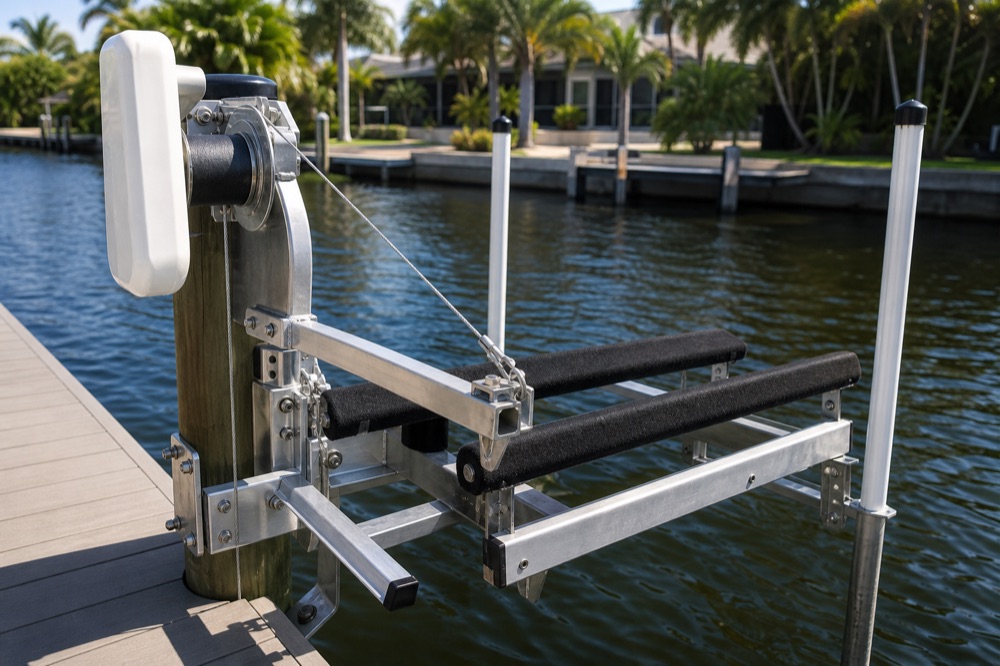
A seawall-mounted jet ski lift is a PWC lift that bolts to your existing seawall and lifts the craft straight off the wall, instead of standing on its own pilings out in the water. All the support comes from the wall and the ground behind it, so it adds almost no footprint into the canal.
A standard PWC lift — the kind in our add-a-jet-ski-lift guide — uses two legs on pilings set out in the water, and on a narrow canal those pilings are the whole problem: they eat the width you can’t spare. The seawall-mount design deletes them entirely. The frame attaches to the seawall cap and face, and the cradle reaches just far enough out to float the ski on and off.
What are the wall-mount and elevator options?
There are two ways to hang a lift on a seawall, and they trade cost for how little water they use — a cantilever that swings the ski up on an arm, or a vertical elevator that lifts it straight up the wall face.
- Cantilever seawall lift. The frame bolts to the wall and a pivoting arm swings the craft up and out of the water. It’s the simpler, more economical design, projecting a few feet off the face — far less than a piling lift, and usually well inside your setback.
- Vertical “elevator” lift. Instead of swinging out on an arm, this raises the cradle straight up the face of the wall, like an elevator car. The outward projection is minimal — often just the depth of the cradle and ski. Reach for it when you have zero width to give up.
Here’s how the two compare on a tight canal:
| Factor | Cantilever seawall lift | Vertical elevator lift |
|---|---|---|
| How it moves the ski | Pivots up and out on an arm | Lifts straight up the wall face |
| Channel width used | A few feet of projection | Almost none |
| Relative cost | Lower | Higher |
| Best for | Narrow canals with a little room | Truly tight canals / no width to spare |
| Pilings in the channel | None | None |
Both leave the channel clear — which keeps you legal on a SW Florida canal, where the navigable width has to stay open for boats that share it and most jurisdictions cap how far you can project from your property line.
How much load does it put on the seawall?
A wall-mounted lift transfers the entire weight of the lifted ski — plus the snatch loads from wind and wake — into your seawall cap and the wall behind it. The wall becomes the foundation, so it has to be sound.
A loaded jet ski isn’t heavy compared to a boat, which is part of why wall-mount works so well for PWCs. But the load isn’t just static — every wake and summer storm makes the cradled ski tug and jerk on the mounting points, working on the cap over time. On a healthy concrete or vinyl wall, that’s no problem; on a tired one, it accelerates whatever was already going wrong. That’s why this is never a “just bolt it on” job for us — we read the wall first.
When does the seawall need reinforcement first?
The wall needs repair or reinforcement before a lift goes on whenever it shows signs it can’t carry the load. None of these mean you can’t have a lift — they just mean the footing gets fixed first. Watch for:
- Cracking or spalling on the seawall cap. The cap is exactly where the lift bolts on, so chunks breaking loose or wide cracks are a hard stop until it’s repaired.
- A leaning, bowing, or bulging wall. A wall that’s already tipping is telling you the soil behind it is pushing and the tiebacks may be failing — not something to load further. (More in signs your seawall is failing.)
- Voids, soft spots, or a sinkhole in the yard behind the wall — soil washing out through the wall, undermining the ground the lift relies on.
- Rusted, exposed rebar or crumbling concrete. In our salt air, exposed steel corrodes and expands, breaking the concrete apart from the inside.
If any of that turns up, we’ll tell you straight whether it’s a targeted repair or a full replacement — and we can do that work and the lift as one coordinated project.
What does it cost, and what’s the install like?
A standalone PWC lift typically runs $3,000–$5,000 installed in Southwest Florida. Any seawall reinforcement or repair is quoted free on-site, because the number depends entirely on what your wall needs — a sound wall adds nothing.
Once the wall checks out, mounting the lift is usually a quick job. Everything we hang on a seawall is built for the Gulf coast, because the salt, sun, and storm surge here punish anything that isn’t:
- Marine-grade aluminum frame that won’t rust through
- 316 stainless cable, bolts, and hardware rated for salt air
- Sealed marine motors on powered units, set on corrosion-resistant anchors driven into the cap
That spec is the difference between a lift that rides out hurricane seasons (June to November) for decades and one that seizes the first summer.
Get the right lift for your narrow canal
A tight canal or a seawall right at the water’s edge isn’t a reason to give up on getting your ski out of the salt — it’s just a reason to mount the lift on the wall instead of in the water. We’ve solved exactly this problem across the coast since 2008, with our own local crew and in-house permitting, never subbed out, and we’ll tell you honestly whether your seawall can carry a lift today or needs a little work first.
Let us take a quick look. We give free on-site estimates seven days a week across Cape Coral, Fort Myers, Naples, and the rest of Southwest Florida. See everything we build on our jet ski lifts page, explore our seawalls, or call (239) 397-3400.