
Solar vs Wired Fish Lights: Do Solar Dock Lights Actually Work?
An honest look at solar fish lights versus a wired low-voltage system for SW Florida — why solar is fine for a little glow but can't stack bait through the late-night bite.
Key takeaways
- Solar fish lights win on price and zero wiring, but a wired low-voltage system wins on brightness, all-night runtime, cloudy-day reliability, and the power to drive a true bright underwater fixture.
- Solar's biggest fishing weakness is runtime — most units dim or quit before sunrise, fading right through the late-night and pre-dawn bite when snook and trout feed hardest.
- A small solar panel can't deliver the wattage a bright submerged fish light needs all night; for serious bait stacking you need a transformer feeding low-voltage cable.
- Honest verdict: solar is fine for accent glow, a renter, or a seasonal dock; if you actually want to stack bait night after night, go wired.
- A wired low-voltage system can run your above-water dock lights and underwater fish lights on one transformer, bright and consistent every night.
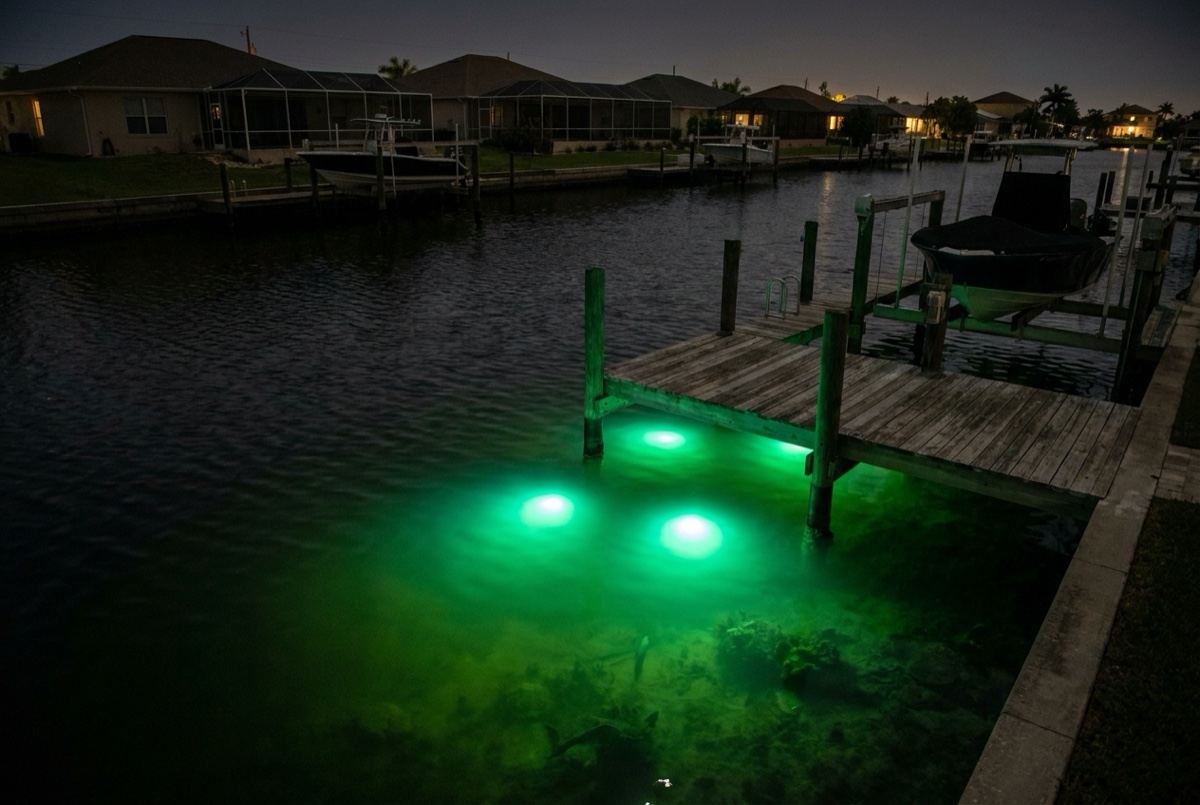
If you’ve watched the videos — bait swirling in a green cone of light off a Cape Coral seawall, a snook easing in to pick them off — you already know the appeal of a fish light. The next question is how to power it. Walk any canal in Southwest Florida and you’ll see both answers: little solar lights stuck to piling caps, and bright wired fixtures glowing steady under the surface.
They are not the same tool, and the honest answer to “do solar dock lights actually work?” is: it depends what you mean by work. For a soft glow, sure. For stacking bait through the late-night bite, that’s a different bar — and it’s where the two paths split hard.
What’s the difference between solar and wired fish lights?
A solar fish light is self-contained: a small panel charges a battery by day, and an LED runs at night with no wiring. A wired fish light is a brighter fixture fed by low-voltage cable from a transformer on shore that steps household power down to a safe 12–24 volts.
The core term to know is fish attraction — lighting the water bright enough, long enough, to draw a food chain. Light pulls plankton and baitfish, the bait stacks in the glow, and snook, trout, snapper, and tarpon move in to feed. The whole point is keeping that show running through the hours fish actually bite. That’s the lens for everything below.
Do solar fish lights actually work for fishing?
For real fishing, only sort of. A good solar light will draw some bait and minnows on a clear night, but it rarely produces the bright, deep, all-night cone that stacks bait and holds predators the way Southwest Florida anglers picture.
Two limits hold solar back as a fishing tool:
- It’s dimmer. A small panel and battery store only so much energy in a day, so output is capped. A dim light throws a small, shallow glow that draws far fewer bait than a bright submerged fixture punching a wide cone into the water column.
- It fades during the bite. This is the big one — covered next.
For a little ambiance, solar can be fun. For someone who bought a waterfront home partly to fish the dock, it usually disappoints.
Will a solar fish light stay bright through the late-night bite?
Usually not, and this is solar’s biggest weakness for fishing. Most solar lights dim or shut off well before sunrise — fading right through the late-night and pre-dawn hours when snook, trout, and tarpon feed hardest under a light.
A solar battery is a fixed fuel tank. Run it bright and it empties fast; stretch it through the night and it’s dim the whole time. Either way, the prime window — that quiet stretch from after midnight to first light when the dock bite often turns on — is exactly when a solar light is running on fumes. A wired fixture is just as bright at 4 a.m. as it was at dusk, because the transformer feeds it steady power every night. When the goal is to fish a light, consistent all-night output is the whole game, and that’s the one thing a battery can’t promise.
How does cloudy weather affect solar fish lights?
It hits them hard. After a string of summer storms or several gray days, the panel never gets a full charge, so the light is dimmer and runs shorter — sometimes barely lighting at all.
That’s a real problem on our coast. Southwest Florida’s hurricane season runs June through November, and even outside named storms our summer afternoons bring daily thunderheads off the Gulf. Those are also some of the best fishing months — a light that quits after three cloudy days in July is failing you exactly when the water’s warm and the snook are thick. Shade makes it worse: under a boathouse roof, a tiki hut, mangroves, or on a north-facing seawall, a solar panel barely charges at all. A wired system doesn’t care whether the sun came out — it’s full brightness every night.
Can a solar light power a real underwater fish light?
Generally, no — and for a lot of owners that settles it. A bright submerged fish light pulls far more power than a small solar panel and battery can deliver all night long.
Solar can handle a small surface or shallow LED. But a true underwater fixture — the kind that lights the water column and stacks bait — is power-hungry, and feeding it consistently overnight is exactly what a transformer is built to do and a little solar cell is not. If you want bright fish lights and bright above-water dock lights, a single low-voltage transformer can run both on one clean system.
Solar vs wired fish lights: side-by-side
| Factor | Solar fish light | Wired low-voltage |
|---|---|---|
| Up-front cost | Lowest | Higher (install + transformer) |
| Wiring required | None | Yes |
| Brightness | Limited | Strong, deep cone |
| Runtime through the night | Fades, often quits early | Full brightness till you shut it off |
| After cloudy days | Dim or dead | Unaffected |
| Shaded / covered dock | Charges poorly | Unaffected |
| Drives a bright underwater fixture | No | Yes |
| Bait-stacking power | Weak | Strong |
| Best for | Accent glow, renter, seasonal | Serious fishing, permanent dock |
So which should you actually choose?
Here’s the fair verdict. If you want a little accent glow on the piling caps, you rent or your dock is seasonal, or you just want to test whether light draws anything, solar is a reasonable, low-cost start. Buy good ones, keep the panel clean of salt film, and accept that the show ends early.
If this is your home and you genuinely want to stack bait and fish the dock night after night, go wired. A low-voltage system is brighter, runs all night, shrugs off cloudy stretches and shade, and can power a true underwater fixture — the difference between a faint glow and a wall of bait with snook hunting the edges. It costs more up front and needs a proper marine install, but it’s the system still lighting up the water in five years. Cost is always quoted free on-site, since it depends on fixture count, seawall length, and the run back to power. (For picking a fixture, see what to look for in saltwater fish lights; for the install, how to power and wire fish lights.)
A wired fish light is marine-electrical work — water, salt, and electricity together — which is why we build it the way we build everything, with 316 stainless hardware and sealed, marine-rated connections that survive the Gulf coast.
Want a fish light that actually does the job? We design and install underwater fish lights and full dock lighting with our own local crew — never subbed, in-house permitting — and give free on-site estimates seven days a week across Cape Coral, Naples, Fort Myers, and the rest of Southwest Florida. Call (239) 397-3400 and let’s light up the water.