
Solar vs Low-Voltage Dock Lights in Florida: Which Actually Holds Up?
A fair, no-hype look at solar/battery dock lights versus a wired low-voltage system on the salty SW Florida coast — and which one survives the sun, salt, and storms.
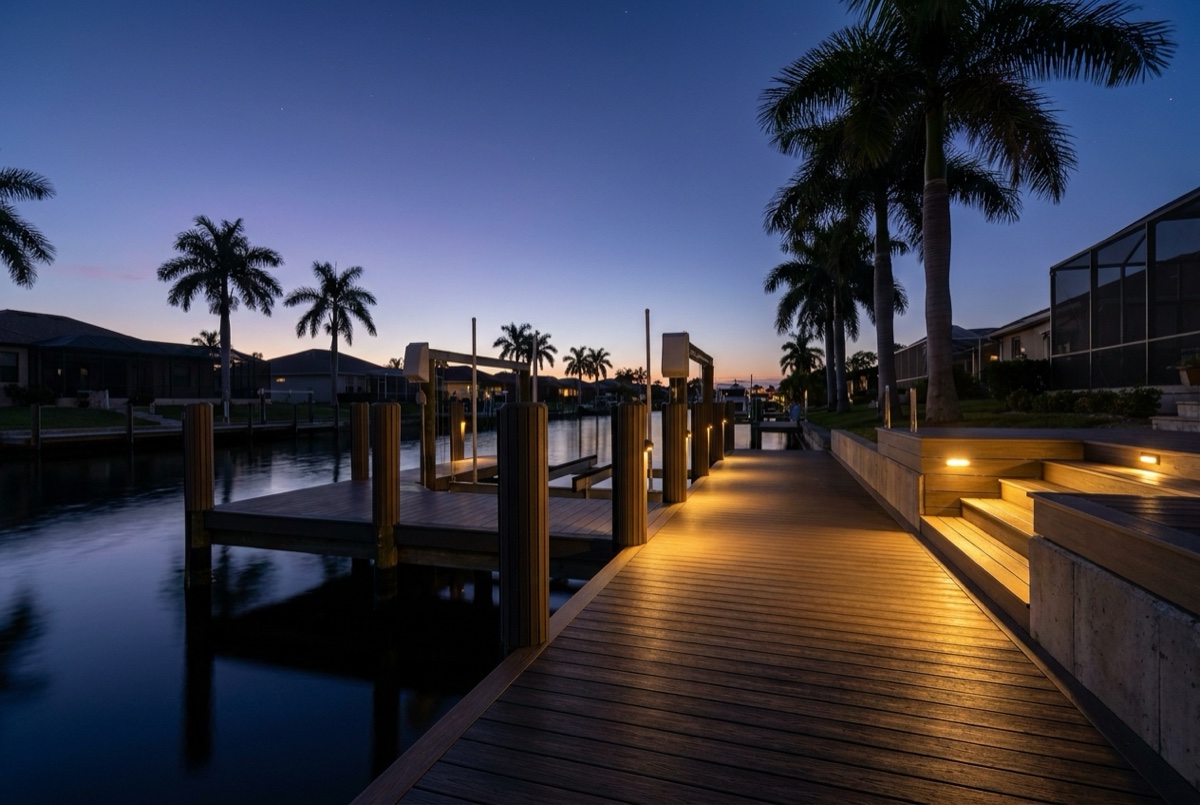
Key takeaways
- Solar dock lights win on cost and zero wiring; a wired low-voltage system wins on brightness, reliability, dusk timers/app control, and the ability to run underwater fish lights.
- SW Florida's salt air, year-round UV, and long hot summers degrade solar panels and batteries faster than the marketing suggests.
- Solar struggles on shaded or covered docks — boathouses, tiki huts, mangroves — because the panel never gets a full charge.
- Honest verdict: solar suits a renter, a seasonal dock, or a quick fix; a permanent SW Florida dock wants low-voltage.
- A wired low-voltage system is the only path to bright, reliable above-water lighting plus underwater fish lights on one transformer.
Good dock lighting does two jobs at once: it makes your dock safe to walk after dark, and it makes coming home by water at night feel effortless. The hard part isn’t deciding that you want lights — it’s choosing how to power them. On a Southwest Florida canal you’ll see both styles in the same neighborhood: little solar lights stuck to the piling caps, and crisp, even low-voltage runs glowing the same color from end to end.
They are not the same product. One is cheap and instant; the other is brighter, smarter, and built to last in salt. Here’s an honest comparison — no hype — so you can pick the right one for your dock.
What’s the difference between solar and low-voltage dock lights?
Solar dock lights are self-contained: each fixture has a small panel, a rechargeable battery, and an LED, so it charges by day and runs at night with no wiring. Low-voltage dock lights are wired fixtures fed by a single transformer that steps household power down to a safe 12–24 volts, then distributes it along the dock.
In plain terms: solar is independent and off-grid; low-voltage is connected and powered. That one difference drives almost everything else — brightness, reliability, control, and how long the system survives the Gulf coast.
Which is brighter and more reliable?
Low-voltage wins on both, and it isn’t close. A transformer delivers steady power all night, every night, so the lights are as bright at 4 a.m. as they were at dusk.
Solar brightness is capped by what a small panel and battery can store in a day. On a clear winter day with a sunny, unshaded dock, decent solar lights look fine for a few hours. But after a string of summer storms, on a shaded or covered dock, or late in the night, solar fades — exactly when you’re trying to dock the boat or walk out for a midnight line check. Low-voltage doesn’t care about cloud cover or moon phase. It also lets you run a dusk-to-dawn photocell, a timer, or app control so the dock lights itself on schedule.
How do solar and low-voltage hold up in SW Florida salt and heat?
This is where most solar dock lights quietly fail. Our environment is unusually hard on the exact parts solar depends on.
- Battery degradation in the heat. Summer heat in Cape Coral, Fort Myers, and Naples runs hot for months, and heat is brutal on the small lithium or NiMH cells inside solar fixtures. You’ll often see dimmer light and shorter run-times within a season or two, then outright battery replacement.
- Salt-corroded panels and contacts. Salt air films over the panel and creeps into seams and battery contacts. A hazed or corroded panel charges poorly, so the light dies sooner each night.
- UV breakdown. Year-round Florida sun chalks and clouds the plastic lenses and panel covers that solar lights are made of, cutting both charging and output over time.
- Storm season. From June through November, surge and wind tear small stick-on solar fixtures off piling caps and railings. A wired fixture mounted into the structure rides it out far better.
A properly built low-voltage system uses marine-rated fixtures and sealed connections designed for this coast — the same philosophy behind everything we install on a custom dock, from 316 stainless hardware to capped composite decking.
Can solar dock lights power underwater fish lights?
No — and for a lot of Southwest Florida owners, that’s the deciding factor. Underwater fish lights draw far more power than a small solar panel and battery can deliver all night.
If you want bait stacking and snook hunting the dock after dark, you need a wired feed. A low-voltage transformer can drive your above-water dock lights and your underwater fish lights together, on one clean system. Solar simply can’t keep a bright submerged light lit through the night. (We break the underwater side down further in our solar vs wired fish lights guide.)
Solar vs low-voltage dock lights: side-by-side
| Factor | Solar / battery | Wired low-voltage |
|---|---|---|
| Up-front cost | Lowest | Higher (install + transformer) |
| Wiring required | None | Yes |
| Brightness | Limited, fades late | Strong, steady all night |
| Reliability | Weather/charge dependent | Consistent every night |
| Shaded or covered dock | Charges poorly | Unaffected |
| Salt + heat longevity | Panels/batteries degrade | Built to last with marine parts |
| Timer / app / dusk control | Basic at best | Full control |
| Runs underwater fish lights | No | Yes |
| Best for | Renter, seasonal, quick fix | Permanent SW FL dock |
So which should you actually choose?
Here’s the fair verdict. If you rent, your dock is seasonal, or you just want a little glow on the piling caps for a season, solar is a reasonable, low-cost choice — buy good ones, expect to baby them, and plan to replace batteries.
If this is your home and you want lighting that’s bright every night, survives the salt and the sun, runs on a dusk timer, and can power fish lights, go low-voltage. It costs more up front and it needs a proper install, but on a permanent Southwest Florida dock it’s the system that’s still working in five years. We size the transformer, plan the runs, and weatherproof every connection for life on the water — and exact cost is always quoted free on-site because it depends on dock length, fixture count, and the run to your panel. (For what drives that number, see our dock lighting cost guide and how many dock lights you need.)
Want lighting that holds up to the Gulf coast? We design and install salt-tough dock lighting with our own local crew — never subbed — and give free on-site estimates seven days a week across Cape Coral, Naples, Fort Myers, and the rest of Southwest Florida. Call (239) 397-3400.