
Tiki Hut vs. Pergola vs. Pavilion: The Best Backyard Shade Structure for Florida
An honest comparison of tiki huts, pergolas, and pavilions for Southwest Florida — which one actually keeps you cool at 2 p.m. in July, and what each costs to live with.
Key takeaways
- For full, midday shade in Southwest Florida, a tiki hut wins — its solid layered-thatch roof blocks the sun completely while open sides let Gulf breezes move heat out.
- A pergola gives filtered light and looks great in dry climates, but it provides almost no real shade at 2 p.m. and its slats and any wood members fight constant humidity, mildew, and UV here.
- A pavilion's solid roof shades as well as a tiki hut but costs more, runs hotter underneath without the same airflow, and reads as generic rather than coastal.
- All three need a permit in Florida and proper engineering for hurricane season (June–November); a cheaply framed structure of any kind becomes debris in a blow.
- A tiki hut's main ongoing cost is periodic re-thatch on natural palm; synthetic thatch skips that and carries a fire rating.
If you have a Southwest Florida backyard or a dock on the water, you know the problem: the sun is relentless, the afternoon rain shows up like clockwork, and from June through November you are watching the tropics. The fix is a shade structure — but which one? The three options every homeowner weighs are a tiki hut, a pergola, and a pavilion, and they are not interchangeable. One keeps you genuinely cool at 2 p.m. in July; the other two are compromises in our climate.
Here is a straight, honest comparison — what each one is, what it costs to live with, and which actually works on the Gulf coast — so you spend your money on the structure you will use, not the one that looks good in a catalog from a drier climate.
What’s the difference between a tiki hut, pergola, and pavilion?
The short version: a tiki hut and a pavilion both have solid roofs that block the sun, while a pergola has an open, slatted roof that only filters it. That single difference decides almost everything in Florida heat.
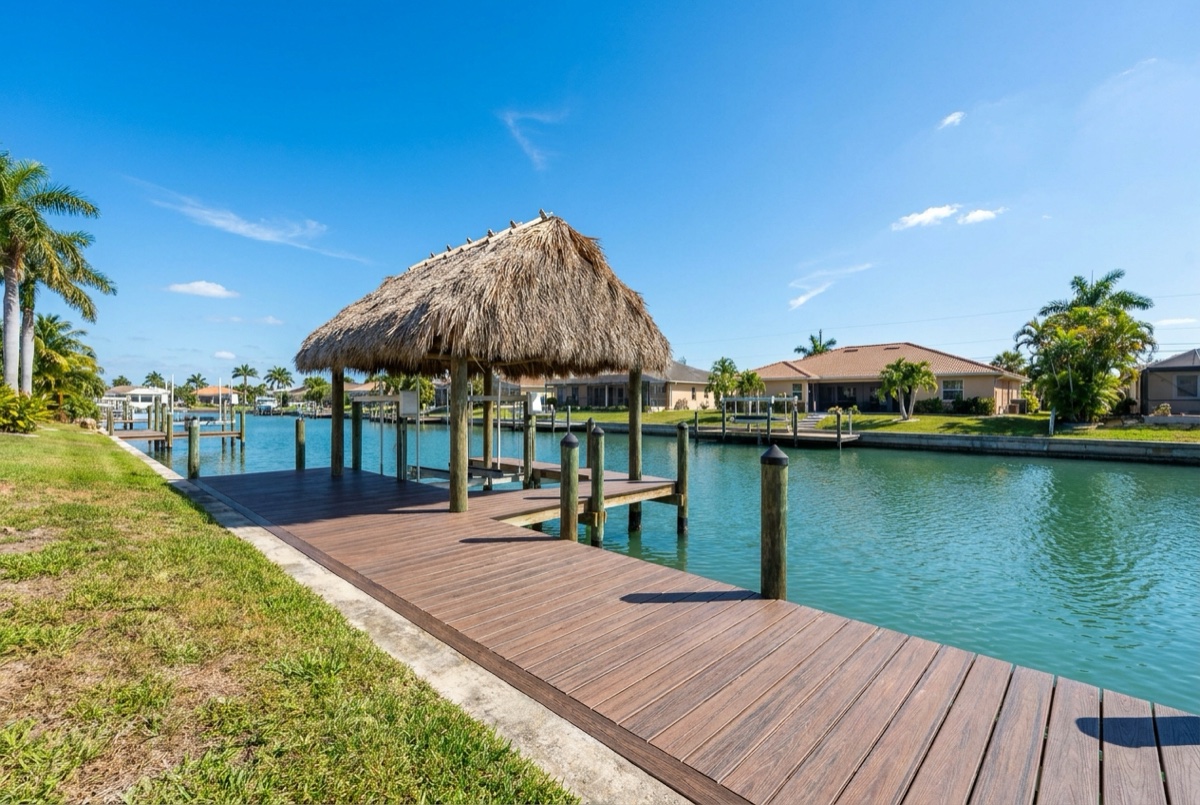
- Tiki hut. An open-sided structure on posts with a layered, thatched roof — the Florida descendant of the Seminole “chickee.” No walls, full roof, built for exactly this climate.
- Pergola. A framework of posts holding up open rafters and slats, designed to filter sunlight and support climbing plants — not to create full shade or block rain.
- Pavilion. A freestanding structure with a solid, pitched roof (often shingle or metal) on posts, sometimes with partial walls — think park picnic shelter or roofed outdoor room.
Define the goal first and the choice gets easy. If you just want to dapple light over a walkway, a pergola does that. If you want to sit outside at the hottest part of a Florida day and stay cool and dry, you want a solid roof.
Which keeps you coolest at 2 p.m. in July?
The tiki hut. Its solid thatch roof blocks the sun completely, and because the sides are open, hot air rises out and Gulf breezes pass straight through — so you get full shade and airflow at once. Thatch also breathes instead of radiating heat down the way a hot shingle or metal deck can.
That combination is why the chickee design has survived here for generations. A pergola fails this test outright: at midday the sun is nearly overhead and pours between the slats, so you sit in a striped pattern of full sun. A pavilion passes — a solid roof is a solid roof — but a closed roof deck and any partial walls can trap heat and feel stuffier than an open hut on a still day. For Southwest Florida, “shade plus airflow” beats “shade alone.”
How do they compare on shade, airflow, cost, and upkeep?
Here is the honest side-by-side for our climate. None of these is a bad structure — they are built for different jobs.
| Factor | Tiki hut | Pergola | Pavilion |
|---|---|---|---|
| Midday shade | Full | Minimal (filtered) | Full |
| Airflow | Excellent (open sides) | Excellent | Good to fair |
| Rain cover | Yes | No | Yes |
| Coastal/tropical look | Strong | Out of place in FL | Generic |
| Upkeep in FL humidity | Periodic re-thatch (natural) | High (slats mildew, need sealing) | Low (esp. metal roof) |
| Relative cost | Mid | Lower to mid | Higher |
| Can it go over a dock? | Yes, engineered | Rarely worth it | Yes, at higher cost |
The line that surprises people is the pergola’s: it is often the cheapest to build but the most upkeep-heavy to own here, because every exposed slat and wood member collects mildew, takes UV, and needs sealing in our humidity and salt air. It also reads as a formal-garden feature that looks out of place on a saltwater canal — and it does not give you real shade when you most need it.
Which holds up best through hurricane season?
Whichever one is engineered and anchored correctly — how it is built matters more than the type. All three can survive a Florida storm season, and all three become debris if they are framed cheaply.
Hurricane season runs June through November, and on the water you also have storm surge, tide swings, salt air, and marine borers working on the canal bottom. That is why a structure on a dock or seawall needs a different spec than a backyard build:
- Pilings driven to the right depth for your canal bottom, not posts in a shallow footing
- Marine-grade aluminum and CCA-treated framing that resists rot and corrosion
- 316 stainless hardware that will not bleed rust down your posts
- Engineering for wind and surge over open water, where nothing breaks the gusts
A tiki hut handles all of this when built right, and if a natural-thatch roof takes damage it is often a quick re-thatch rather than a full rebuild. The same marine engineering applies to a pavilion over the water; it just costs more, and a pergola over the water rarely earns its keep. Our tiki hut hurricane prep and repair guide covers what we build to and what to do after a blow.
What does each cost to build and maintain?
Up front, a pergola is usually cheapest, a tiki hut lands in the middle, and a pavilion is the most expensive — but upkeep can flip that order over time. We quote shade structures free, on-site, because span, site, and what you put underneath move the number more than type alone. The big drivers:
- Footprint and roof type. Square footage is the biggest factor; on a tiki hut, natural palm is cheaper up front but needs periodic re-thatch, while synthetic costs more to install, skips that cycle, and carries a fire rating (palm vs. synthetic thatch).
- Where it goes. A backyard build on solid ground is the baseline; a dock-top or seawall-edge structure costs more for the marine spec.
- Add-ons and permits. A built-in bar, fans and electrical, finished seating, and salt-rated dock lighting each add meaningfully. All three generally require a permit (do you need a permit for a tiki hut).
For real tiki-hut numbers by size, see our tiki hut cost guide.
So which should you choose?
For true midday shade with a coastal look and breezes moving through it, build a tiki hut — for the Southwest Florida climate it is the most complete answer. Choose a pavilion if you want a solid, enclosed roof line to match your home’s architecture and do not mind paying more, and choose a pergola only as a light garden feature, knowing it will not keep you cool or dry when it counts.
We have built on these canals since 2008 with our own local crew — never subbed out — hold a 5.0-star rating on Google, and handle the entire permitting process in-house across the 18 cities we serve. Ready to figure out the right structure for your space? We give free on-site estimates seven days a week across Cape Coral, Naples, Fort Myers, and the rest of the coast. See everything we build on our tiki huts page, explore a matching custom dock build, or call (239) 397-3400 and we’ll tell you exactly what it’ll take.