
Dock, Lift & Seawall Inspection Checklist for SW Florida Owners
The do-it-twice-a-year master checklist that ties your dock, boat lift, pilings, and seawall together — what to look for, what it means, and when to call a pro.
Key takeaways
- Inspect your dock, lift, pilings, and seawall twice a year — once in spring before hurricane season and once after the season ends in late fall.
- A single broken cable strand, a leaning piling, or a long crack in the seawall cap means stop using the structure and call a pro before it fails.
- Soft or spongy decking, rust-streaked fasteners, and washed-out soil behind a seawall are all early signs of damage that's cheaper to catch now than after a storm.
- Most issues you find are simple repairs if caught early; the same issues ignored are how a dock collapses or a boat drops in a storm.
If you own a waterfront home in Southwest Florida, four structures stand between your property and the water: your dock, your boat lift, the pilings that hold both up, and the seawall that keeps your yard from sliding into the canal. They live in the harshest environment a structure can face — salt water, year-round sun, swinging tides, marine borers, and a hurricane season that runs from June through November. Damage here doesn’t announce itself. It builds quietly until a board gives way, a cable snaps, or a seawall bulges out after the first big surge of the season.
This is the one page to run twice a year. A dock and seawall inspection is a top-to-bottom visual check of all four structures, component by component, so you catch the small problems while they’re still cheap to fix. The best time to do it is in spring, before hurricane season, with a second look in late fall after the storms have passed. Below is the full checklist, organized by structure, with a plain answer under each item: what you’re looking for, and what it means if you find it.
When and how should you inspect your waterfront?
Inspect twice a year — once in spring before hurricane season starts in June, and once in late fall after it ends. Pick a low-tide day so more of your pilings and seawall base sit exposed, bring your phone for photos, and work through one structure at a time.
A good inspection doesn’t take long, but it does take attention. Walk slowly. Touch things. The goal isn’t to admire your dock — it’s to diagnose it. Photograph anything that looks off so you can compare it season to season; a crack that grows or a lean that worsens between inspections tells you something is actively failing.
A few ground rules before you start:
- Go at low tide so the waterline section of pilings and seawall is visible.
- Bring a flashlight to look under the dock and into shadowed areas.
- Tap and push — soft wood, loose hardware, and movement reveal themselves to touch.
- Photograph everything questionable and date it for next time.
- Don’t go in or under the water to inspect; leave anything below the surface to a pro.
How do you inspect the dock decking and frame?
Walk the entire dock slowly and feel for any board that’s soft, spongy, or bouncy underfoot, then look closely at the fasteners and the joists below. Soft decking and rotted joists are the two findings that mean keep weight off that section until it’s repaired.
Your dock takes constant UV, foot traffic, and salt spray. Capped composite like TimberTech or Trex holds up far better than wood here, but every dock has fasteners and a frame that need checking. Go board by board.
- Decking surface — Look for splitting, cupping, cracking, or soft spots. What it means: surface wear is cosmetic; a board that flexes or feels spongy is structurally gone and needs replacing.
- Fasteners and screws — Look for rust streaks, screws backing out, or popped heads. What it means: on a salt-water dock, fasteners that aren’t stainless corrode first; rust-bled fasteners are an early warning the connections are weakening.
- Joists and stringers — Use your flashlight underneath. Look for rot, splitting, sagging, or daylight where boards have pulled away from the frame. What it means: a rotted or sagging joist is what soft decking is usually sitting on, and it’s a structural fix, not a board swap.
- Ledger and connections — Check where the dock meets the seawall or land for loose bolts, rust, or separation. What it means: a failing connection here can drop a whole section.
If you find a handful of bad boards, that’s a straightforward redecking job. If the frame underneath is rotted, that’s where a full dock repair comes in.
How do you inspect a boat lift?
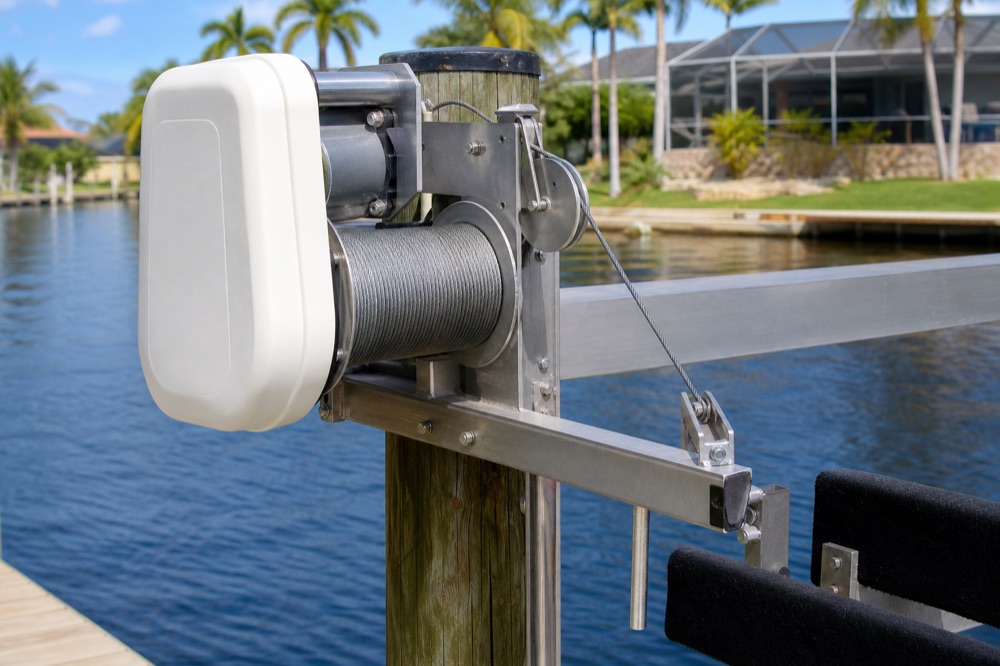
Check the cables for fraying and rust, look over the bunks and cradle, run the motor through a full cycle, and make sure every anchor bolt is tight. A single broken cable strand means stop using the lift immediately and replace the cable.
Your lift is the most mechanical thing on your waterfront, and it carries your most expensive toy. The 316 stainless cables, sealed marine motors, and marine-grade aluminum we install are built to resist salt — but every lift needs eyes on it.
- Cables — Run your hand and eye along the full length. Look for fraying, broken strands (“fishhooks”), kinks, flat spots, and rust streaking. What it means: one broken strand and the cable is on its way out — this is a hard stop, not a “watch it.”
- Bunks and carpet — Check for worn padding, exposed bolts, and rot in the wood underneath. What it means: worn bunks let the hull rest on bare metal and throw off how the boat sits.
- Cradle and beams — Look for bending, cracks, or a cradle that racks to one side when it lifts. What it means: an uneven lift usually points to a stretched cable or a binding pulley.
- Motor and gears — Run a full up-and-down cycle empty. Listen for grinding, straining, or humming-without-moving. What it means: any new noise or slow operation signals a worn cable, a failing gear, or water in the motor.
- Anchor bolts and brackets — Check every bolt tying the lift to the pilings. What it means: loose or rust-bled anchor bolts are how a lift works free of its mounts under load.
Our full routine for keeping a lift healthy between inspections is in the salt-water boat lift maintenance guide. If the inspection turns up cable wear or a motor problem, that’s a boat lift service call.
How do you check pilings for damage?
Look at every piling for cracks, splitting, lean, and marine borer damage, paying closest attention to the section at and just below the waterline. A piling that’s leaning, badly cracked, or eaten through near the waterline can no longer carry its load and needs professional attention.
Pilings are the foundation for everything — dock and lift both. In Southwest Florida’s salt water, the enemy below the surface is marine borers, tiny organisms that hollow out wood pilings from the inside, often leaving the surface looking fine while the core is destroyed. The waterline zone takes the worst of it.
- Cracks and checks — Distinguish surface “checking” (normal in wood) from deep structural cracks. What it means: a deep crack, especially one that runs with a lean, signals real loss of strength.
- Lean or movement — Sight down the row; any piling out of line with its neighbors has moved. What it means: a new lean after a storm is a structural red flag — stop loading it.
- Marine borer damage — Check the waterline for a pinched, hourglass-shaped narrowing or a spongy, riddled surface. What it means: borer damage at the waterline is the most common reason a wood piling fails here.
- Wraps and connections — If pilings are wrapped, check the wrap is intact and sealed at the top. What it means: a torn or unsealed wrap lets borers right back in.
Wood, concrete, and composite pilings each age differently, and a single compromised piling can put a whole dock at risk. Replacement and reinforcement are quoted free on-site; learn what we install on our pilings page.
How do you inspect a seawall?
Scan the cap and face for cracks, check for rust stains bleeding through the concrete, make sure the weep holes are clear, and look for soil washing out or the yard sinking behind the wall. Cracks, rust stains, clogged weep holes, and lost soil are the four signs a seawall is starting to fail.
The seawall is the most expensive structure to replace and the one most owners ignore until it’s too late. It holds back tons of soil and water pressure every single day, and storm surge multiplies that load. Most seawall failures give you warning signs first — if you know where to look.
- Cracks in the cap and panels — Hairline cracks are common; long, widening, or stair-step cracks are not. What it means: a growing crack is structural movement, often from pressure behind the wall.
- Rust stains — Brown or orange stains bleeding through the concrete. What it means: the steel reinforcement inside is corroding and expanding, which cracks the concrete from within.
- Clogged weep holes — The small drains along the wall should let water seep through. What it means: clogged weep holes trap water pressure behind the wall and push it outward — a leading cause of failure.
- Soil loss and sinkholes — Look for the yard sinking, dips, or voids near the wall, especially after rain. What it means: soil escaping through gaps in the wall means the wall is leaking and the ground behind it is going into the canal.
- Tieback and lean — A wall tilting toward the water, or bulging panels. What it means: the hidden tieback anchors that hold the top of the wall back may be failing.
These signs are covered in depth in our guide on the signs your seawall is failing, and whether a finding means repair or full replacement is broken down in seawall repair vs. replacement. The wall itself is on our seawalls page.
Quick-reference inspection table
Here’s the whole checklist at a glance — what to look at on each structure, and the findings that mean call a professional before hurricane season.
| Structure | What to look at | Red flag — call a pro |
|---|---|---|
| Dock decking & frame | Soft/spongy boards, splitting, fasteners, joists | Flexing decking, rotted or sagging joist, failing ledger connection |
| Boat lift | Cables, bunks, cradle, motor, anchor bolts | A single broken cable strand, uneven lift, grinding motor, loose anchor bolts |
| Pilings | Cracks, lean, marine borers at waterline | New lean, deep crack, hourglass borer damage at the waterline |
| Seawall | Cap/panel cracks, rust stains, weep holes, soil | Widening or stair-step crack, clogged weep holes, soil loss, bulging or leaning wall |
What do you do with what you find?
Fix the small stuff yourself, log everything with a photo, and call a professional for any structural finding — and do it before hurricane season, not after. A worn board or a clogged weep hole is a quick job today; the same issue ignored is how a dock collapses or a seawall blows out in the first storm of the year.
Most of what a twice-yearly inspection turns up is minor: a few boards, a rusted fastener, a weep hole to clear, a cable due for replacement. Handled on your schedule, these are small, predictable costs. The findings that move to the top of the list are the structural ones — a leaning piling, a moving seawall, a frayed cable — because those are the failures that turn a routine repair into an insurance claim. Getting your structures sound before June is the single best storm prep you can do; our hurricane prep guide for docks, lifts, and seawalls covers the rest. What this same walk looks like when you are buying rather than maintaining is buying waterfront in Estero, where the four structures get checked and then the permit record does.
When your inspection turns up something you’d rather have a pro look at — or you’d simply like a trained eye on all four structures before the season — that’s what we’re here for. Florida Lifts & Docks has rebuilt and repaired waterfronts across Southwest Florida since 2008 with our own local crew, never subbed out, and we handle permitting in-house. See everything we do on our dock repair page, get a free on-site estimate seven days a week in Cape Coral, Fort Myers, Naples, and the rest of the coast, or call (239) 397-3400.