
Floating Dock Hurricane Playbook: Before, During & After the Storm
Floating docks ride water up, which is a strength until it isn't. How guide piles, connectors, and gangways behave in a storm, and what to clear off before one arrives.
Key takeaways
- A floating dock is designed to rise and fall with the water, the storm risk isn't the rise itself, it's what happens if the water outruns the guide piles or the connections give way.
- Guide piles, pile rollers or collars, and the hardware tying sections together are the whole ballgame. That inspection belongs in the spring.
- Anything on the deck that isn't bolted down comes off: kayaks, paddleboards, ladders, furniture, dock boxes, hoses, and gear.
- The gangway is the piece most owners forget: check how it's attached at both ends and whether it can travel as the float rises.
- After the storm, look before you step. A float can look level and still be riding on failed hardware.
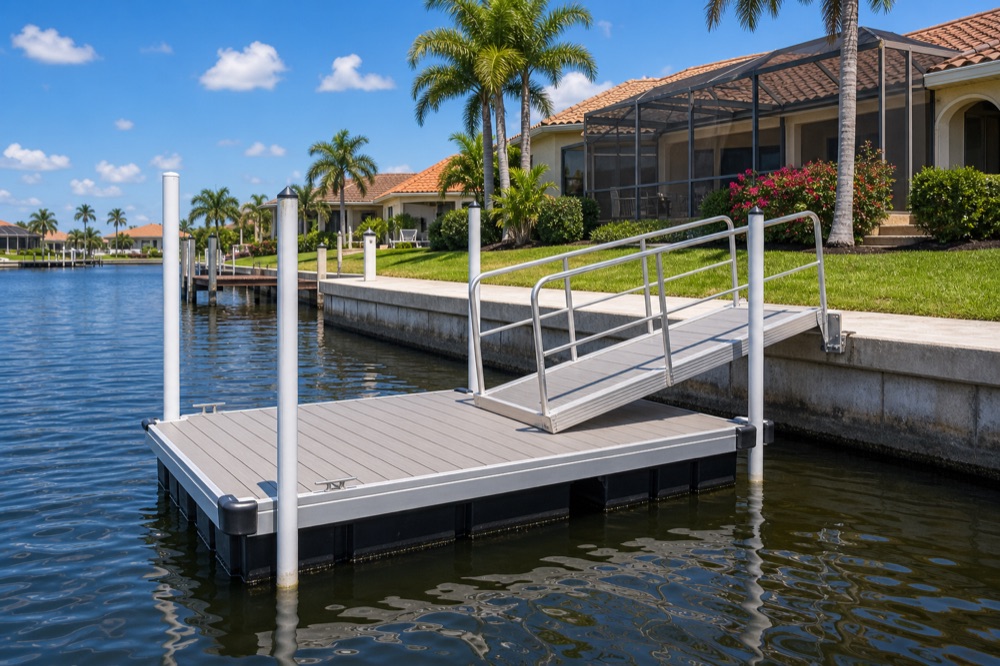
A floating dock has one behavior that defines everything about it in a storm: it goes up with the water. A fixed dock takes rising water against the underside of its deck and has to resist it. A float doesn’t fight. It rides. On Southwest Florida canals, where tide swing is a daily fact and a tropical system can stack water on top of it, that’s a genuine structural advantage.
But it’s an advantage with conditions attached. A floating dock only stays where it belongs because guide piles hold it in place and hardware holds it together. Those are the parts that decide how your storm goes, and both of them are easy to check in the spring. Here’s the playbook, front to back.
How does a floating dock behave in storm surge?
It rises, and the risk lives in what happens if it rises past what’s holding it.
Under normal conditions the float travels up and down its guide piles with the tide, staying level with the water and with your seawall access. Push more water into a canal and it keeps doing exactly that, which is why floats often come through rising water in better shape than a fixed structure at the same address.
Two things change that picture:
- The dock can outrun its guides. If water climbs high enough that the float reaches the top of the guide piles, nothing is capturing it anymore. How much room your dock has is entirely site-specific, and how high water gets in any given storm isn’t something anyone can tell you in advance. That’s what makes the National Hurricane Center forecast and your county’s emergency management alerts the sources to watch, not a rule of thumb, and the mechanism is worth understanding: see how storm surge works on SW Florida canals.
- The connections can let go. Rollers, collars, section hardware, gangway attachments, and any mooring or anchoring points. If those fail, the dock is loose in moving water with everything else that’s loose.
Wave and wake energy inside a canal adds a second load on top of water level. A float working hard against its guides all night is putting every hour of that into the same hardware.
What should you check on the guide piles and connectors?
Pre-season, and in this order: piles, guides, then every fastener holding sections to each other. Season here runs June 1 through November 30, so this is April and May work.
- Guide piles: plumb and sound, no cracking or softness at the waterline, no new lean, no scour showing at the base at low tide.
- Pile rollers, collars, or brackets, the parts riding the pile take constant wear. Look for elongated holes, cracked housings, missing rollers, and bolts rust-jacked loose.
- Section-to-section hardware, the connectors joining float modules stress hardest when a dock is working in chop.
- Floats themselves: waterlogged, cracked, or displaced floats mean a section already sits differently than its neighbors.
- Anchoring and mooring points, if your setup uses chain, cable, or anchors alongside or instead of piles, confirm they’re rated and intact. Our guide on how floating docks are anchored explains the difference.
- Cleats, ladders, and rails: anything bolted through the deck can work loose.
Anything questionable gets fixed in the spring. That’s the entire trick, the whole-waterfront version is in our hurricane prep guide.
What do you do with the gangway?
Decide early, because it’s the heaviest awkward object on the structure and the one most owners forget.
A gangway spans fixed ground to a moving dock, so it has to be free to travel at the float end while staying secure at the shore end. Check:
- The shore end: hinge, pins, or bearing plate, and the condition of what it’s attached to.
- The float end: rollers or a sliding plate that can move as the dock rises. Something binding there transfers load straight into the dock and the seawall cap.
- Whether it’s removable at all. If yours is designed to lift off and you have the equipment and hands to do it safely well ahead of the weather, removing it takes a long lever out of a moving system. If it isn’t designed for that, don’t improvise: confirm what your manufacturer or installer specifies and secure it properly instead.
- Handrails and removable panels: off, if they’re meant to come off.
What has to come off the deck?
Everything not bolted down, and off the dock entirely, not stacked at the seawall.
| Item | Where it goes | Why |
|---|---|---|
| Kayaks, paddleboards, racks | Inside, on land, tied or stored | Light, buoyant, and shaped to catch wind |
| Dock box and contents | Emptied; box secured or removed | A full box is weight; an empty one is a sail |
| Ladders, chairs, tables, grills | Off entirely | Small hard objects do real damage in moving water |
| Hoses, lines, fenders, bumpers | Coiled and stowed inside | Loose line fouls hardware and props |
| Solar or low-voltage dock lights | Removable fixtures off; wired ones de-energized | Fixtures snap; wet circuits are a hazard |
| Anything with a plug | Power off at the breaker, cords brought in | Nothing should be energized when water arrives |
If a dock circuit serves your float, shut it off at the breaker panel, not the switch, before the storm. Afterward, it stays off until a licensed electrician inspects and clears it. That’s not a maybe.
What do you check after the water goes down?
Look before you step. A float can sit perfectly level and still be riding on failed hardware.
- From dry ground: is the dock still captured on its guide piles? Are the piles plumb? Does one section sit lower or angle differently than the rest? Is the gangway still seated properly at both ends?
- Assume any downed line is live and stay clear. Keep dock power off.
- Photograph everything before you move a thing: wide shots and close-ups of piles, connectors, floats, gangway, and the seawall behind it. Documentation requirements vary by policy, so ask your agent or carrier what they want.
- Then, carefully, the close look: connector hardware, rollers, cleats, and the underside of float sections for cracks or water intrusion.
- Don’t put weight back on it until the connections have been checked. The full sequence is in post-storm dock triage.
When to call us: once you’re safe and documented. Florida Lifts & Docks has installed and repaired floating docks across Southwest Florida since 2008 with our own crew, never subbed, and we handle permitting in house on rebuilds. We’ll inspect the piles, connectors, gangway, and seawall and give you a written estimate for repair or replacement, free and on site. See our floating docks page or call (239) 397-3400.