
Piling Hurricane Playbook: Before, During & After the Storm
Sound pilings are the storm protection you already own, here is how to check wraps, splash zones, and necking before the season, and how to triage lean and wobble after.
Key takeaways
- Every load a storm puts on your dock ends up in the pilings. Sound pilings are the storm protection you already own, and nothing you strap on in the final week adds to them.
- Check three things before the season: the wrap, the splash zone underneath it, and whether anything moves. All three are spring jobs, not storm-week jobs.
- Necking is a piling losing cross-section in a band at the waterline. It is the most consequential piling defect for a storm, because that pinched band is exactly where bending load peaks.
- The most common post-storm piling problem here is not a broken post. It is a sound post that lost the soil holding it. Scour does not show above the waterline.
- A piling that leans, has settled, or moves under load means stop using the dock and do not run the lift. A loaded lift puts the heaviest force of all through the pilings.
Pilings are the part of your waterfront you can do the least about in the final 72 hours and the part that decides the most. Everything above them: deck, lift, boat, boathouse: is only as anchored as they are. When a dock goes in a storm, the failure usually starts down there, below the waterline, in something that was already wrong.
A piling is the vertical structural post: wood, concrete, or composite: driven into the canal or bay bottom and held rigid by the soil packed around it. This playbook covers what to check while the water is calm, the one thing worth doing as a storm approaches, and how to read a piling afterward.
Why are sound pilings the storm protection you already own?
Because every load a storm puts on your dock ends up in the pilings, and a piling that has already lost embedment or cross-section has nothing left in reserve when it needs it most.
Pilings resist two kinds of load. Vertical load is the easy one, the weight of the structure, the lift, and the boat. Lateral load is what storms deliver: wind pushing on everything above the deck, moving water pushing on the posts themselves, and floating debris arriving at speed. Add uplift when water gets under a deck, and you have forces the dock never sees on an ordinary day.
Then there is load sharing. Pilings work as a row, and when one weakens, the load it was carrying shifts onto the posts beside it, which were never designed to carry extra. Going into hurricane season with one bad piling means the whole row is running with less margin than it was built for. That is why honest piling prep is not something you do in September.
What should you check on your pilings before the season?
Three things: the wrap, the splash zone underneath it, and whether anything moves.
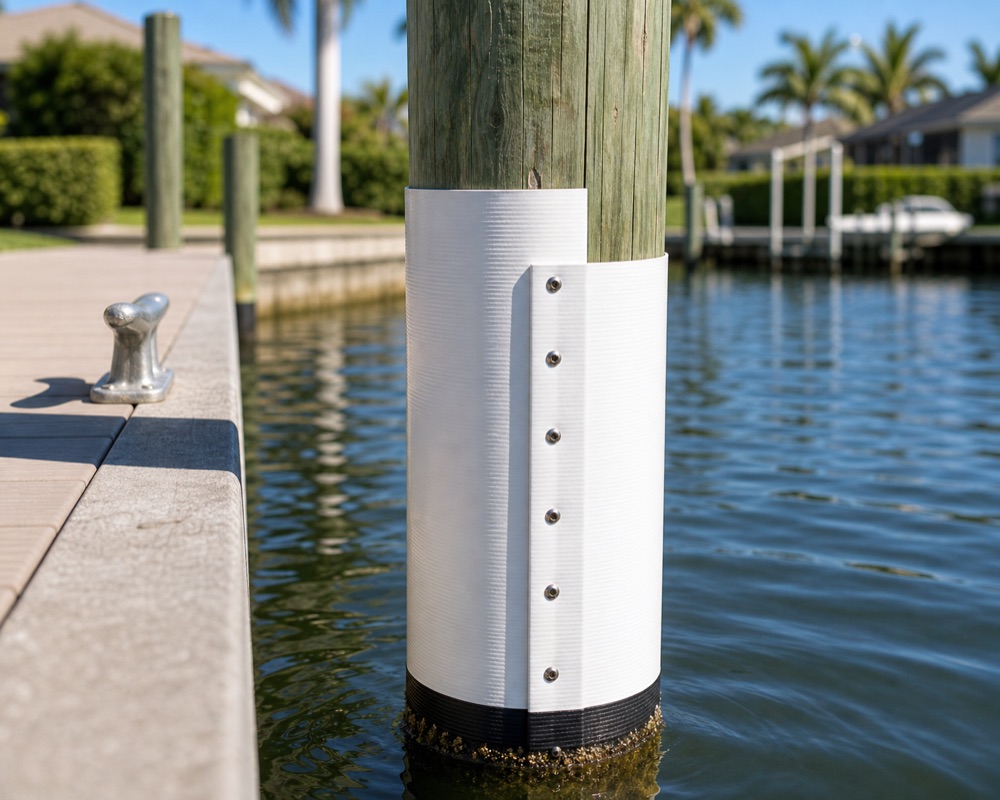
A piling wrap is a sleeve, usually PVC: fastened around the post through the tidal and splash zone to seal wood off from oxygen and marine borers. It is the cheapest protection on your dock and the easiest to stop checking once it is installed.
- Wrap condition. Seams closed and fastened, no gap top or bottom, no tears, not sagging loose. A wrap with a gap can be worse than no wrap at all, because borers get in and you cannot see what they are doing, our guide to marine borers and piling wrapping explains what happens under there.
- The splash zone. The wet-then-dry band at the tide line is where wood fails first. Probe exposed wood with an awl, if it sinks in easily, that is rot. Look for splintering, deep checking, and borer holes.
- Movement. Push hard on each piling and watch for give. Watch the posts while the lift cycles. Sight down the row from shore for anything out of plumb or sitting low.
- Hardware. Through-bolts and brackets that are rusted or weeping stain have been working loose for a while.
| What you find | What it usually means | Pre-season move |
|---|---|---|
| Wrap torn, gapped, or sagging | Borers may already have access, and the damage is hidden | Inspect underneath, then re-wrap |
| Wood soft where you probe it | Rot has started in the worst possible place | Assess for jacket versus replacement |
| Visible narrowing at the waterline | Lost cross-section where bending load peaks | Assess before the season; stop loading it |
| Piling rocks, or the dock sways | Lost embedment or a failed connection | Stop using it and get it looked at now |
| Out of plumb versus its neighbors | Movement is already underway | Assess now. It will not stop on its own |
| Rusted or weeping bolts at brackets | Connections are losing their grip | Replace hardware before the season |
What is piling necking, and why does it matter in a storm?
Necking is a piling losing cross-section in a band, usually right at the tidal zone, so a post that is full diameter above and below is pinched in the middle. Marine borers eat it from the inside and abrasion works it from the outside, and the result is an hourglass where you wanted a cylinder.
It matters more than almost any other defect for one reason: that narrowed band sits right where waves and floating debris do their work. A post can look healthy from the deck, stand perfectly plumb in calm water, and have very little material left exactly where the storm is going to hit it.
You usually cannot see necking from the seawall. It shows up at or just below the waterline, which is why a real pre-season look means getting low, checking at the bottom of the tide, and pulling a suspect wrap rather than trusting it.
What can you do as the storm approaches?
Almost nothing structural, the one meaningful lever is reducing what the pilings have to hold.
Take weight and windage off. Clear the loose gear from the dock, and strip the pilings of anything hanging on them: fenders, bumpers, removable ladders, and light fixtures that come off. Anything that catches wind or water is load you are asking the posts to carry.
Decisions about your boat and lift belong to your equipment, not to a general guide. Whether to raise or lower, whether to strap, and whether to pull canopy panels all vary by rig: confirm with your lift manufacturer’s storm guidance for your specific model and with your insurer, and do not improvise.
Two things not to do: no last-minute bracing, and no lashing a boat to pilings never designed for that kind of pull. Both add load in a direction the structure was not engineered for. Then photograph the pilings intact: sight down the row and shoot both ends. If an evacuation order comes for your zone, it outranks all of this.
How do you check pilings after the storm?
From dry land, look for three failures: lean, drop, and movement. Any one of them means stop using the dock and stop using the lift.
- Sight down the row from shore. A post out of line with its neighbors has moved.
- Look for one sitting lower than the rest.
- Look where each post enters the water: churned or hollowed bottom, a fresh open collar, a small moat. That is scour.
- Look for impact scars, fresh splits, and wraps torn open by debris.
- Do not run the lift. A loaded lift puts the heaviest force of all through your pilings, and it is the fastest way to turn a compromised post into a failed one.
Here is the thing to understand about post-storm pilings: the most common problem is not a broken post. It is a perfectly sound post that lost the soil holding it. Moving water pulls bottom material out from around pilings, the mechanism is covered in how storm surge actually works, and the post keeps standing until real load finds it. None of that shows above the waterline.
If a piling is leaning, has settled, or moves under load, read what a leaning or loose piling after a storm means next, and work the rest of the structure in order using post-storm dock triage.
When is it a repair, and when is it a replacement?
It comes down to how much sound material and hold is left. A post that is still structurally sound and only loosened in its seat can often be re-driven to firm bearing or reinforced with a repair jacket. A post that is rotted, hollow, necked through, snapped, or pushed badly out of plumb needs full replacement. Nobody can tell you which from a photo. It takes hands on the actual piling.
What is not worth doing is waiting. One leaning piling is rarely a one-piling problem for long, because the load it stopped carrying goes straight to its neighbors and every tide works its seat wider. Caught early it is the smallest version of the job; left through the season it becomes a multi-piling dock repair.
Florida Lifts & Docks has driven, wrapped, and replaced pilings up and down this coast since 2008, with our own crew we never sub out and permitting handled in-house. See everything we do with dock pilings or call (239) 397-3400 for a free on-site assessment, repair, or replacement estimate.