
Seawall Hurricane Playbook: Before, During & After the Storm
Almost all seawall storm prep happens months before the storm, here is what to fix in spring, what surge actually does to a wall, and how to triage one afterward.
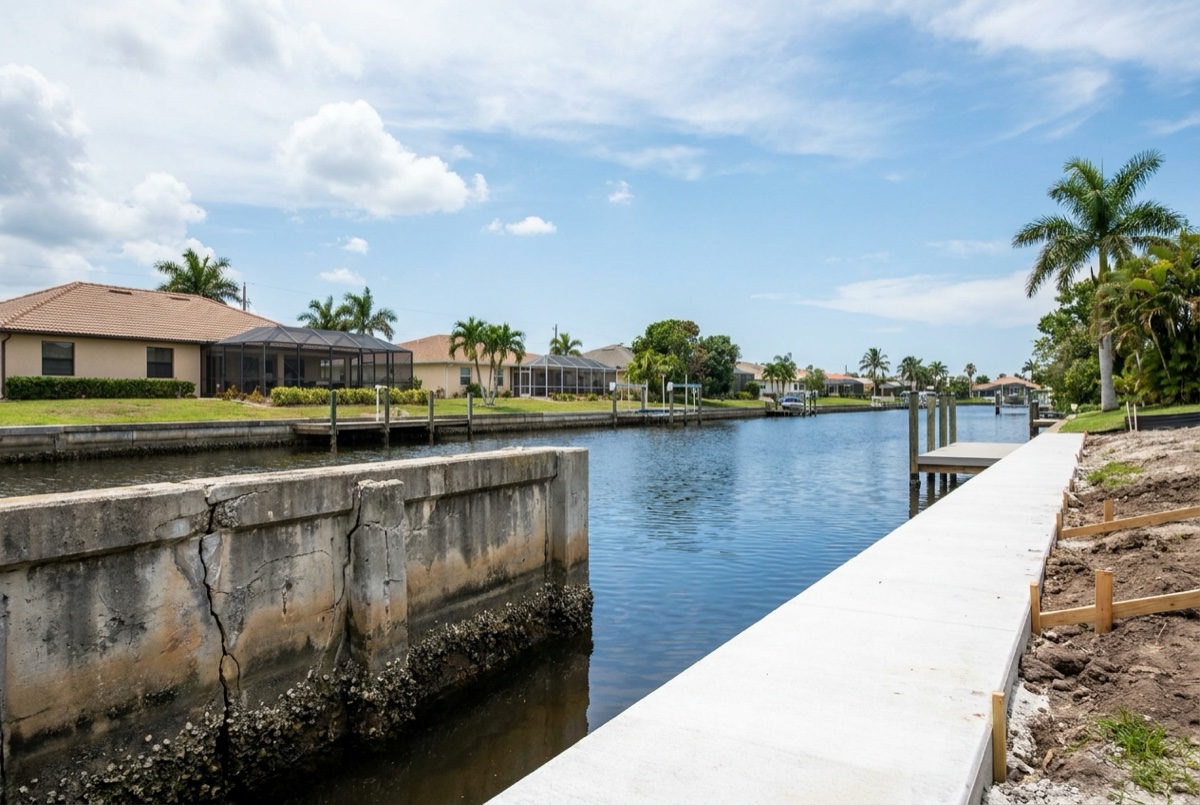
Key takeaways
- There is no last-minute fix for a seawall. Its condition on the day the water arrives is set months earlier, which makes pre-season inspection and repair the entire prep.
- Clear weep holes are the highest-value thing you can check. Blocked drainage traps water pressure in the soil behind the wall exactly when that pressure peaks.
- Your yard is part of the wall. Downspouts, grade, irrigation, and pool-deck drainage all decide how much water the soil behind the panels is holding.
- Surge loads a wall from four directions: wave impact on the face, scour at the toe, overtopping that erodes from the land side, and the drawdown as water drops faster outside than in.
- After the storm, sight down the cap line from dry land. A bow or kink in a line that used to be straight is the earliest sign a wall has moved.
Here is the honest version of seawall hurricane prep: almost all of it happens months before the storm. There is no strap, sandbag, or tarp that makes a retaining wall stronger in the last 48 hours. What determines how your wall does is its condition on the day the water arrives, and that is set in the spring.
A seawall is a retaining structure: panels driven into the bottom, tied back to anchors buried in your yard, and locked together with a poured concrete cap. It does not just stop waves. It holds your land in place. That distinction is why the list below is short on last-minute heroics and long on things you do while the water is flat.
What is the real hurricane prep for a seawall?
Getting the wall inspected and repaired before June, because what fails in a storm is nearly always something that was already failing. Walls rarely fail out of nowhere. They give you months of warning in the form of small, unglamorous symptoms, and a storm simply collects on them.
Walk the full run of your wall in the spring and check it against the list below. If anything reads wrong, our guide to the signs your seawall is failing explains what each symptom means. Then get on a crew’s calendar early, a repair in April is routine work, and the same repair once a system is in the Gulf is not something anyone can schedule.
| Pre-season check | What you are looking for | Why it matters when the water comes |
|---|---|---|
| Cap | Cracks, spalling, separation from panels | The cap is what ties the panels together into one wall |
| Panel joints | Gaps, daylight, soil trailing out | Soil leaving through a joint is your yard draining into the canal |
| Weep holes | Visible, open, filter intact | Blocked weeps trap pressure behind the wall exactly when it peaks |
| Yard behind the wall | Depressions, soft spots, sinking pavers | Voids under the surface mean soil is already gone |
| Toe of the wall | Exposed base, scoured bottom, displaced rip-rap | Lost material at the toe means shallower embedment before the storm starts |
| Alignment | Bow, kink, or lean in the cap line | A leaning wall is already losing its argument with the soil |
Why do weep holes matter so much?
Because they are the only way water trapped in the soil behind your wall gets out. A weep hole is a small drain through the wall, backed by a filter that lets water pass while holding soil in place. When they work, the ground behind the panels drains and the wall carries only the load it was built for.
Storms attack that system from both ends: heavy, sustained rain saturates the soil behind the wall, and then, as surge recedes, the water level outside drops much faster than the water in that soil does. For a stretch of time the wall holds back saturated ground with far less water on the other side pushing back, and if the weeps are plugged, that pressure has nowhere to go.
So confirm every weep hole is visible and open before the season. Sod, mulch, a paver edge, or a new landscape bed can bury a whole row without anyone noticing. If they are clogged, resist the urge to ram something through: punching out the filter behind a weep hole starts pulling soil out with the water, which is the failure you were trying to prevent. Our guide on clogged seawall weep holes covers doing it correctly.
Does yard drainage really affect a seawall?
Yes. The yard behind the wall is part of the wall’s load, and everything that puts water into that soil without taking it away adds pressure. This is the piece of seawall prep almost nobody thinks of as seawall prep.
- Downspouts discharging toward the water are feeding the exact soil you want dry.
- Grade that slopes toward the wall ponds water along the cap and soaks the tieback zone.
- Irrigation heads running heavy at the wall do the same thing, quietly, every week.
- Pool deck drains and equipment discharge aimed at the seawall concentrate a lot of water in one spot.
- Depressions and soft spots are the symptom to act on. They mean water is already moving soil.
What does surge actually do to a wall?
It loads the wall from four directions, and only one of them is the obvious one. Surge behavior at any given address depends on the storm’s track, size, forward speed, timing against the tide, and the shape of your canal or bay, so nobody can hand you a number for your wall. What we can describe is the mechanism, and it is worth understanding before you decide whether that hairline crack can wait another year.
- Wave energy on the face. Repeated impact works joints open, chews at the cap, and finds every weakness in the panel line.
- Scour at the toe. Moving water pulls bottom material away from the base of the wall, and the wall’s embedment gets shallower, the wall did not change, but what is holding it did. This is where rip-rap earns its place: armor stone breaks up wave energy before it reaches the panels and holds bottom material where it belongs.
- Overtopping. Water coming over the cap lands behind the wall, erodes the yard from the land side, and saturates the soil the tiebacks are anchored in. That damage is mostly invisible, because it happens under your sod.
- The drawdown. As water recedes, outside levels drop long before the soil behind the wall drains. Marginal walls often fail on the way out rather than the way in.
For the plain-language version of how surge builds and moves through Southwest Florida canals, see how storm surge actually works. For the forecast itself, watch the National Hurricane Center and your county emergency management office: nothing on this page substitutes for them.
What can you actually do in the last 48 hours?
Very little to the wall, which is the whole point of doing the work in spring. The short list:
- Clear the cap and the strip behind it. Furniture, planters, and decor along a seawall become impact loads.
- Check that weeps and yard drains are not blocked by fresh debris, palm fronds, or mulch.
- Move vehicles and trailers off the ground near the wall. Concentrated weight on saturated soil is a bad combination, and they float.
- Photograph the wall intact, the full run, both ends, straight down the cap line, and the yard behind it. Shots taken along the cap show a lean better than anything else you can take.
- Follow the order. If evacuation is called for your zone, that outranks every item above.
How do you triage a seawall after the storm?
From dry land, look for three things: a change in the line, missing soil, and water where it should not be. Stay off a cap that is cracked or tilted, stay out of the water entirely, and give the edge a wide berth, a void can hide under grass that looks perfectly normal.
- Sight down the cap. It is the most sensitive gauge you own. A bow or kink in a line that used to be dead straight means the wall moved.
- Look at the joints for new gaps, and at the water along the base for silt or soil fans. That material is your yard.
- Walk the yard well back from the edge. Depressions, cracked pool deck, sinking pavers, and sod that gives underfoot all point to soil loss behind the panels.
- Check the rip-rap. Stone shifted or carried away from the toe has done its job, and the toe is now exposed.
A wall that looks perfect can be hollow behind it, and one that looks rough can be structurally fine, which is why the full step-by-step, including what to document, lives in post-storm seawall triage. Photograph everything before you clean up or backfill. What your policy covers and what your carrier wants documented varies, so confirm with your agent rather than assuming.
Call for an assessment if the cap line changed, if the yard is losing soil, if joints opened, or if rip-rap moved, and call if water came over the wall and nothing looks wrong, because that is precisely when the damage is out of sight. Florida Lifts & Docks has built and repaired seawalls across this coast since 2008 with our own crew and permitting handled in-house. See our seawalls page or call (239) 397-3400 for a free on-site inspection, repair, or rebuild estimate.