
Building for the Next Storm: Specs That Survive
Nothing on the water is hurricane-proof. But the difference between a dock that comes through and one that doesn't is mostly decided at design time, not in the last 72 hours.
Key takeaways
- Nothing on the water is hurricane-proof, and any builder who uses that word is selling you something. The realistic goal is a structure that fails later, less, and in cheaper places.
- Deck elevation is the single largest lever, because almost every bad thing that happens to a dock starts when water gets above deck level, and it trades directly against how pleasant the dock is to use every other day.
- The lumber is almost never what fails. Connections fail. Hardware grade, unbroken coatings, and no mixed metals in wet connections buy more storm performance per dollar than anything else on the list.
- Thru-flow decking reduces the surface water and air can push against; every solid vertical plane and enclosed box you add is a surface a storm can load.
- Piling embedment is a design decision made per site, not a number copied from the neighbor's dock: bottom conditions change along a single canal.
Start here, because it matters more than anything else on this page: nothing on the water is hurricane-proof. Not our docks, not anybody’s. Storms produce conditions beyond what any residential marine structure is designed to take, and even a well-built dock is exposed to debris, current, and water levels no design assumption covers. Any builder who says otherwise is careless with language or selling something. We do not use the word.
What is true is that there is a large, real difference between a dock built to the minimum and one built with the next storm in mind, and nearly all of it gets decided at the design table. Once a dock is built, your options are maintenance and preparation. Before it is built, you choose where the weak points go.
How much does deck elevation really matter?
More than any other single choice, because nearly every bad thing that happens to a dock begins when water gets above deck level.
Below deck level, water is mostly a lateral and buoyancy problem for the pilings. Above deck level the loading reverses: water pushes up on decking and framing engineered around load pressing down, and floating debris arrives at deck height, striking framing, rails, and mounted equipment instead of passing beneath. Every bit of height is a decision about how often your dock is on the wrong side of that line.
Height is bounded by what your jurisdiction will permit and by how the deck sits against your seawall and your neighbors’, and by the fact that you board a boat from it on every day a storm is not happening. Make it a deliberate choice, not a default.
Why is hardware the thing to spend on?
Because the lumber almost never fails. The connections fail.
Walk any storm-damaged dock and the pattern repeats: sound boards lying loose, framing intact but disconnected, brackets still bolted to one member and torn free of the other. Salt gets into every fastener, fastest where a coating was interrupted, a cut end, a drilled hole, a scratch from an impact driver. Dissimilar metals in a wet connection corrode faster than either would alone, so mixing what is convenient is quietly expensive.
Practical design consequences:
- Specify hardware as a system, with compatible metals throughout the load path.
- Treat cut ends and field-drilled holes as coating breaks to be addressed, not as incidental.
- Design connections where they can be inspected. Hidden hardware is hardware you will never look at again, and it is still in the load path years from now.
Does thru-flow decking actually help?
It reduces the surface water and air can push against, which is a real mechanism rather than a marketing claim.
A solid deck is a plane: wind loads it, and rising water loads it from underneath. Decking built to let water and air through: gaps, slots, or an open pattern depending on the product: presents less for that pressure to act on. Even with conventional boards, spacing is worth choosing rather than accepting. Our dock decking materials guide covers how the options compare for everyday living, which is the other half of the decision.
How should pilings be thought about at design time?
As the part of the dock actually holding it in place, which makes embedment a per-site engineering decision, not a number to copy.
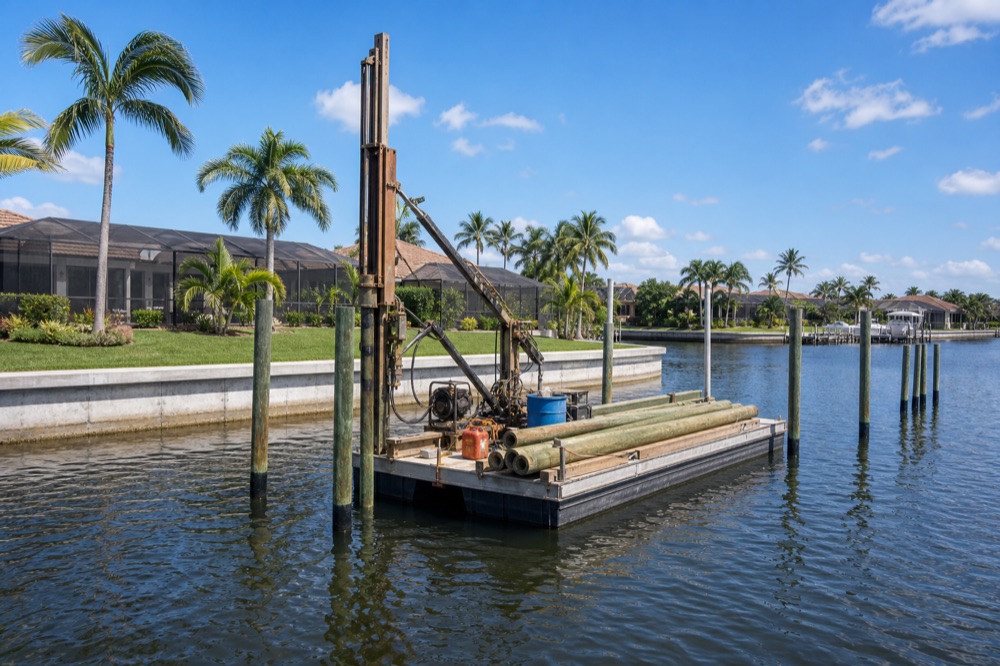
Pilings resist load because of the soil around and beneath them, and bottom conditions change along a single canal: sand, muck, rock at different levels, fill of unknown history. The right answer for your lot comes from the design plus what the crew finds while driving, and it may not match your neighbor’s. We will not publish a depth on a web page, and you should be skeptical of anyone who does: what matters is that embedment was set for your site with the structure’s real loads in mind. Our guide on how deep dock pilings are driven explains what governs it.
Material is the other half. Wood, concrete, and composite pilings age differently in saltwater, and marine borers and the splash zone are the long-run enemies. A piling quietly deteriorating for years is the piece that gives first, so choosing a material and protection approach you will actually keep up with is a storm decision disguised as a maintenance decision.
What does “simpler” buy you?
Fewer things for a storm to grab.
Every solid vertical plane is a surface wind and water can push, and every enclosed box is a place water collects and pushes from inside. Privacy panels, deep skirting, closed-base benches, oversized lockers, canopy fabric, each is nice, and each adds catch surface in the wrong place.
Two design habits help:
- Prefer open to solid where function allows. Open rails over solid panels, framed seating over enclosed benches, freestanding storage over built-in.
- Make what has to be there removable. If an element earns its place, design it so one person can take it off with hand tools in reasonable time, the difference between a pre-storm afternoon and a pre-storm impossibility.
The related idea is choosing where you would rather lose something: if something will be sacrificed in a bad enough storm, better a light, cheap, replaceable element than the framing or the pilings.
How should the power be planned?
So that shutting it off is a single confident action, not an investigation.
The pre-storm move on any dock’s electrical is to de-energize it at the breaker: easy where power was designed in, hard where it accumulated. Design it so that:
- Dock and lift power sit on dedicated, clearly labeled circuits rather than sharing with the garage or pool.
- There is a disconnect you can find and identify without a flashlight and a guess.
- GFCI protection is in place, and equipment, enclosures, and conduit runs are placed with water and salt spray in mind rather than convenience.
All of it is licensed electrician work, new or after flooding, and once water gets into dock electrical, staying clear and having an electrician verify it is the only safe sequence, as covered in post-storm electrical safety.
None of these choices is free, which is the point of naming them out loud:
| Design choice | What it buys | What it costs |
|---|---|---|
| More deck elevation | Fewer hours with water above the deck | Harder boarding, heavier look, permit limits |
| Higher-grade hardware, one metal system | The failure mode that actually happens | A line item on the estimate |
| Thru-flow decking | Less surface for pressure to act on | Appearance, barefoot feel, dropped items |
| Embedment engineered for your site | Confidence in the part holding everything up | Site work, not a copied number |
| Fewer, simpler, removable features | Less to catch water and wind | Some of the built-in comfort you wanted |
What it adds up to is a dock that fails later, less, and in cheaper places than it otherwise would have. That is worth a great deal, but it is not immunity, and we would rather say so at the estimate than have you learn it in November. For the seasonal side, see the custom docks hurricane playbook.
Florida Lifts & Docks has designed and built docks, boathouses, and lifts across Southwest Florida since 2008 with our own crew, permitting in-house. If you are planning a new dock or a rebuild and want these trade-offs laid against your actual site, that conversation and the estimate are free on-site. See our custom docks page, read up on pilings, or call (239) 397-3400.