
Can You Add a Floating Dock to an Existing Seawall or Fixed Dock?
How to retrofit a floating dock onto the seawall or fixed dock you already have — the mooring brackets, telescoping ports, and saltwater hardware that make it work, plus when it triggers a permit.
Key takeaways
- Yes — you can almost always add a floating dock to an existing concrete seawall, wood seawall, or fixed dock; it's a popular budget-friendly way to gain low-tide access or a PWC slip without rebuilding what you already have.
- The float is connected with mooring brackets or telescoping ports that bolt to the seawall cap or dock face, so the float rides up and down with the tide while staying locked against current and wakes.
- Hardware choice is everything in salt water — 316 stainless bolts, brackets, and pins outlast galvanized, which streaks rust and fails fast on SW Florida canals.
- A simple add-on float can sometimes be a light retrofit, but anything bolted to a seawall or extending farther into the water usually needs a permit; we confirm and handle it in-house.
If you already have a seawall or fixed dock you’re happy with, you don’t have to tear it out to solve a low-tide problem. You can add a floating dock right onto what you already own — bolting a buoyant platform to the seawall cap or the face of your fixed dock so it rides the tide and gives you easy, water-level access. It’s one of the most budget-friendly upgrades on a Southwest Florida canal, and we do them constantly from Cape Coral to Naples and up into Charlotte Harbor.
Here’s how a retrofit float actually attaches, what changes when your seawall is concrete, wood, or steel, and the one detail that decides whether it lasts twenty years or starts streaking rust in two.
Can you really retrofit a floating dock onto an existing structure?
Yes — in most cases, a floating dock can be added to an existing concrete seawall, wood seawall, or fixed dock without rebuilding anything. The float is the new piece; your seawall or dock becomes its anchor point.
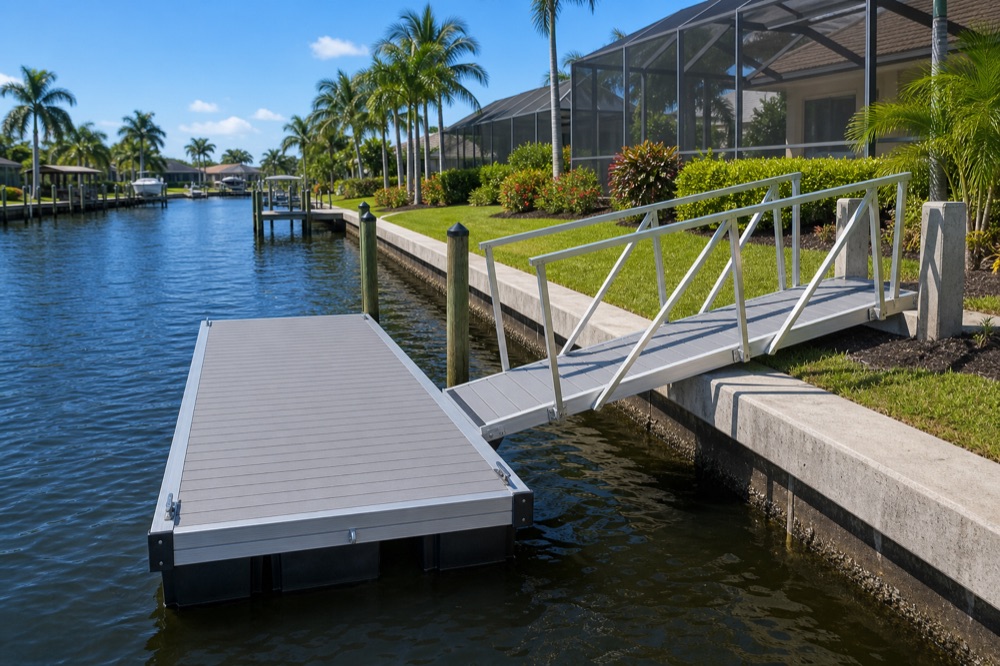
A floating dock is a deck built on sealed buoyant floats that rides directly on the water and rises and falls with the tide, keeping the deck a constant height above the water all day. In a retrofit, instead of standing on its own pilings, the float ties to a structure you already have — so you keep the dock or seawall you like and bolt on the low-tide access, kayak launch, or PWC slip you’ve been missing. The only two prerequisites: a structure sound enough to take the load, and enough depth to float the platform without grounding at low tide.
How does a floating dock attach to a seawall or fixed dock?
It attaches with mooring brackets or telescoping ports that bolt to the seawall cap or dock face, letting the float slide up and down with the tide while staying locked against current and wakes — the float moves vertically, the brackets hold it horizontally. A few proven methods, chosen by your tide swing and how you’ll use the float:
- Telescoping (tide-riding) ports. A bracket on the seawall and a matching arm on the float telescope against each other so the float rides the full tide range smoothly — the go-to on canals with real swing off the Caloosahatchee or Charlotte Harbor.
- Fixed mooring brackets with rollers or slides. The float is captured against the structure and rolls vertically with the tide. Simple, strong, low-maintenance.
- Hinged gangway off a fixed dock. A short ramp from your fixed dock down to the float lets you step to water level while the float moves with the tide.
- Stiff-arm attachment. Rigid arms hold the float a set distance off the seawall while still letting it rise and fall — useful when you want a gap and don’t want to rely on the bottom.
Every method shares one goal: the float rides the tide freely but can’t drift, swing, or slam your seawall on a wake. For more, see how floating docks are anchored.
Does the seawall material change how it’s done — concrete vs. wood vs. steel?
Yes. The float and brackets stay similar, but how we fasten into your wall changes with the material — and the common thread is that we anchor only into sound, solid structure.
| Seawall type | How the float attaches | What we watch for |
|---|---|---|
| Concrete (cap or panel) | Bolted to the cap or face with stainless anchors | Spalling or cracks that won’t hold an anchor |
| Wood (timber) | Lagged/bolted into sound structural members | Rot, marine-borer damage, soft wood |
| Steel / vinyl with steel waler | Clamped or through-bolted to framing | Corrosion at the fastener; dissimilar metals |
That makes a retrofit a good moment for an honest look at your wall — you want to know about a failing cap or a tilting wall before you hang a dock on it. Our guides on signs your seawall is failing and seawall repair vs. replacement cover the warning signs, and you can see what we do on the seawalls page.
What hardware actually matters in salt water?
The single most important spec in a retrofit is corrosion-resistant hardware — 316 stainless for the bolts, brackets, pins, and rollers that connect the float to your structure. It’s the difference between a connection that lasts decades and one that fails in a couple of seasons.
Our canals are brutal on metal. Salt spray, full UV, and the tide working the connection thousands of times a year find any weak fastener, and galvanized hardware streaks rust and seizes fast. On every retrofit we build for the conditions:
- 316 stainless bolts, brackets, pins, and roller hardware at every connection
- Sealed, marine-grade floats — not open-cell foam that waterlogs and rides low
- Capped composite (TimberTech or Trex) or CCA-treated decking sized for UV and moisture
- Isolation at dissimilar metals so a steel seawall doesn’t eat a stainless bolt galvanically
A cheap float or a galvanized bolt is the most expensive part you’ll ever buy on the Gulf coast. Spending on the parts that touch salt water is what makes a float shrug off hurricane season and marine borers instead of failing fast.
When does adding a floating dock trigger a permit?
Often. A small, simple add-on float can sometimes be a light retrofit, but anything bolted into a seawall, extending farther over the water, or changing your footprint usually requires a permit — and rules vary by city, county, and waterway.
The more you change, the more likely a permit is in play — a larger boat-side float or anything that pushes farther into the canal can trigger local or even state review, depending on the waterway and zone. We don’t guess at this: we confirm what your site needs and handle the entire process in-house, so you’re not chasing paperwork. (Our overview of permitting to modify an existing dock, seawall, or lift walks through how this generally works.)
Get a real number for your retrofit
A retrofit float shines when you like your dock or seawall but want what it can’t give you: access at dead low tide, a safe step-down for kids and pets, or a slip for a kayak, paddleboard, or PWC. If watercraft is the goal, a jet-ski lift beside the float keeps it out of the salt between rides. Weighing a float against other shallow-water fixes? Our fixed vs. floating dock in shallow water guide lays out the trade-offs.
The only way to know what your seawall or dock can take — and what it’ll cost — is an on-site look at your structure, your depth at low tide, and your tide swing. We’ve built for Southwest Florida waterfront since 2008 with our own local crew, never subbed, and we’re 5.0 stars on Google. Start with our floating docks page, then book a free on-site estimate seven days a week across Cape Coral, Naples, Fort Myers, and the rest of the coast. Call (239) 397-3400.