
How Much Does a Floating Dock Cost in Florida? (2026 Price Breakdown)
What a floating dock actually costs in Southwest Florida in 2026 — per square foot, real project totals, and the five things that move the price up or down.
Key takeaways
- Floating docks in SW Florida are priced per square foot; a small kayak/PWC float is an entry-level project, while a full boat-side floating dock with a gangway and proper anchoring runs much higher — all quoted free on-site.
- The five real cost drivers are float type and quality, anchoring method, decking material, the gangway, and overall size — not just square footage.
- Floating is usually cheaper up front in shallow or soft-bottom water; a fixed piling dock can win on 20-year ownership cost because floats and anchoring hardware wear in salt.
- Permitting is part of every floating-dock project and we handle it in-house.
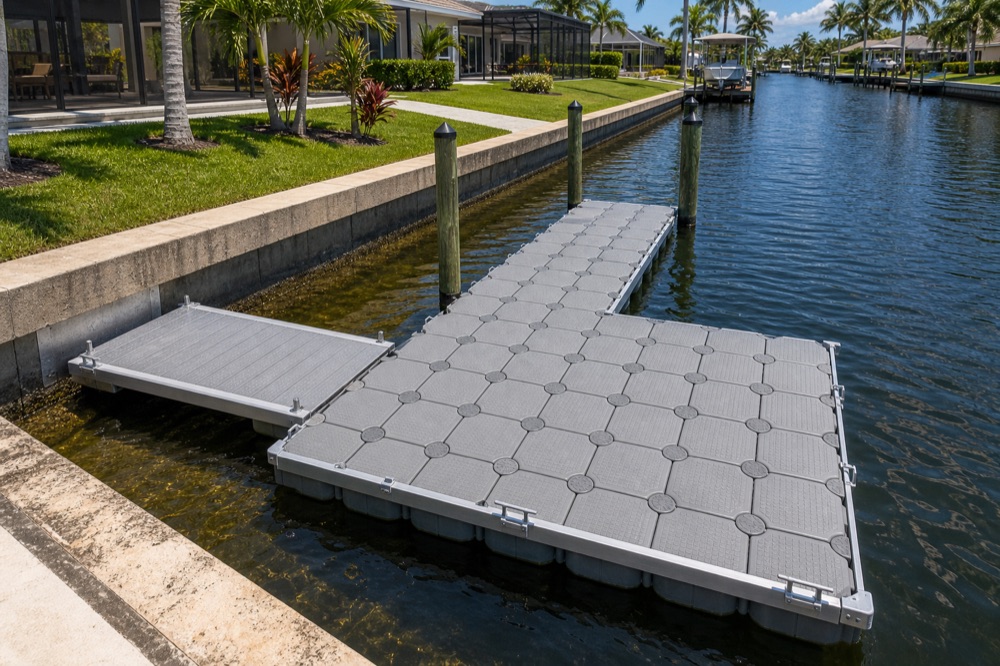
A floating dock can be the right call on the wrong-depth canal — the spot where the water is too shallow at low tide for a comfortable fixed dock, or the bottom is too soft to drive pilings affordably. It rides the tide, keeps your deck a constant height above the water, and gives kayaks, paddleboards, and personal watercraft an easy step-down launch. The first thing every owner wants to know is what it costs.
Here’s a floating-specific breakdown — not a generic “cost to build a dock” rehash — with how we actually price these across Cape Coral, Fort Myers, Naples, and up into Charlotte Harbor, plus an honest look at where floating beats a piling dock and where it quietly loses over twenty years.
What is a floating dock, and how is it priced?
A floating dock is a deck platform built on sealed buoyant floats that rises and falls with the water, connected to shore by a hinged gangway and held in place by an anchoring system. It is priced per square foot of platform, then adjusted for float quality, anchoring, and the gangway.
In Southwest Florida, the platform itself generally runs from the low tens to the mid-tens of dollars per square foot installed. Where you land in that band depends almost entirely on the float and decking you choose. Because anchoring and shoreline access vary so much from one seawall to the next, we don’t post a flat number — every floating dock is quoted free on-site.
What does a floating dock actually cost in SW Florida?
For a realistic budget, think in project tiers rather than a single price. A small kayak or PWC float is an entry-level project; a full boat-side floating dock with a gangway and engineered anchoring is a multiples-higher investment.
- Small kayak / paddleboard / PWC float — the most affordable build. Less material, lighter floats, simpler anchoring. A common add-on beside an existing seawall or fixed dock.
- Mid-size floating dock — a usable platform for stepping aboard a smaller boat, fishing, or lounging, with a proper gangway and tide-rated anchoring.
- Full boat-side floating dock — the largest build, sized to berth a boat alongside, with heavier floats, robust anchoring, and a longer gangway. This approaches fixed-dock money and is where the float-vs-piling decision really matters.
If you mostly want a launch pad for paddle craft or a PWC, a float is a smart, low-cost win — we cover that use case in detail in our guide to a floating dock for kayaks, paddleboards, and PWC.
What drives the price up or down?
Square footage is only the starting point. Five factors move a floating-dock quote more than size alone:
- Float type and quality. Sealed HDPE pontoons, concrete floats, and aluminum-framed float systems all behave differently in salt — and price differently. Cheap floats are the part that fails first. Our breakdown of the best floating-dock material for saltwater walks through the trade-offs.
- Anchoring method. How the float stays put is a core cost line. Guide pilings give the most stable, low-maintenance result; helical or chain-and-weight anchoring can cost less but behaves differently in tide and surge.
- Decking material. We build floats with capped composite (TimberTech or Trex) or CCA-treated framing. Composite costs more up front and saves on maintenance over the years.
- Gangway. The hinged ramp from your seawall to the float is required for a floating dock to work, and its length scales with your tide swing and freeboard. A longer or wider gangway adds material.
- Size and permitting. Bigger platform, more of everything. And like any structure over the water, a floating dock requires permits — handled in-house, scoped into the job from the start.
Is a floating dock cheaper than a piling dock?
Up front, often yes — especially in shallow or soft-bottom water where driving pilings is expensive. Over twenty years, a well-built fixed dock can cost the same or less, because floats, anchoring hardware, and connections wear in salt water and eventually need service or replacement.
Here’s the honest comparison the way we frame it on-site:
| Factor | Floating dock | Fixed piling dock |
|---|---|---|
| Up-front cost (shallow / soft bottom) | Usually lower | Higher (piling-driving cost) |
| Tide and surge behavior | Rides the tide; can take a storm beating | Stays put; engineered for surge |
| Maintenance over time | Floats, anchoring, barnacles on floats | Pilings, decking, hardware |
| Boat-lift compatibility | Limited | Excellent (boat lifts mount to pilings) |
| 20-year ownership cost | Can creep up as floats wear | Often lower over the long haul |
Two things tilt the math toward a float: very shallow water or a wide tide swing, and a soft bottom that makes pilings costly. Two things tilt it toward a piling dock: wanting a boat lift, and planning to own the home for decades. Our cornerstone guide, floating dock vs. fixed dock in Florida, is the full decision matrix.
How do I keep the cost reasonable without buying junk?
The way to save on a floating dock is to right-size the platform and spend on the parts that touch salt water — not to cut corners on floats and hardware. A cheap float is the most expensive float you’ll ever buy on the Gulf coast.
What we won’t compromise on, because the saltwater canals here punish weak hardware:
- 316 stainless cable and connectors at the anchoring and gangway hinges
- Sealed, marine-grade floats rather than open-cell foam that waterlogs
- Capped composite or CCA-treated decking sized for UV and constant moisture
Spending there is what separates a dock that shrugs off hurricane season and marine borers from one you’re replacing in a few years. (If you’re weighing decking specifically, our composite vs. wood docks guide compares lifetime cost.)
Get a real floating-dock number
The only way to turn these ranges into a figure you can budget against is an on-site look at your water depth at low tide, your tide swing, your seawall, and how you plan to use the dock. We’ve been building for Southwest Florida waterfront since 2008 with our own local crew — never subbed — and we handle permitting in-house.
See everything we build on our floating docks page, and book a free on-site estimate seven days a week across Cape Coral, Naples, Punta Gorda, and the rest of the coast. Call (239) 397-3400.