
Boat Lift Bunks vs. Cradle vs. Sling: How Should Your Boat Sit?
How your boat rests on the lift — full cradle with bunks, a bunk setup, or slings — decides hull support, storm stability, and cleaning access. Here's how to choose.
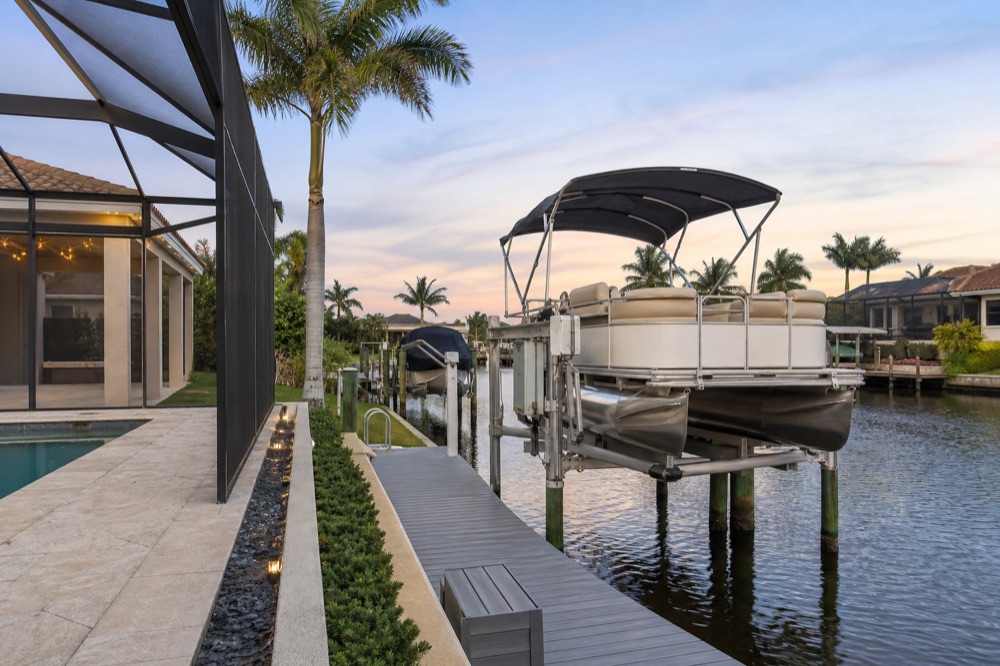
Key takeaways
- For nearly every boat, a full cradle with adjustable bunks is the right choice — it spreads the load along the keel and stringers and holds steady in wind and surge.
- Slings carry the whole loaded weight on two narrow straps, which can warp the hull or crush a hull-to-deck seam on heavier boats left in them through Florida summers.
- Slings also let the boat swing in storm wind; a cradle locks it in place, which matters on a saltwater canal in hurricane season.
- Slings are best reserved for small, light boats or specific round-bottom and stepped hulls a manufacturer recommends them for.
- Bunks must be placed under the stringers and keel and adjusted to your hull — we set and verify them on site.
How your boat sits on the lift is one of those details nobody thinks about until it’s wrong. Pick the right support and your hull rides out of the salt cleanly, sits dead still in a blow, and lasts decades. Pick the wrong one to save a few dollars and you can stress the very thing you’re trying to protect. On Southwest Florida canals — where boats hang on the lift through brutal summers, big tide swings, and a hurricane season that runs June through November — that choice matters more than almost anywhere else.
There are three ways a boat commonly rests on a lift: a full cradle with bunks, a bunk configuration, and slings. Here’s how each supports the hull, handles a storm, and fits your boat — and why the cheapest option is usually the wrong one.
What’s the difference between bunks, a cradle, and slings?
A cradle is the welded aluminum frame that hangs from the lift cables; bunks are the padded beams bolted to that frame for your hull to rest on; slings are wide fabric straps that cradle the hull like a hammock. The first two work together — the third is a different approach entirely.
Let’s define the core terms, because the words get used loosely:
- Cradle. The structural frame — usually marine-grade aluminum on our installs — that the cables lift. It’s the skeleton everything else attaches to.
- Bunks. Long, carpeted or composite-capped beams mounted on the cradle. The hull sits on the bunks, which sit on the cradle. People say “bunks vs. cradle,” but a bunk setup is a cradle with bunks. The real comparison is cradle-and-bunks vs. slings.
- Slings. Two wide straps slung under the hull — no rigid beams touching the boat, just fabric carrying the load at two points.
How does each one support the hull?
A cradle with bunks spreads the boat’s weight along its keel, stringers, and chines — the structural backbone. Slings carry the entire loaded weight on two narrow bands of fabric.
This is the heart of the matter. A boat is engineered to carry its weight along its bottom structure, the way it does sitting in the water. Bunks mimic that — positioned under the longitudinal stringers and keel, so the load lands where the boat is built to take it. Placed and angled correctly, they cradle the hull fully and evenly.
Slings work differently. The boat’s entire loaded weight — hull, engines, fuel, gear — rides on two straps, concentrating pressure into two narrow zones. On a small, light boat that’s no problem. On a heavier fiberglass boat, those pressure points can, over time, lead to hull distortion or stress at the hull-to-deck seam. It’s not instant, which is why it sneaks up on people: the boat looks fine for a season or two, then the gelcoat starts telling on you.
Which holds up better in a Florida storm?
A cradle with bunks wins on storm stability, every time. The boat sits locked into rigid beams; slings let it swing.
When a summer squall or a named storm pushes wind down a canal, you want your boat to not move. A cradle with properly fitted bunks holds the hull firmly in place — no slack, no sway. Slings, by their nature, let the boat rock and swing in the wind, because it’s hanging in fabric rather than seated on structure. That swing is hard on the boat, the straps, and the lift, and it’s the last thing you want when you’ve raised everything high and walked away ahead of a storm. (Our hurricane prep guide for docks, lifts, and seawalls covers the rest of the plan.)
Which is easier to clean and maintain?
Slings give you slightly more open access to the bottom, but a well-placed bunk setup leaves the running gear clear too. The maintenance trade-off rarely justifies the structural downside of slings.
This is the one honest point in the slings column: with no beams under the hull, you’ve got a more open bottom to pressure-wash. But it’s thin. Bunks are spaced to support structure, not blanket the hull, so most of the bottom — and your lower units, props, and transducers — stays accessible. And on a saltwater canal, the bigger maintenance story isn’t access; it’s getting the boat fully out of the water so barnacles and growth never get started. Both setups do that, and keeping the lift healthy is the same routine either way — see our salt-water lift maintenance guide.
Which should you choose by boat type?
For nearly every boat, choose a cradle with adjustable bunks. Reserve slings for small, light boats or the specific hulls a manufacturer calls for.
Here’s how it shakes out across the boats we see on the coast:
| Boat type | Best support |
|---|---|
| Center console / bay boat | Cradle with bunks |
| Cruiser / express / cuddy | Cradle with bunks |
| Pontoon / tritoon | Bunks (tuned to the tubes) |
| Personal watercraft | Bunk or specialty PWC cradle |
| Small, light skiff / jon boat | Bunks, or slings if light enough |
| Round-bottom or stepped hull | Per manufacturer — sometimes slings |
The pattern is clear: cradle-and-bunks for the overwhelming majority of hulls. Slings have a place — a very light boat, or a round-bottom or stepped hull the builder specifically recommends them for — but they’re the exception, not the budget default. If a quote steers you toward slings purely because they’re cheaper, ask why, especially with a heavier boat. Sizing the support right starts with your real numbers, covered in what size boat lift do I need and our overview of lift types.
Why bunk placement is the part that really matters
A cradle and bunks are only as good as where the bunks sit. Placed under the stringers and keel, they cradle the hull perfectly; placed wrong, even good bunks can press on unsupported fiberglass.
Bunk width, height, and angle all get set to your specific hull. The goal is simple: every bunk lands under structure — never on a flat, unsupported panel — and the hull beds down evenly across all of them. We set and verify bunk placement on site, with your boat, so the weight rides where the hull is engineered to carry it.
Whether you’re adding a lift, replacing slings that never fit right, or building a covered setup with a boathouse, getting the support right is the difference between a hull that lasts and one that quietly takes on stress every summer. Explore everything we build on our boat lifts page, and if you want a straight answer for your boat, we give free on-site estimates seven days a week across Cape Coral, Fort Myers, Naples, and the rest of the coast. Call (239) 397-3400 and we’ll spec the right cradle for your hull.