
Boathouse Maintenance in Florida: Roof, Mildew, and Bird Mess
You built the boathouse — now here's how to keep it nice. A plain-English upkeep guide for the roof, mildew, salt-air hardware, and the relentless bird mess on SW Florida canals.
Key takeaways
- Rinse and inspect your boathouse every 2–3 months in SW Florida — the salt, sun, and birds work year-round, and small problems get expensive fast.
- Skip the bleach on mildew. A mild soap-and-water wash with a soft brush cleans framing and soffits without bleaching wood, etching aluminum, or running into the canal.
- Bird droppings are acidic and will dull finishes and pit hardware — combine deterrents (spikes, reflective tape, sound) with gentle, frequent cleaning rather than one harsh scrub.
- Check 316 stainless fasteners and lift hardware for staining or corrosion every visit; salt finds the cheap fastener first.
- A boathouse roof keeps UV, rain, and most droppings off the boat and lift below, so maintaining the structure protects the expensive machinery underneath it.
You spent real money and waited through permitting to get a boathouse on your canal. Now comes the part nobody mentions at the estimate: keeping it nice. Southwest Florida is hard on anything over salt water — the sun bleaches finishes, the humidity grows mildew, the salt air hunts the weakest fastener, and the birds treat your new ridgeline like a public restroom.
The good news is that boathouse upkeep is simple and cheap if you stay ahead of it. This guide is about the structure — the roof, gutters, framing, soffits, and hardware — not the lift mechanics underneath (that’s our salt-water lift guide). Here’s what to do, what to avoid, and how often.
What does boathouse maintenance actually involve?
Boathouse maintenance is the routine of rinsing, inspecting, and gently cleaning the roof, gutters, framing, and hardware so salt, UV, mildew, and bird droppings don’t shorten the life of the structure. It’s mostly a hose, a soft brush, mild soap, and a calendar — not a big annual project.
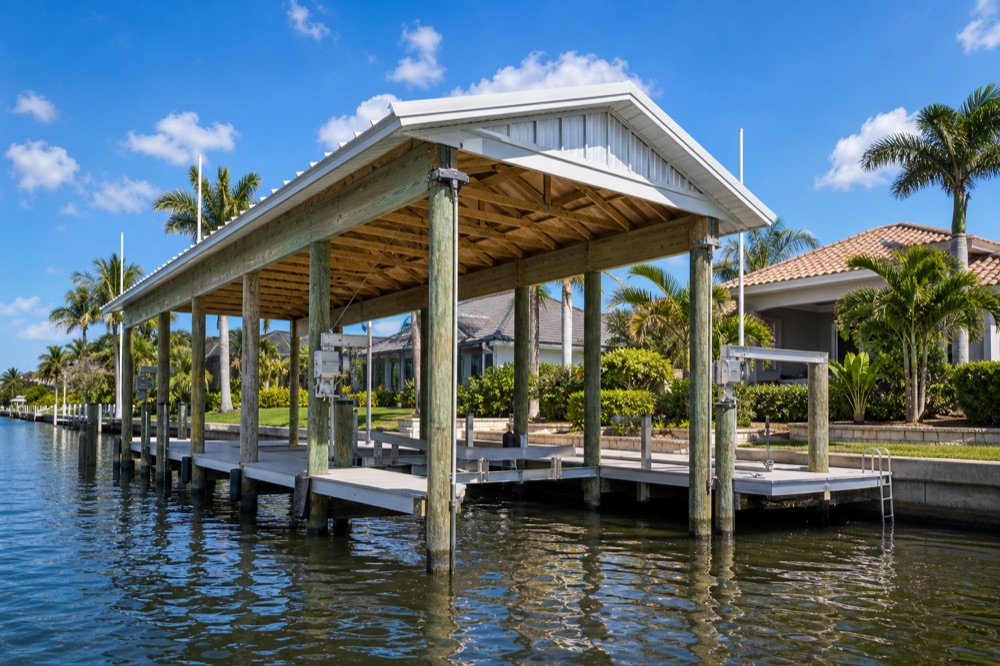
A boathouse is the roofed structure built over your slip, usually on its own pilings, that covers the boat and the lift below. The same things that make it valuable — shade, a dry deck, a protected lift — are taking the daily beating, so a little attention goes a long way.
How do you clean a boathouse roof and gutters?
Rinse the roof with fresh water a few times a year, clear leaves and debris from gutters and valleys, and check the flashing and fasteners while you’re up there. The goal is to keep water moving off and away from the structure.
Most SW Florida boathouses run a metal roof for exactly this reason — it sheds water and droppings better than shingle (we cover that in metal vs. shingle). To keep it doing its job:
- Rinse off salt and droppings with a garden hose; low pressure is fine, but skip aggressive pressure-washing that can drive water under panels or dent metal.
- Clear gutters and downspouts so afternoon storms drain instead of pooling — standing water breeds mildew and adds weight.
- Check the flashing, ridge cap, and fasteners for lifted edges or backed-out screws, especially heading into hurricane season (June through November).
- Watch for streaking or chalking on the panels; surface staining is cosmetic, but bare or scratched spots are where corrosion starts.
A wet roof over a canal is no place to slip, so many owners happily leave the on-the-roof items to us during a service visit.
How do you get mildew off framing and soffits without bleach?
Wash mildew with a mild soap-and-water solution and a soft-bristle brush, rinse well, and let it dry — and skip the bleach. Mildew thrives in our shade and humidity, and a gentle wash a few times a year keeps it from ever taking hold.
Skip the chlorine bleach — it does more harm than good here. Bleach lightens and dries out CCA-treated wood framing, corrodes aluminum and fasteners over time, and runs straight into the canal you fish and swim in. Instead:
- Mix mild dish or boat soap with water and scrub soffits, beams, and trim with a soft brush.
- For stubborn black spotting, step up to a marine-safe mildew cleaner made for boats and docks, and follow the label.
- Rinse thoroughly and let everything air-dry; trapped moisture is what mildew wants.
- Keep the underside open and uncluttered so the structure dries between storms.
Catching mildew while it’s a light film means a five-minute wipe instead of a scrub. Let it sit a year and it stains into the grain.
How do you deal with bird droppings on a boathouse?
Bird droppings are acidic and will dull paint, stain wood, and pit metal if left to bake in the sun, so the play is to deter the birds and clean the mess gently and often. No single deterrent works forever — rotate a few.
Pelicans, herons, ospreys, and cormorants all love a boathouse ridge. A layered approach works best:
- Physical deterrents: bird spikes or tensioned wire on favorite perches like the ridge, beam ends, and corners.
- Visual scares: reflective tape, flash deterrents, or a predator decoy (owl/hawk) that you move around every week or two so the birds don’t learn it’s fake.
- Sound or motion: wind chimes or a motion device near a stubborn perch.
- Gentle cleaning: soften dried droppings with water first, then wipe with mild soap — never let it harden into a crust.
There’s more in our guide on keeping birds off your dock and lift. The pattern is the same: deter, then clean before it does damage.
How does salt air affect boathouse fasteners and hardware?
Salt air corrodes the weakest metal first, so the fasteners, brackets, and lift hardware are where to look. We build with 316 stainless for this reason, but every owner should rinse and inspect hardware a few times a year.
On the SW Florida coast — Charlotte Harbor, the Caloosahatchee, the Gulf canals — there’s salt in the air every day, not just when it’s blowing. A well-built boathouse uses marine-grade aluminum framing and 316 stainless hardware, which is what holds up here. Still:
- Rinse hardware when you rinse the roof; salt that dries on metal is what does the damage.
- Tea-colored surface staining on stainless is normal and usually wipes off — it’s cosmetic, not failure.
- Pitting or rust means a sub-spec fastener has been found out; replace it before storm season loads it.
- Watch the connection points where the roof meets the pilings, and the lift hardware below — those carry the load.
Spot a corroded bracket or tired-looking piling? Don’t wait — our dock and boathouse repair team can swap a fastener now instead of rebuilding after it fails in a blow.
What’s a simple boathouse maintenance schedule for Florida?
Do a light rinse and walkthrough every 2–3 months, plus a quick check after any major storm. That cadence matches how fast salt, sun, and birds work down here.
| How often | What to do |
|---|---|
| Every 2–3 months | Rinse roof and hardware, clear gutters, wash off droppings, scan for mildew |
| Twice a year | Wash framing/soffits with mild soap, inspect fasteners and flashing closely, refresh bird deterrents |
| Before hurricane season (by June) | Full inspection: roof fasteners, flashing, pilings, lift hardware, clear all drains |
| After any storm | Walk it for lifted panels, debris, loose hardware, and new leaks |
On the calendar, the whole thing takes an hour or two a few times a year. And remember the payoff: that roof is also shielding the boat and the lift below from UV, rain, and droppings, so maintaining the structure is really maintaining everything beneath it.
Want a professional eye on your boathouse before storm season, or a hand with the up-high work? Florida Lifts & Docks has built and serviced covered slips across SW Florida since 2008 with our own local crew — never subbed. Learn more on our boathouses page, book a free on-site estimate seven days a week in Cape Coral, Fort Myers, Naples and beyond, or call (239) 397-3400.