
How Much Does It Cost to Repair a Dock After a Hurricane in Southwest Florida?
Storm-damage dock repair is never a flat number. Here are the real cost tiers, the on-site factors that drive them, and why an honest quote has to happen at the water.
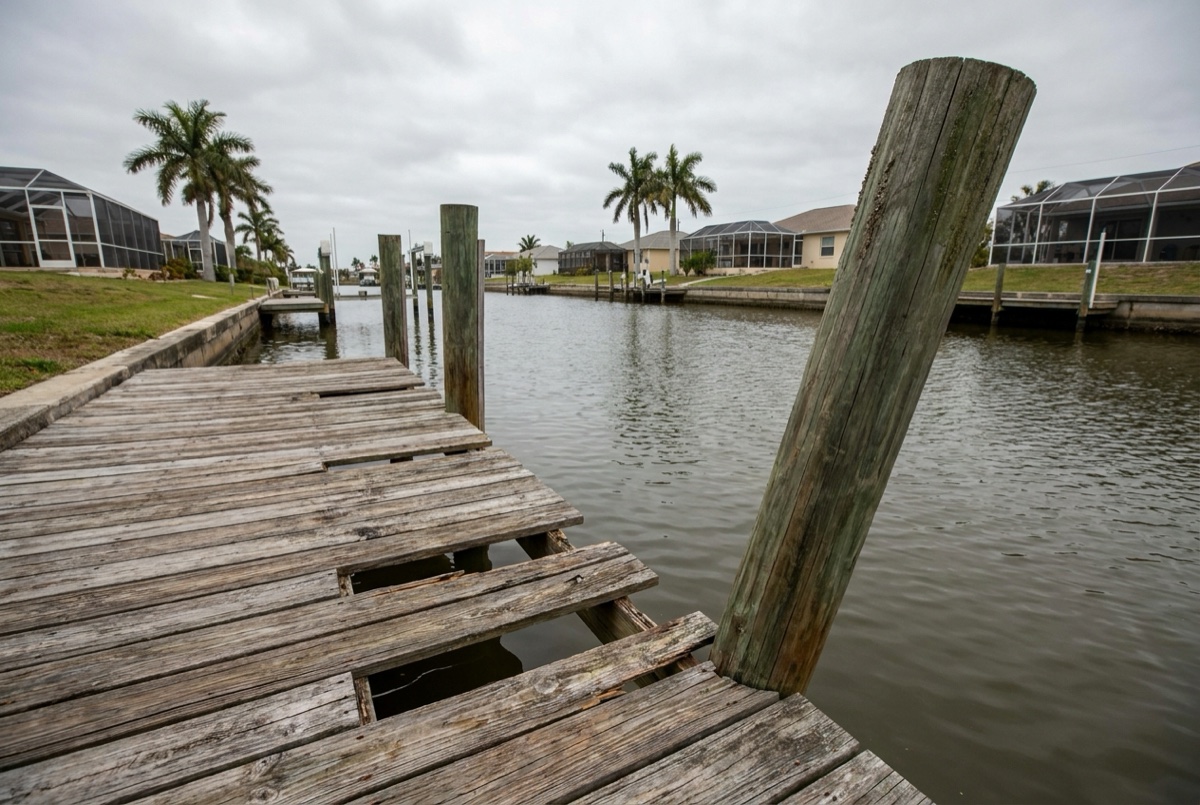
Key takeaways
- Hurricane dock repair has three real tiers — minor board-and-piling fixes, partial section rebuilds, and full teardown-and-rebuilds — and only the full rebuild maps to fixed pricing ($22,000 single-slip up to $68,000+ estate).
- Surge and wind damage is rarely a flat number because the worst damage (cracked pilings, racked framing, twisted lifts) often hides below the waterline.
- The big cost drivers are number of pilings, decking material, lift involvement, debris removal, water depth, and permitting.
- An honest storm-damage quote has to be done on site — we give free on-site estimates seven days a week, surge season included.
- Repair if the pilings and frame survived; rebuild if the structure is compromised. We tell you which one your dock actually needs.
After a hurricane rolls through Southwest Florida, the first thing most waterfront owners do is walk out back and try to make sense of what’s left of the dock. Sometimes it’s a few boards peeled up and a lift that needs realigning. Sometimes the whole structure is shoved sideways, a piling is snapped at the waterline, and your boat is sitting somewhere it shouldn’t be. Either way, the question is immediate: what is this going to cost to fix?
Here’s the honest answer up front, and it’s the same one we give every caller from Cape Coral to Punta Gorda to Marco Island: storm-damage dock repair is almost never a flat number, and any builder who quotes you one over the phone is guessing. Below we’ll walk through the real cost tiers, define what “dock repair” actually covers, and lay out exactly which on-site factors move the price — so when we come look at your dock, you’ll know precisely what we’re pricing and why.
What counts as “dock repair” after a storm?
Dock repair is any work that restores a damaged dock without rebuilding it from scratch — replacing boards, resetting or swapping pilings, re-securing or replacing hardware, and getting a boat lift working again. Once enough of the structure is compromised that piecemeal fixes no longer make sense, you’ve crossed into rebuild territory, which is a different conversation and a different price.
The line between the two isn’t about how bad it looks from the seawall. It’s about how much of the load-bearing structure survived. A dock can look wrecked — every board lifted, railings gone — and still sit on perfectly sound pilings, which makes it a repair. Another dock can look mostly intact and have a cracked piling and a racked frame hiding under the deck, which makes it a candidate for a partial rebuild. That’s the whole reason we have to see it.
What are the real cost tiers for hurricane dock repair?
There are three honest tiers: a minor board-and-piling fix, a partial section rebuild, and a full teardown-and-rebuild. Only the full rebuild maps cleanly to fixed pricing — the two repair tiers depend entirely on what we find and are quoted free on-site.
Here’s how the tiers break down in plain terms:
- Minor fix. A handful of storm-loosened pilings to reset or replace, some snapped or lifted decking boards, bent or missing hardware, and a boat lift that needs realigning or new cables. The bones are good; you’re restoring the parts that took the hit. This is the lower tier, and it’s quoted at the estimate.
- Partial section rebuild. Surge tore out a run of the dock — a section of framing racked or collapsed, two or three pilings snapped, a stretch of deck gone — but the rest of the structure held. We rebuild the failed section and tie it back into the sound portion. Mid-tier cost, again quoted on site because it hinges on how many pilings and how much framing.
- Full teardown-and-rebuild. The structure is compromised end to end — pilings snapped or pushed out of plumb across the dock, the frame twisted, the deck unsalvageable, often with seawall or lift damage layered on top. At this point you’re not repairing a dock, you’re building a new one, and that lands in custom-dock pricing.
Because a full rebuild is effectively a new dock, that’s the only tier we can attach real ranges to. Those are the same numbers in our custom dock cost guide:
| Rebuild scenario | Typical installed cost |
|---|---|
| Single-slip dock | $22,000–$30,000 |
| Captain’s walk | $32,000–$44,000 |
| Multi-slip dock | $46,000–$62,000 |
| Estate / T-dock | $68,000+ |
If a boat lift went down with the dock, that’s its own line: a jet-ski lift runs $3,000–$5,000, a 7,000–10,000 lb lift $8,000–$13,500, a 16,000 lb lift $14,000–$19,000, and a 24,000 lb-plus offshore lift starts around $22,000. We’ll fold the right one into the scope once we know what survived.
Why can’t you just quote my dock over the phone?
Because surge and wind damage is rarely what it looks like from a photo, and the most expensive problems hide where you can’t see them — below the waterline and under the deck. Quoting blind means quoting wrong, and a wrong number helps nobody.
Think about what a Category storm actually does to a structure standing in a saltwater canal. Storm surge doesn’t just push water up; it shoves debris, floats boats off lifts, and applies sideways load to pilings that were only ever designed for vertical weight. After the water drops, the damage that matters most is the damage you can’t easily see:
- Pilings can be cracked below the waterline even when the part above looks straight and solid. A piling that’s split at the mudline will fail the next time it’s loaded, so we check each one — wood, concrete, or composite — for plumb, soundness, and movement.
- Framing can be split or racked under the decking where it’s hidden. A frame that’s shifted even a few inches has lost its structural integrity, and bolting new boards over a compromised frame is throwing money away.
- A boat lift can be twisted on its mounts or have stretched cables and a flooded motor, none of which shows up in a quick glance from the seawall.
- The seawall behind the dock may be undermined. Surge scours fill out from behind a seawall, and a dock anchored to a failing seawall is only as good as the wall holding it.
A photo flattens all of that into something that looks like “a few boards and a leaning post.” Once we’re actually standing on it — pushing on pilings, pulling back decking, checking the lift, looking at the waterline — the real scope shows up, and so does an honest price. That’s not a sales tactic. Even the list of likely failures shifts with the water a dock stands in, which is why we keep a separate one in dock and lift repair in Estero. It’s the difference between a number you can budget around and a number that doubles the day work starts.
What drives the price of storm-damage repair?
The biggest cost drivers are how many pilings need work, the decking material, whether a lift is involved, how much debris has to come out, water depth, and permitting. Two docks with identical-looking damage can carry very different prices once these factors are weighed.
Here’s what we’re actually evaluating at the estimate:
- Number of pilings. Pilings are the foundation, and they’re the single biggest swing in any storm repair. Resetting one loosened piling is minor; driving four new ones through hard canal bottom is a different job entirely. Cracked or snapped pilings almost always have to be replaced, not patched. (See leaning or loose dock pilings after a storm and dock piling replacement cost.)
- Decking material. Replacing a few capped composite boards to match an existing TimberTech or Trex deck costs differently than re-decking in CCA-treated lumber, and matching an older deck sometimes means more than just the damaged run.
- Lift involvement. A dock repair that also has to realign, re-cable, or replace a boat lift is two jobs in one. Saltwater is brutal on lift hardware even before a storm, so we check cables, the motor, and the mounts closely.
- Debris removal. Surge leaves behind more than a broken dock — pieces of other docks, mangrove wrack, sunken hardware, sometimes a boat that needs moving before we can even work. Clearing the site safely is real labor.
- Water depth and tide. Deeper water and bigger tide swings on the Caloosahatchee or out toward Charlotte Harbor change how we set pilings and stage the crew, which affects the timeline and the cost.
- Permitting. Storm or no storm, structural dock work in Southwest Florida requires permits, and the rules can differ by city and county. We handle permitting in-house so it’s scoped into the job from the start, not a surprise at the end — but it’s a real part of the cost and the schedule.
Should I repair or rebuild?
Repair if the pilings and framing came through the storm sound and only the decking, hardware, or lift took damage. Lean toward a rebuild if pilings snapped, the frame racked, or surge undermined the seawall — because patching a compromised structure rarely lasts through the next season. We’ll tell you straight which one your dock needs.
The math is simpler than it feels in the moment. Marine-grade aluminum framing, 316 stainless hardware, sealed marine motors, and properly driven pilings are built to last decades in salt water. If those bones survived, restoring the surface damage is money well spent. But if you’re sinking thousands into a frame that’s already shifted, you’re buying a repair that fails — and after a major storm, the whole coast is competing for the same crews, so you don’t want to do this twice. We walk every owner through the honest version of that trade-off at the estimate rather than upselling a rebuild that isn’t warranted. Our deeper breakdown lives in repair or replace your dock, and there’s a related question of insurance that’s worth sorting early — see does homeowners insurance cover dock damage.
How can I keep repair costs down next time?
The cheapest hurricane repair is the one you don’t need, and that comes from building to spec the first time and prepping ahead of the season. A dock built on properly driven pilings with marine-grade aluminum, stainless hardware, and capped composite decking simply survives storms that destroy cut-rate construction.
A few things genuinely move the needle:
- Build it right. A cheap dock is the most expensive dock you’ll ever own on this coast, because the Gulf, the salt, the UV, and the marine borers never stop working. Quality framing and pilings are what stand up to surge.
- Prep every season. Hurricane season runs June through November. Pulling smaller boats, securing or removing lift canopies and loose gear, and getting a pre-season inspection all reduce what a storm can take. Our hurricane prep guide for docks, lifts, and seawalls covers the checklist.
- Catch problems early. A loose piling or a corroding cable found in October is a small fix. Found after a November storm, it’s a failure point. Don’t ignore the small stuff.
If a storm did a number on your dock, don’t try to price it from the seawall — let us look at it properly. We’re a Cape Coral company, established in 2008, with a 5.0-star rating on Google, our own local crew that we never sub out, and in-house permitting to keep your project moving when the whole coast is scrambling. We give free on-site estimates seven days a week, surge season included, across all 18 of the Southwest Florida communities we serve, from Cape Coral to Naples to Punta Gorda. See everything we handle on our dock repair page, or just call (239) 397-3400 and we’ll come take a real look.