
Should You Repair or Replace Your Dock? A Southwest Florida Decision Guide
How to tell whether your dock needs a few smart repairs or a full rebuild — a clear decision framework built for SW Florida's salt water, sun, and storm seasons.
Key takeaways
- If your pilings and frame are structurally sound, repair — re-deck, swap fasteners, and fix isolated members instead of rebuilding.
- If you have widespread rot, a failed substructure, multiple leaning pilings, or major storm damage, a full rebuild is almost always the smarter spend.
- A SW Florida dock realistically lasts 15–20 years; if yours is in that window with multiple failing systems, replacement usually wins on cost-per-year.
- Check four things first: pilings at the mudline, stringers and joists, fasteners, and decking. Two or more failing usually tips the call toward replace.
- The honest answer comes from an on-site look at the structure below the deck — that's free, seven days a week, at (239) 397-3400.
Your dock has seen better days. A board flexes underfoot, a piling looks like it’s leaning a little more than it used to, and after the last storm season you’re not entirely sure what’s holding the whole thing up. Now you’re staring at the question every Southwest Florida waterfront owner eventually faces: do you patch it, or do you tear it out and start fresh?
There’s a real answer, and it isn’t “it depends” thrown over its shoulder on the way out the door. The decision comes down to one thing — the condition of the structure below your deck boards. Get that part right and the call between repair and replace becomes clear. This guide walks you through the framework we use on-site every week, the four things to check first, and the honest math on cost and lifespan for docks on our salt-water coast.
What’s the difference between a dock repair and a dock replacement?
A repair fixes specific, isolated failures while leaving the load-bearing skeleton in place. A replacement removes the structure down to (or including) the pilings and rebuilds it. The dividing line is whether your dock’s bones — the pilings and framing — can be trusted to carry the load for another decade.
A “repair” means your pilings and frame are sound, and you’re addressing things that ride on top of them: rotted or splintered deck boards, corroded fasteners, a single damaged stringer, a loose railing, a worn-out section of decking. The dock’s structure stays; you’re refreshing the parts that wear out first.
A “replacement” means the structure itself has failed. The pilings are rotted at the mudline, multiple framing members are gone, or a storm has racked the platform out of square. At that point, bolting new boards onto a dying frame is throwing good money after bad — you’re paying real money for a dock that’s still on borrowed time.
Most real-world situations land somewhere between those poles, which is exactly why the checklist below matters.
How long does a dock actually last in Southwest Florida?
Plan on 15 to 20 years for a typical canal dock here. Our environment is uniquely hard on marine structures, and that lifespan is the single most useful number for framing the repair-or-replace decision.
Think about what your dock fights every day. Salt water wicks into wood and corrodes metal around the clock. The Gulf-coast sun bakes and bleaches everything above the waterline. Marine borers — the tiny shipworms and crustaceans living in our canals, Charlotte Harbor, and the Caloosahatchee — quietly eat wood pilings from the inside, often right at the mudline where you can’t see it. And every hurricane season, June through November, brings the threat of surge that can lift, twist, or shear an entire dock off its pilings.
Where your dock falls in that window matters:
- Under ~10 years old: Repair is almost always the answer. The structure should have plenty of life left; you’re just maintaining it.
- 10 to 15 years: It depends on the condition. A well-built dock that’s been maintained can absolutely be repaired. A neglected one may already be on the edge.
- 15 to 20+ years: This is the decision zone. If you’re seeing multiple failing systems, replacement usually wins on cost-per-year — you stop pouring repair money into a structure that’s near the end regardless.
A dock built with capped composite decking and concrete or composite pilings sits at the top of that range. An older dock framed in CCA-treated wood with wood pilings that hasn’t been sealed or maintained often falls short of it.
Check these 4 things first
Before you can make the call, you need to know what condition your dock is actually in — and that means looking below the deck, not just at it. Here are the four things that decide the outcome, in order of importance.
- Pilings at the mudline. This is the most important check and the one homeowners skip. Pilings rot and get eaten by marine borers right at the waterline and just below it, in the splash zone where wet meets dry. Push on each piling, look for soft or hollow spots, cracking, or a visible “hourglass” pinch near the water. Sound pilings are the foundation of a repair. Compromised pilings push you toward replacement — and if they’re leaning, see our guide to a leaning or loose dock piling after a storm.
- Stringers and joists (the substructure). These are the horizontal beams under your deck boards that carry the load to the pilings. Probe them for rot, especially at the ends where they meet the pilings and trap moisture. One soft stringer is a repair. Widespread rot across the framing means the substructure is failing, and that’s a rebuild signal.
- Fasteners. Bolts, lag screws, and deck screws are the first things salt water destroys. Rusted, weeping, or sheared fasteners — and the tell-tale black streaks bleeding from each bolt head — mean connections are losing strength. Fasteners alone are an easy fix. But if the corrosion has eaten into the wood around them, the damage runs deeper than the hardware.
- Decking. The boards you walk on. Splinters, cupping, soft spots, rot at the board ends, and popped fasteners are normal wear and often the easiest, most satisfying repair of all. If the decking is the only thing failing and the structure below is solid, you’ve got a clear-cut re-decking job, not a rebuild.
The rule of thumb: if only the decking and fasteners are failing and the pilings and frame are sound, repair. If two or more of these systems are compromised — especially the pilings or substructure — the math almost always favors replacement.
Repair or replace: how the two options compare
Here’s the honest side-by-side. A repair always wins on day-one cost; a replacement usually wins on everything that happens after.
| Factor | Repair | Replace |
|---|---|---|
| Up-front cost | Lower — you pay only for what’s failing | Higher — full structure (single-slip docks run $22,000–$30,000; larger builds more) |
| Lifespan added | A few years to a decade, depending on what’s left | A fresh 15–20-year clock |
| Downtime | Short — often days, dock stays usable | Longer — the dock is out of service during the rebuild |
| Permitting | Often lighter for repairs in kind | Typically required, especially if footprint or pilings change |
| Warranty | Covers the new parts only | Covers the whole new structure |
| Best when | Sound pilings + frame, isolated wear | Widespread rot, failed substructure, major storm damage |
The trap to avoid is the slow rebuild — replacing a few boards this year, a couple of pilings next year, a stringer the year after. Do that on an old dock and you’ll spend close to replacement money over a few seasons while still owning a patchwork dock that ages out anyway. If the inspection shows you’re heading that direction, building once is the cheaper path. For the cost side of new pilings specifically, see our dock piling replacement cost guide.
What about storm damage — repair or rebuild?
After a storm, the question shifts from “is it worn out” to “is it still structurally trustworthy.” Cosmetic damage is a repair; anything that compromised the pilings or racked the frame is usually a rebuild.
Surge and wave action don’t just break boards — they can lift a dock and drop it back down out of square, crack pilings below the waterline where the damage hides, or shear the connections that tie the platform to its foundation. A dock can look mostly intact and still be structurally finished underneath.
After any major weather, walk the dock and look for:
- Pilings that shifted, leaned, or lifted (even slightly)
- A platform that’s no longer level or square
- Boards or framing pulled loose at the connections
- New cracking in concrete pilings or caps
- A dock that feels “soft” or moves more than it used to
If you see any of those, stop using it and get it inspected. We break the full process down in our guides to repairing a dock after a hurricane and broader hurricane prep for docks, lifts, and seawalls. Storm damage is also the moment to check whether your homeowners policy applies, since dock coverage varies widely.
How we build a dock to last on the salt-water coast
When the call is replace, the rebuild should be the last dock you think about for two decades. The spec is what makes the difference on this coast, where a cheap build is the most expensive dock you’ll ever own.
Everything we put in the water is chosen to survive salt, sun, and storms:
- CCA-treated framing rated for marine immersion
- Concrete or composite pilings where conditions call for maximum borer and rot resistance
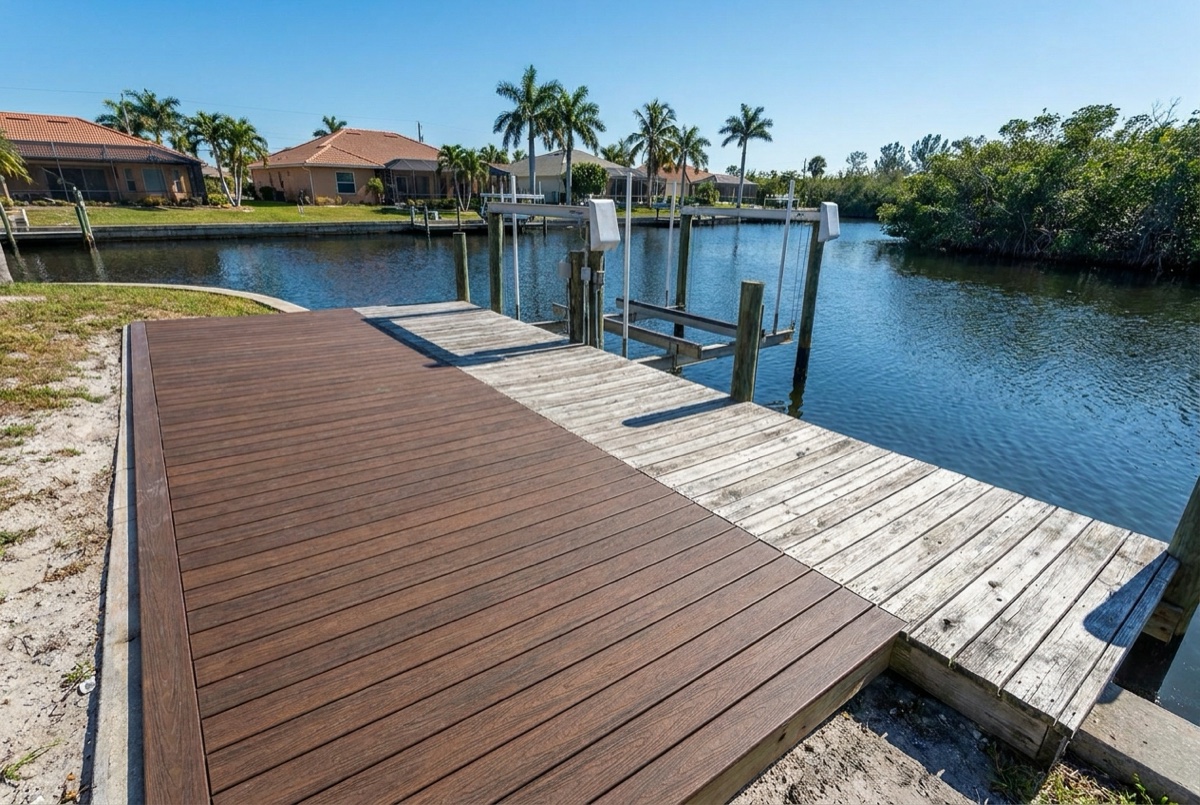
- Capped composite decking (TimberTech / Trex) that won’t rot, splinter, or bake your feet
- 316 stainless fasteners and hardware that hold their strength in salt water
That’s the difference between a dock that lasts decades and one you’re patching in five years. If you’re weighing decking materials for a rebuild, our composite vs. wood docks breakdown is the place to start.
Get an honest answer for your dock
The truth is, you can’t make this decision from the seawall. The deciding factors — the pilings at the mudline, the framing under the deck, the connections you can’t see — all live below the surface. That’s why we come look in person.
Florida Lifts & Docks has built and rebuilt docks across Southwest Florida since 2008 with our own local crew — never subbed out — and 5.0 stars on Google to show for it. We handle permitting in-house, and our free on-site estimate comes with a straight recommendation: if repairs will get you there, we’ll tell you. If a rebuild is the smarter spend, we’ll show you why.
Start with our dock repair page, see what a new build looks like on our custom docks page, and when you’re ready for an honest look at your structure, call (239) 397-3400. We give free on-site estimates seven days a week across Cape Coral, Fort Myers, Naples, and the rest of the coast.