
Does a Dock or Boat Lift Add Home Value in Southwest Florida?
The honest answer to the big money question — when a dock or lift pays you back at resale, when it doesn't, and what separates a value-adding build from a liability.
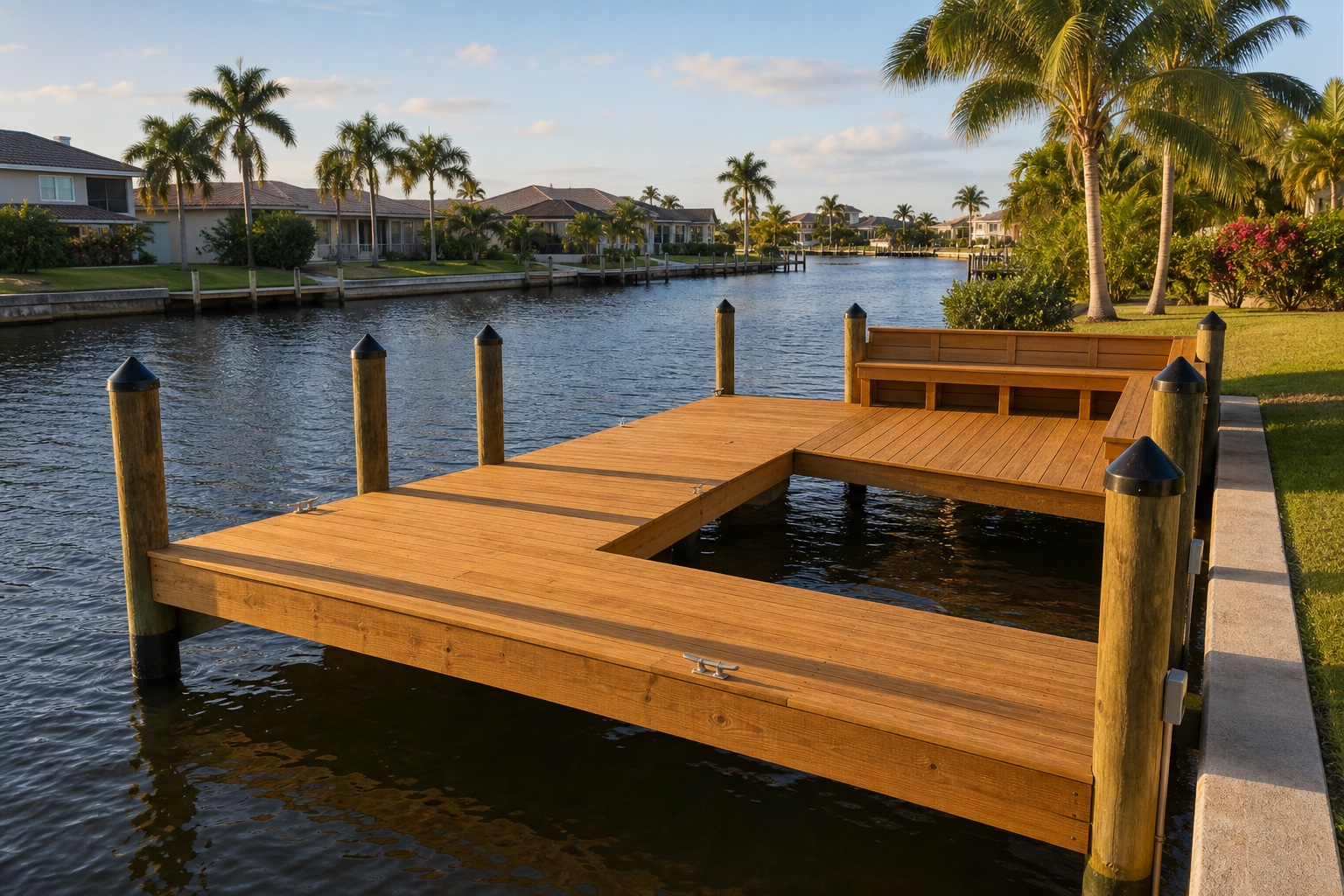
Key takeaways
- In Southwest Florida, a well-built dock and boat lift on navigable deep water are among the highest-return waterfront upgrades — buyers here shop for the water access first, and turnkey boating is what they pay a premium for.
- Value is driven by four things in order: usable deep-water access, build quality and condition, a lift that protects the boat, and a sound seawall. Weak water sinks the return no matter how nice the dock.
- A quality marine-grade build (aluminum, 316 stainless, composite decking) reads as an asset on a listing; a cheap or rotting dock reads as a repair bill buyers subtract from their offer.
- Permits matter at closing — an unpermitted or undocumented structure can stall a sale or force a price cut, so a properly permitted build protects resale value, not just the boat.
If you own waterfront in Southwest Florida — or you’re about to spend serious money on a dock, a boat lift, or a new seawall — the question underneath all the others is simple: is it worth it, and will it pay me back? It’s the right question to ask, and you deserve an honest answer instead of a sales pitch.
Here’s the short version. In this market, a quality dock and lift on good water are among the best returns you can get on a waterfront home, because buyers here are shopping for the water access first and the house second. But the word “quality” is doing a lot of work in that sentence, and the return varies enormously by where you are and what your canal can actually float. Below is how dock and lift value really works on this coast, framed the way a builder who’s been doing this since 2008 would tell a neighbor.
Does a dock add home value, or is it just a nice-to-have?
In Southwest Florida, a well-built dock on navigable deep water is a genuine value driver, not just a lifestyle perk. Waterfront here is bought for the boating, so turnkey access is exactly what buyers are paying a premium for.
Think about how buyers actually search in Cape Coral, Fort Myers, or Naples. They don’t filter for “house with a yard.” They filter for Gulf access, sailboat water, deep canals, no bridges. The water is the headline. A home with a clean, ready-to-use dock and lift lets that buyer picture their boat in the slip on closing day. A comparable home with no dock — or a sun-cooked, sagging one — turns into a project they have to price out before they’ll commit.
That gap is where the value lives. You’re not just adding a structure; you’re removing a buyer’s hesitation and a buyer’s to-do list. On this coast, that’s worth real money.
What actually drives a dock’s resale value?
Four things, roughly in this order: usable deep-water access, build quality and condition, a lift that protects the boat, and a sound seawall. Get the water and the build right and the rest follows; get the water wrong and even a beautiful dock won’t rescue the return.
It helps to separate what you can change from what you can’t. Here’s how the big factors break down:
| Value driver | Can you change it? | Why it moves the number |
|---|---|---|
| Deep-water / Gulf access | No (it’s your lot) | The single biggest factor; sets the ceiling on what any dock is worth |
| Build quality & materials | Yes | A marine-grade build reads as an asset; a cheap one reads as a repair bill |
| Condition & age | Yes (maintenance, rebuild) | Buyers subtract obvious wear and rot from their offer |
| A right-sized, working boat lift | Yes | Turnkey boating; protects the hull from day one |
| Seawall condition | Yes (repair / replace) | A failing seawall is a major red flag and a price-killer |
| Permits & documentation | Yes (build it right) | Unpermitted work can stall or cut a sale at closing |
The lesson in that table: most of what determines your return is in your control. You can’t move your house to deeper water, but you absolutely control whether the structure on that water is an asset or a liability.
Why does a quality build out-return a cheap one?
A quality dock returns more of its cost — and protects the rest of your home value — because Southwest Florida’s saltwater environment destroys cheap construction fast, and buyers know it. A budget dock isn’t a bargain; it’s a depreciating liability with a short clock.
The Gulf coast is a brutal place to put wood and metal in the water. You’ve got year-round saltwater canals, UV that bakes everything, marine borers chewing untreated pilings from the waterline down, big tide swings, and a hurricane season from June through November that stress-tests every fastener. A dock built to the cheapest possible spec starts losing value the day it’s finished.
What we build to last — and what a sharp buyer’s inspector looks for — is the opposite:
- Marine-grade aluminum lift frames that won’t rust out in salt air
- 316 stainless cable and hardware, the grade that actually survives saltwater
- Sealed marine motors rated for this environment
- Capped composite decking (TimberTech / Trex) that won’t rot, splinter, or need yearly sealing
- CCA-treated framing sized and driven for our canal bottoms
To a buyer, a dock built like that is a checkmark — one less thing to budget for. A dock built from untreated lumber and galvanized hardware that’s already weeping rust stains is the opposite: a visible, datable expense the buyer will subtract from the offer, often for more than it would have cost you to build it right in the first place. That’s the whole argument for quality in one sentence. (For a full breakdown of what a quality build actually costs, see our custom dock cost guide and boat lift cost guide.)
How much value does a dock or lift actually add?
Honestly? There’s no universal percentage, and you should distrust anyone who gives you one as a hard rule. What’s reliable in Southwest Florida is that turnkey deep-water boating commands a clear premium over a comparable home with no dock or a tear-down dock — and a quality build returns far more of its cost than a budget one.
Why the honest hedge instead of a tidy number? Because the return genuinely depends on your specific situation:
- Location and water. A dock on wide, deep, Gulf-access water in Cape Coral or Punta Gorda supports a much bigger premium than the same dock on a shallow, dead-end canal that can only float a kayak at low tide.
- What the neighborhood supports. An estate-grade multi-slip dock on a street of modest single-slip homes won’t return its full cost — you can over-build for the market. The best return comes from a dock right-sized to the home and the canal.
- Condition at sale. A five-year-old composite dock shows completely differently than a twenty-year-old wood one, even if both “work.”
- Whether it’s permitted. More on that below — it matters more at closing than most owners expect.
So the practical answer isn’t a percentage. It’s this: on good water, a quality dock and lift are very likely to be worth building, and very likely to pay back a strong share of their cost at resale — while a cheap or neglected one can quietly cost you. The way to know your number is an on-site look at your actual water, not a rule of thumb from the internet.
How does a dock factor into actually selling the home?
When you list a waterfront home, the dock and seawall move from “your boating setup” to “due-diligence items the buyer’s inspector and lender scrutinize.” A clean, permitted, well-built waterfront package speeds the sale and protects your price; a problem package becomes a negotiation against you.
A few things change the moment a home goes on the market:
- Inspectors look hard at the waterfront. Leaning pilings, corroded lift cables, rotted boards, and a bowing seawall all show up in reports — and every finding becomes a line item the buyer asks you to credit or fix.
- A failing seawall is a deal-shaker. Of all the waterfront red flags, a seawall that’s leaning, cracked, or undermined is the scariest to buyers, because replacement is a major expense and it protects the whole backyard from washing into the canal. A sound seawall protects your sale price; a failing one invites a big discount.
- Permits and paperwork surface at closing. This is the one owners underestimate. If your dock, lift, or seawall was built without the right permits — or you simply can’t document it — it can stall the sale, complicate the appraisal, or force a price cut while it gets sorted out. (We dig into this in buying or selling a home with an unpermitted dock or seawall.)
This is exactly why we handle permitting in-house on every job and build to a documented, inspectable spec. A dock that’s done right on paper is part of what makes the home easy to sell, not just easy to boat from. Buying waterfront in Estero, the buyer’s-side version of that idea, walks what to inspect and what to ask for in writing before the money moves.
A simple decision framework: should you build before you sell?
Use this quick gut-check to decide whether a dock or lift investment is likely to pay you back. It won’t replace an on-site estimate, but it’ll tell you which direction the math is pointing.
- Is your water genuinely good? Deep, navigable, ideally Gulf-access water means a dock is very likely worth it. Shallow or restricted water means be conservative — build for use, not for resale premium.
- What’s there now? No dock or a failing one on good water is the classic “build it” case, because you’re removing a buyer’s project. A sound, recent dock usually just needs maintenance, not replacement.
- Are you matching the neighborhood? Right-size to the home and canal. A quality single-slip or captain’s walk on the right lot beats an over-built estate dock the market won’t pay for.
- Is the seawall sound? If it’s questionable, address that first — it’s the foundation everything else sits on, and the biggest red flag at sale. Compare your options in seawall repair vs. replacement.
- Will you build to last? Marine-grade aluminum, 316 stainless, composite decking, and proper permits are what turn the project from a cost into an asset. A cheap build undercuts the whole return.
If most of those point the right way, building (or rebuilding) before you sell tends to pay — and you get to enjoy the dock in the meantime. If your water is weak or the neighborhood ceiling is low, build for your own use and don’t expect the market to fully reward it. Either way, the honest move is to get a real look at your site before you spend a dollar.
Get a straight answer for your specific waterfront
Whether a dock or lift will pay you back comes down to your water, your seawall, and how it’s built — and those are exactly the things we can read in person in a few minutes. Florida Lifts & Docks has built and rebuilt waterfront across 18 Southwest Florida cities since 2008, using our own local crew (never subbed), with in-house permitting and a 5.0-star track record on Google.
If you’re weighing a new build or a rebuild before a sale, start with our custom docks page to see what a quality build looks like, then get a free on-site estimate — seven days a week — so you have real numbers for your canal instead of a rule of thumb. Call (239) 397-3400 and we’ll tell you honestly whether the math works for your waterfront.