
Best Floating Dock Material for Salt Water: HDPE vs. Concrete vs. Aluminum
Forget the decking for a second — this is about the floats and frame that keep your dock UP. Here's what survives SW Florida salt water and what waterlogs, corrodes, or spalls.
Key takeaways
- The best floating dock material for salt water is sealed marine-grade HDPE floats on a marine aluminum frame with 316 stainless hardware — it won't waterlog, rust, or spall.
- Thin-wall and foam-filled drums are the cheap option that fails first; once the shell cracks they soak up water, ride low, and list.
- Concrete pontoons float plenty of weight but crack over time, and salt water reaches the rebar inside, which rusts and spalls the concrete apart.
- Steel frames have no place on a saltwater canal — they corrode fast even when galvanized; marine aluminum is the only frame metal that lasts.
- Decking is a separate decision from the float and frame, so spec the structure that keeps you up first, then choose the surface you walk on.
When people compare floating dock “materials,” they usually mean the decking — the boards under their feet. But on a saltwater canal, the part that actually decides whether your dock survives is the part you never see: the floats and the frame holding everything up. Get those wrong and it doesn’t matter how nice the deck is. Within a few seasons the dock rides low, lists to one side, or starts coming apart at the joints.
So let’s talk about the structure, not the surface. Here’s how the real float and frame systems hold up in Southwest Florida salt water, tide, sun, and storm surge — and which one we build for canals from Cape Coral to Charlotte Harbor.
What actually keeps a floating dock up?
A floating dock is two systems working together: buoyancy (the floats that lift the dock) and the frame (the structure that ties the floats into a rigid platform and carries the deck). Pick the right material for each and the dock lasts decades. Pick the cheap version of either and the whole thing fails early.
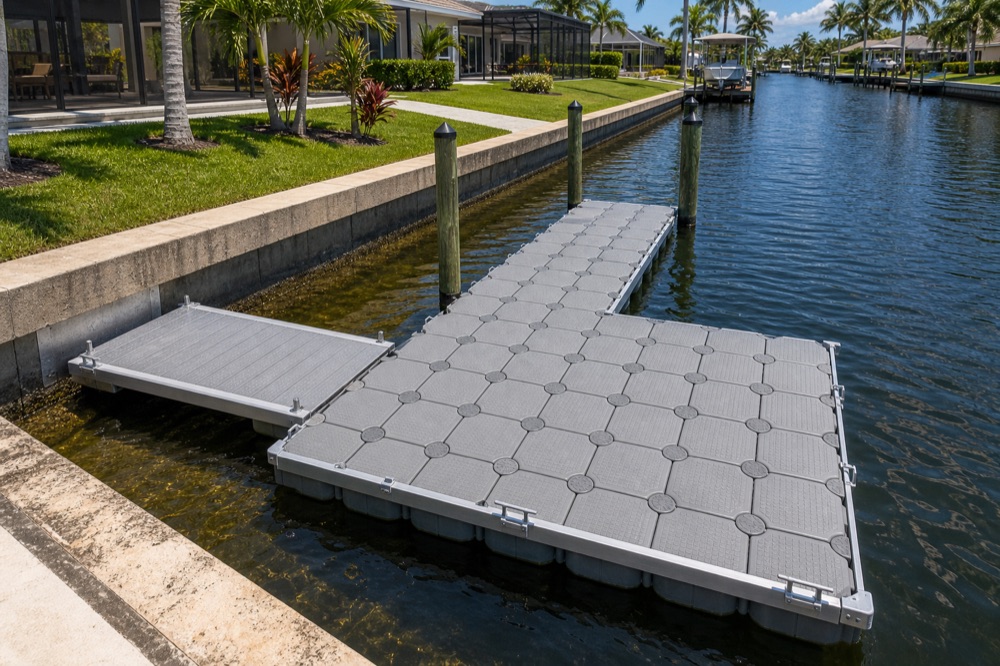
The float is the heart of it. The best floats are sealed, thick-wall marine-grade HDPE — high-density polyethylene, a solid, dense plastic that doesn’t absorb water, rust, or rot. Modular HDPE cubes (the interlocking kind) and large molded HDPE pontoons are both proven in salt water. They take UV, barnacles, and the occasional hull bump and keep doing their job.
Why do thin-wall and foam-filled floats fail first?
They fail because the moment the shell is breached, the float starts drinking. A cracked or punctured float takes on water, rides low, and pulls that corner of the dock down with it.
The bargain options are the ones to avoid:
- Thin-wall hollow drums. A skinny plastic skin cracks from UV embrittlement, dock-line chafe, and barnacle pressure. Once it’s breached, water gets in and won’t come out.
- Foam-filled floats with a thin coating. The foam holds shape for a while, but a thin shell still cracks, the foam waterlogs, and it gets heavier instead of lighter.
- Bare EPS foam blocks. Unencapsulated foam crumbles in UV and current, and it’s exactly what curious wildlife and barnacles destroy.
The tell is always the same: a once-level dock that now sits low on one end or rocks unevenly. That’s a float taking on water, and it only gets worse. If you’re already seeing it, our dock repair crew can diagnose whether it’s a float, an anchor, or the frame.
Are concrete floating docks good for salt water?
Concrete pontoons float serious weight and feel rock-solid underfoot — but they carry a long-term risk that’s easy to underestimate on a saltwater canal: rebar spalling.
Here’s the chain of events. Concrete cracks eventually — from load cycling, impact, and our salt-soaked conditions. Once a hairline crack opens, salt water carries chloride to the steel rebar cast inside the pontoon. That steel rusts, and rusting steel expands, and that outward pressure pops the surrounding concrete off in chunks. You’ve seen it on old seawall caps and bridge pilings; the same physics works on a concrete float, just hidden inside a shell you’re trusting to stay sealed for decades.
Concrete also makes a heavy dock that’s hard to adjust or repair. It can be done well, but for most canal-front floating docks it’s more mass and more long-term risk than you need.
Steel vs. aluminum: which frame survives the canal?
Marine-grade aluminum. Full stop. Steel — even hot-dip galvanized — does not belong in SW Florida salt water.
Galvanizing buys time, but the zinc coating gives out where it matters most: at welds, scratches, bolt holes, and the splash zone right at the waterline. Once bare steel meets salt, it rusts, and a rusting frame loses strength at the joints that hold your dock together. We see the same story on cheap lifts, which is why we cover it in our aluminum vs. galvanized boat lift guide.
Marine aluminum doesn’t rust. It forms a tight oxide layer that protects itself, it’s light enough to keep the dock buoyant and easy to service, and it carries plenty of load. Paired with 316 stainless bolts and brackets — the marine grade that resists chloride pitting far better than cheaper stainless — you get a frame that outlasts the floats themselves.
How the float and frame systems compare
| System | Salt-water lifespan | Main failure mode | Best for |
|---|---|---|---|
| Sealed marine HDPE floats + aluminum frame | Longest | Very few; floats can be swapped | The default we build on SW FL canals |
| Concrete pontoons (rebar inside) | Long, but with risk | Cracking, then rebar rust and spalling | Heavy commercial use; less ideal for canals |
| Steel frame (even galvanized) | Short | Coating fails, frame rusts at joints | Nothing in salt water — avoid |
| Thin-wall / foam-filled drums | Shortest | Shell cracks, float waterlogs and lists | The cheap option that fails first |
A floating dock’s floats are also the part most likely to be replaced over its life, which is its own decision — we walk through it in how long floating docks last and when to replace floats.
Don’t confuse the floats with the decking
One last thing that trips owners up: the float and frame are a separate choice from the deck surface. The floats keep you up; the decking is what you walk on, whether that’s capped composite or marine wood. A beautiful composite deck won’t save a waterlogging float, so spec the structure first, then choose the surface. (For the deck itself, see our composite vs. wood docks guide.)
It also matters how the whole thing is held in place. Even the best floats need the right anchoring for your canal’s tide range and bottom, which we cover in how floating docks are anchored.
Spec floats that won’t let you down
If you want a floating dock that’s still level and solid a decade from now, the answer is consistent: sealed marine-grade HDPE floats, a marine aluminum frame, and 316 stainless hardware. Skip the thin-wall drums, think hard before you trust rebar-filled concrete to stay sealed in salt water, and never put steel in the canal. We’ve built for this exact environment since 2008 with our own local crew — never subbed — and we handle permitting in-house.
See everything we build on our floating docks page, or get a real plan for your site. We give free on-site estimates seven days a week across Cape Coral, Naples, Fort Myers, and the rest of the coast up to Punta Gorda. Call (239) 397-3400.