
Floating Dock Maintenance in Salt Water: Barnacles, Algae & Slippery Decks
A seasonal salt-water care routine for SW Florida floating docks — how to stay ahead of fast-growing barnacles, control slippery algae, and inspect floats and hardware twice a year.
Key takeaways
- In SW Florida's warm canal water, barnacles and oysters can colonize a float in weeks — left alone, the added shell weight rides the dock low and eventually sinks the float.
- Rinse and soft-wash the deck on a monthly cadence, scrape the floats every few months, and do two full inspections a year (spring and after hurricane season).
- Control slippery algae with a soft-bristle brush and mild soap or a vinegar-and-water solution; never high-pressure wash capped composite, which erodes the cap and voids the warranty.
- DIY the rinsing, deck washing, and light float scraping; call a pro for soft or waterlogged floats, corroded structural hardware, and anchoring repairs.
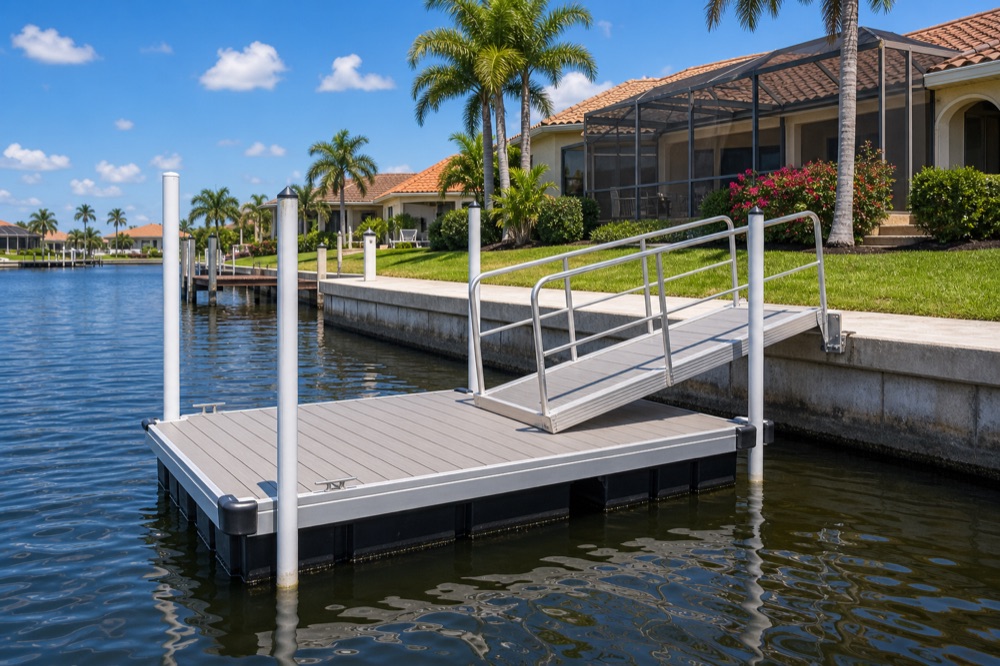
A floating dock is a low-maintenance structure, not a no-maintenance one. It rides the tide on sealed floats, so there’s no piling to rot — but the same warm Gulf-coast canal that makes waterfront life great is also one of the most aggressive fouling environments in the state. Leave a float alone for a season and it doesn’t just get ugly. It gets heavy.
The good news is that staying ahead of it is simple and mostly DIY. Here’s the seasonal routine we hand owners across Cape Coral, Fort Myers, and Naples — what to do, how often, and the line where it’s time to call a crew.
How fast do barnacles grow on a floating dock in Southwest Florida?
Fast — in our warm, brackish canal water, barnacles and oysters can settle on a submerged float within weeks, and a heavy season of growth can build in a few months. The single most important maintenance job on a floating dock is keeping that growth off the floats.
Floating dock maintenance is the routine of keeping the deck clean and safe, the floats scraped and sound, and the hardware tight — so the dock keeps doing its job and lasts its full service life. On a fixed piling dock the enemy is rot and marine borers chewing the wood below the waterline. On a floating dock, the enemy is weight.
Every barnacle and oyster that latches onto a float adds mass. Across the whole submerged surface of every pontoon, that builds into a dock riding noticeably lower than it did a year ago. Sit lower and you expose more surface to fouling, which adds more weight — a cycle that ends with a waterlogged or submerged float. Scraping growth back on a schedule breaks the cycle for the cost of an hour and a putty knife.
How do you clean a floating dock in salt water?
Work the topside and the underwater side as two separate jobs. The deck gets a gentle soft-wash for algae and salt film; the floats get scraped for barnacles and oysters.
For the deck:
- Rinse first. Hose down the decking and rails with fresh water to flush salt and organic film before it dries on.
- Soft-wash, don’t blast. Wet the boards, apply warm water with a little dish soap or a white-vinegar-and-water solution, let it dwell a few minutes, then scrub along the boards with a soft-bristle brush.
- Rinse clean. Flush every section before it dries so no cleaner leaves a haze.
If your floating dock has capped composite decking, the same warranty-safe rules apply as on any composite — never pressure wash above the manufacturer’s PSI limit. Our full method is in how to clean composite dock decking in saltwater.
For the floats, scrape the sides and underside with a plastic or wood scraper to knock barnacles and oysters back to bare surface — from a kayak, from the water, or by tipping a section where the design allows. Knocking growth off while it’s young is easy; letting a full season cement on makes it a real chore.
How do you keep a floating dock from getting slippery?
Keep the surface clean. Slippery decks are caused by a thin film of algae and biofilm on top of the boards — not by the decking material — so the fix is removing that film before it builds into a slick.
That slime is a genuine safety issue on a dock that’s already moving under your feet with the tide and wake. A few habits keep it grippy:
- Rinse salt spray and organic film off on a roughly monthly cadence — it’s the single best thing you can do.
- Soft-wash with a brush before the green film turns into a slick, especially on the shaded north side where algae thrives.
- Skip wax, oil, or “sealers” on the walking surface — they make HDPE and composite slicker, not safer.
- Keep birds off; droppings feed algae and stain the deck. (See how to keep birds off a dock or boat lift.)
How often should you inspect a floating dock and its hardware?
Twice a year. In Southwest Florida the two natural checkpoints are spring, before the busy boating season, and right after hurricane season ends in late fall, when surge and wind have had their chance to work on every connection.
At each inspection, walk the whole structure and check:
- Floats — cracks, soft or spongy spots, and any that sit lower than their neighbors (a sign of water intrusion).
- Gangway and hinge — the connection to your seawall or fixed dock takes constant flex; look for elongated bolt holes and worn pins.
- Anchoring — depending on how the dock is anchored, check guide-piling rollers, helical anchors, or chain-and-weight rodes for wear and corrosion. (Background on the methods is in how floating docks are anchored.)
- Hardware — confirm 316 stainless fasteners are tight and corrosion-free, and look for any galvanized parts that have started to bleed rust.
DIY vs. call a pro: where’s the line?
Do the cleaning, scraping, and inspecting yourself; call a pro the moment you find a structural or anchoring problem. The routine upkeep is well within any owner’s reach — the repairs that protect your dock through a storm are not.
| Handle it yourself | Call Florida Lifts & Docks |
|---|---|
| Monthly fresh-water rinse and soft-wash | Soft, cracked, or waterlogged floats |
| Light barnacle and algae scraping | Float that rides low or won’t level |
| Tightening an obvious loose fastener | Corroded or failing structural hardware |
| Spotting and noting wear | Gangway, hinge, or anchoring repairs |
A waterlogged float or a worn anchor connection is exactly the kind of small problem that becomes an expensive one in a hurricane-season blow. Catch it at your spring or fall inspection and it’s a quick fix. For more on when wear crosses into replacement, see how long floating docks last and when to replace the floats.
A dock built right is far easier to maintain. We use marine-grade aluminum frames, 316 stainless hardware, and quality sealed floats so there’s less to fight in the first place — and if you’re choosing a system, our best floating-dock material guide walks through HDPE, concrete, and aluminum for salt water.
Want a professional set of eyes on your floats, gangway, and anchoring before the next storm season? Florida Lifts & Docks has built and serviced waterfront on the SW Florida coast since 2008, with our own local crew, in-house permitting, and a 5.0-star reputation. We give free on-site estimates seven days a week across Cape Coral, Fort Myers, Naples, and the rest of the coast. See everything we build on our floating docks page, explore dock repair, or call (239) 397-3400.