
How Long Do Floating Docks Last in Salt Water, and When to Replace the Floats?
Realistic salt-water lifespans for floating docks in Southwest Florida — and the warning signs that tell you it's the floats failing, not the whole dock.
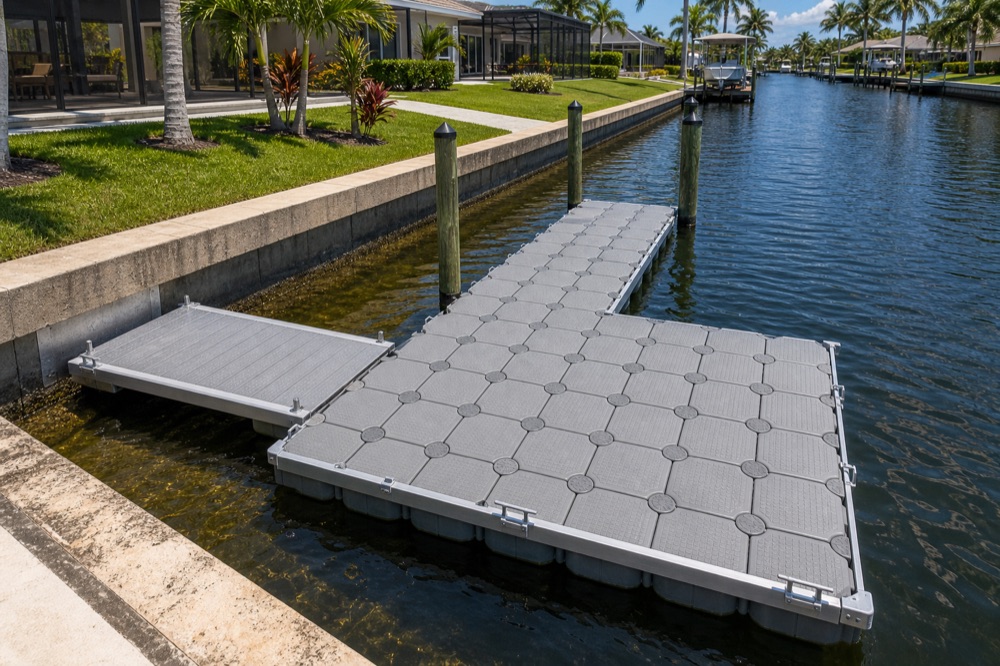
Key takeaways
- A quality floating dock's parts age separately — HDPE/rotomolded floats often last 15–20+ years, capped composite decking can outlast them, and hinges, connectors, and anchor chain are usually the first to wear in salt.
- The five warning signs of failing floats are low or uneven freeboard, a list or tilt to one side, a soft spongy bounce, visible cracks, and heavy barnacle weight pulling a corner down.
- On a modular floating dock you can often replace just the failed floats and restore the freeboard — far cheaper than a full rebuild.
- Replace floats when the frame and decking are sound; rebuild when the frame is corroded or the decking is failing too.
- We give free on-site floating-dock inspections seven days a week across Southwest Florida.
If your floating dock is riding lower than it did a few seasons ago, or it leans just enough that you notice when you step on, you’re asking the right question: is the dock failing, or is it just the floats? On a well-built modular floating dock those are two very different problems with two very different price tags.
The platform you see — frame, decking, railing — and the floats holding it up don’t age at the same rate, and neither do the hinges, connectors, and anchor chain underneath. Here’s how long each part realistically lasts in Southwest Florida salt water, and the warning signs that say it’s time for an inspection.
What is “freeboard,” and why does it matter?
Freeboard is the height your dock deck rides above the waterline — and it’s the single best gauge of float health. When floats are doing their job, freeboard stays consistent; when a float loses buoyancy, freeboard drops, and you can usually see it.
Your floats are the foundation of everything above them, keeping the deck level and at the right height. So when something goes wrong below the waterline, freeboard shows it first: the dock sits lower, or a corner dips. Note where your deck normally sits relative to your seawall, gangway, or a fixed piling — that baseline lets you catch a failing float early.
How long do the floats themselves last?
Quality rotomolded or HDPE floats commonly last 15 to 20 years or more in salt water; cheaper sealed-foam or thin plastic billets fail far sooner. Float material is the biggest factor in how long the dock stays serviceable, and the difference is dramatic on our canals:
- Rotomolded / HDPE floats (often foam-filled): the standard for serious saltwater use. Thick plastic shells resist UV and impact, and a foam fill means a single puncture won’t sink the float. The long-haul performers.
- Sealed-air plastic floats: lighter and cheaper, but one crack lets water in and buoyancy goes with it. Common on bargain docks; first to go.
- Bare or thin-walled foam: the worst choice for salt water. UV chews the surface, marine growth burrows in, and they waterlog and crumble fast.
The enemies are the same ones that wear everything on the water here — relentless UV, salt, storm surge during the June-through-November hurricane season, and the barnacles and oysters that colonize anything wet on a Charlotte Harbor or Caloosahatchee canal. Our best floating-dock material guide covers how each option holds up.
How long do the decking and hardware last?
Capped composite decking can outlast the floats entirely, while the hinges, connectors, and anchor chain are usually the first parts to wear out in salt. The deck on top often ages slower than the metal holding it together.
| Component | Realistic salt-water lifespan |
|---|---|
| Quality HDPE / rotomolded floats | 15–20+ years |
| Capped composite decking (TimberTech/Trex) | Often longest-lived; many years |
| Marine-grade aluminum frame | Decades, if properly spec’d |
| 316 stainless hardware | Long-lived; budget hardware corrodes early |
| Hinges, connectors, anchor chain | First to wear; inspect regularly |
The takeaway: a dock that “feels old” is often just tired floats and worn connectors under a frame and decking that have years left — exactly the situation where a targeted repair beats a teardown.
What are the warning signs your floats are failing?
Watch for five things: low or uneven freeboard, a list or tilt to one side, a soft spongy bounce underfoot, visible cracks, and heavy barnacle weight. Any one of them is reason to get the dock looked at before the problem spreads to the frame.
- Low or uneven freeboard. The clearest signal. The whole dock sitting lower means floats are losing buoyancy across the board; only one end low means a localized float problem.
- List or tilt. A dock that leans almost always has a single float that’s taken on water or lost its core. An imbalanced platform stresses the frame and connectors, so don’t let it ride.
- Soft, spongy bounce. A healthy floating dock feels firm and buoyant. A mushy, sinking-underfoot feel means a float is no longer carrying its share of the load.
- Visible cracks or damage. A crack in the float shell is an open door for water. Once a sealed float floods, it’s done as a flotation device.
- Barnacle and growth weight. Floats packed with barnacles and oysters carry real added weight that drags freeboard down — and combined with any water intrusion, it’s a fast track to a sinking corner. Staying ahead of it is half the battle; see our floating-dock maintenance guide.
Spotting any of these and wondering whether it’s a quick fix or a bigger job? That’s the moment to call — early float problems are cheap; ignored ones become frame problems.
Should you replace the floats or rebuild the dock?
Replace just the floats when the frame, decking, and hardware are still sound; rebuild when the frame is corroded or the decking is failing too. That’s the real advantage of a modular floating dock — you can often fix the part that failed instead of the whole platform.
Lean toward a float replacement when:
- The aluminum frame is solid and corrosion-free
- The decking has plenty of life left
- The problem is isolated to one or a few floats — or aging floats under an otherwise sound dock
- Hinges and connectors are serviceable or worth swapping alongside the floats
Lean toward a full rebuild when:
- The frame shows real corrosion or has been racked by storm surge
- Decking is rotting, cupping, or pulling loose along with the floats
- Piecemeal repairs keep adding up year after year
- You want to resize, reconfigure, or upgrade the whole system
Because every floating dock is built differently, the only honest way to make this call is to put eyes on it — check the float type, probe the frame, inspect the connectors and anchoring. Our repair-or-replace breakdown walks the same economics for fixed docks, and the floating vs. fixed dock comparison helps if you’re weighing systems entirely.
When should you get it inspected?
A floating dock losing freeboard rarely fixes itself, and the longer a tilted, waterlogged float pulls on the frame, the more likely a cheap float swap turns into a rebuild. The smart move is an inspection while the choice is still yours.
We’ve built and repaired waterfront here since 2008 with our own local crew — never subbed — and we hold a 5.0-star rating on Google. We’ll tell you straight whether your floats are the problem, whether the frame and decking are worth saving, and what each path costs, with permitting handled in-house. Learn more on our floating docks page or dock repair page, serving Cape Coral, Punta Gorda, and the rest of the coast. Book a free on-site estimate seven days a week by calling (239) 397-3400.