
How Much Space Does Rip-Rap Take? Slope & Footprint Explained
Rip-rap is sloped, not vertical, so it reaches farther into the water than a seawall. Here's the real geometry, what it costs you in frontage, and how to make rock fit a tight canal lot.
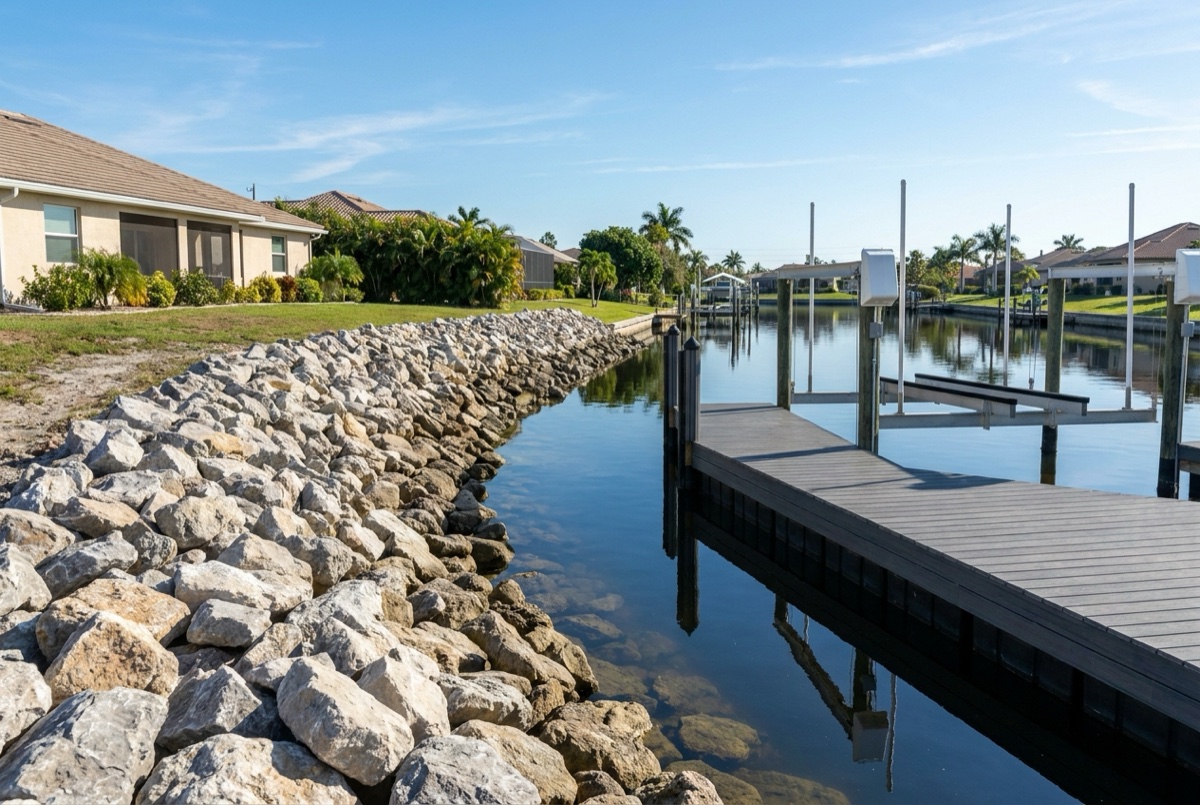
Key takeaways
- Rip-rap slopes from the top of your bank down into the water, so the toe of the rock commonly sits up to about 10 ft waterward of the high-water line — far more reach than a vertical seawall.
- At the standard 2:1 slope, every 1 ft of height needs 2 ft of horizontal run, so a higher bank pushes the rock even farther out into the canal.
- Your usable backyard at the top of the bank stays put; what you trade is open frontage and a vertical edge to step off — the water effectively moves "in" toward you.
- On narrow canals where reach matters, a vinyl or concrete seawall holds the line in a near-straight footprint; rip-rap fits best where you have room or naturally sloped ground.
- You don't lose access — integrated rock steps and pairing rip-rap with a dock give you a clean path to the water over the slope.
There’s one objection we hear on almost every narrow canal lot, and it’s a fair one: rip-rap takes up too much room. It’s true that a sloped blanket of armor rock reaches farther into the water than a flat, vertical seawall — that’s not a flaw, it’s literally how the rock does its job. But “farther” is a number you can plan around, and most owners are surprised how predictable it is once you understand the geometry.
So let’s put real measurements to it: how far rip-rap reaches, why the slope works that way, what you trade in frontage and access, and how to tell whether rock fits your lot or your canal is too tight for it. It’s the question competitors gloss over, and on a skinny canal it decides the whole project.
What is rip-rap, and why is it sloped?
Rip-rap is a sloped layer of heavy, clean armor rock placed along your shoreline to stop erosion. Unlike a seawall, which is a vertical wall that holds your bank in a hard line, rip-rap absorbs wave and wake energy by letting it climb and spend itself in the rocks.
That energy-absorbing job is exactly why it has to slope. Laid back at a gentle angle, the stones lock together, hold their shape, and flex with storm surge instead of cracking like a rigid wall. A flat pile would slump into the canal on the first big wake. The slope isn’t optional — it’s the engineering that makes loose rock behave like a permanent shoreline.
How far does rip-rap reach into the water?
The short answer: the toe of the rock commonly sits up to about 10 feet waterward of the high-water line. That’s the spatial reality you’re budgeting for on a residential job in Southwest Florida.
That figure isn’t arbitrary. It lines up with the general-permit limits that keep most residential rip-rap projects in the easy lane — clean rock at a slope no steeper than 2:1, with the toe no more than roughly 10 ft past mean high water. Stay inside those numbers and the rock both performs and permits smoothly. (For the full permitting picture, see do you need a permit for rip-rap in Florida.)
How does the 2:1 slope translate to footprint?
The math is simple: a 2:1 slope means 2 feet of horizontal run for every 1 foot of vertical height. The taller your bank, the farther the rock has to lay out into the water to reach a stable angle.
| Bank height above water | Horizontal reach at 2:1 |
|---|---|
| 2 ft | ~4 ft |
| 3 ft | ~6 ft |
| 4 ft | ~8 ft |
| 5 ft | ~10 ft |
A couple of practical notes on reading that table:
- A low, gentle bank barely intrudes. A tall, steep bank is where rip-rap eats real frontage — and where a narrow canal starts to feel tight.
- Deeper water at your edge means more rock below the surface to build the slope up from, plus a toe that armors the canal bottom against scour — both of which extend the footprint further.
Bank height is the biggest variable, which is why a measurement at your bank beats any rule of thumb.
What do you actually give up — your yard or your water?
Your backyard stays put; your open water frontage moves in. Rip-rap is built into the bank and the water, not your lawn, so the usable space at the top of your slope is essentially unchanged.
What you trade is twofold:
- Open frontage. The waterline effectively comes toward you by the width of the slope. On a 100-ft-wide canal, losing ten feet on your side is a non-issue. On a narrow finger canal, it can be the difference between comfortable navigation and a pinch.
- A vertical edge. With a seawall you step straight off the cap onto a dock or into a boat. With rip-rap there’s a rock slope between you and the water — exactly the access question we solve below.
For a side-by-side on cost, lifespan, and which shoreline each option suits, see our rip-rap vs. seawall guide.
Does rip-rap fit a tight canal lot — and how do you keep access?
On a wide canal or naturally sloped lot, the footprint is rarely a problem. On a narrow canal where every foot of waterway counts, the reach can push too far — and that’s precisely where a vinyl or concrete seawall, which holds the line in a near-straight footprint, may be the smarter call.
But “it slopes” doesn’t mean “you lose the water.” You keep clean access two proven ways:
- Integrated rock steps. We set stable stone steps into the revetment so you have a defined path down the slope for foot traffic, kayaks, and paddleboards.
- Pair it with a dock. This is the move that wins most often. A custom dock carries you up and out over the rock to deeper water, giving you a flat walking surface and a clean platform for a boat lift — the rock protects your shoreline while the dock handles access. More in rip-rap with a dock and boat lift.
Rip-rap and access are not a trade-off when the project is designed as one piece from the start.
Should you choose rip-rap or a seawall for your lot?
Lean rip-rap when you have room for the slope — a wider canal, a naturally sloped bank, a lake or pond edge, or calmer water where the gentle angle is a non-issue. Lean seawall when the footprint can’t give — a tight canal, a sharp lot line, or a spot where you need deep water right at the edge.
The honest answer comes from three numbers we take on-site: your canal width, your bank height, and the frontage you can spare. Plug those in and the right shoreline almost picks itself — sometimes it’s even a hybrid, with rock at the toe of a wall.
Not sure rock fits your frontage? That’s the whole point of an on-site look. We measure your bank, your water depth, and your canal width, then tell you straight whether rip-rap works or a seawall is the better fit — and design dock access right into the plan. Florida Lifts & Docks has protected SW Florida shorelines since 2008 with our own local crew and in-house permitting. Get a free on-site estimate, seven days a week across Cape Coral, Naples, Fort Myers, and Charlotte Harbor — call (239) 397-3400.