
Boat on the Lift or on a Trailer for a Hurricane?
The considerations on both sides, laid out honestly: canal exposure, lift height and capacity, where you'd actually tow it, evacuation timing, and haul-out demand. No universal verdict, because there isn't one.
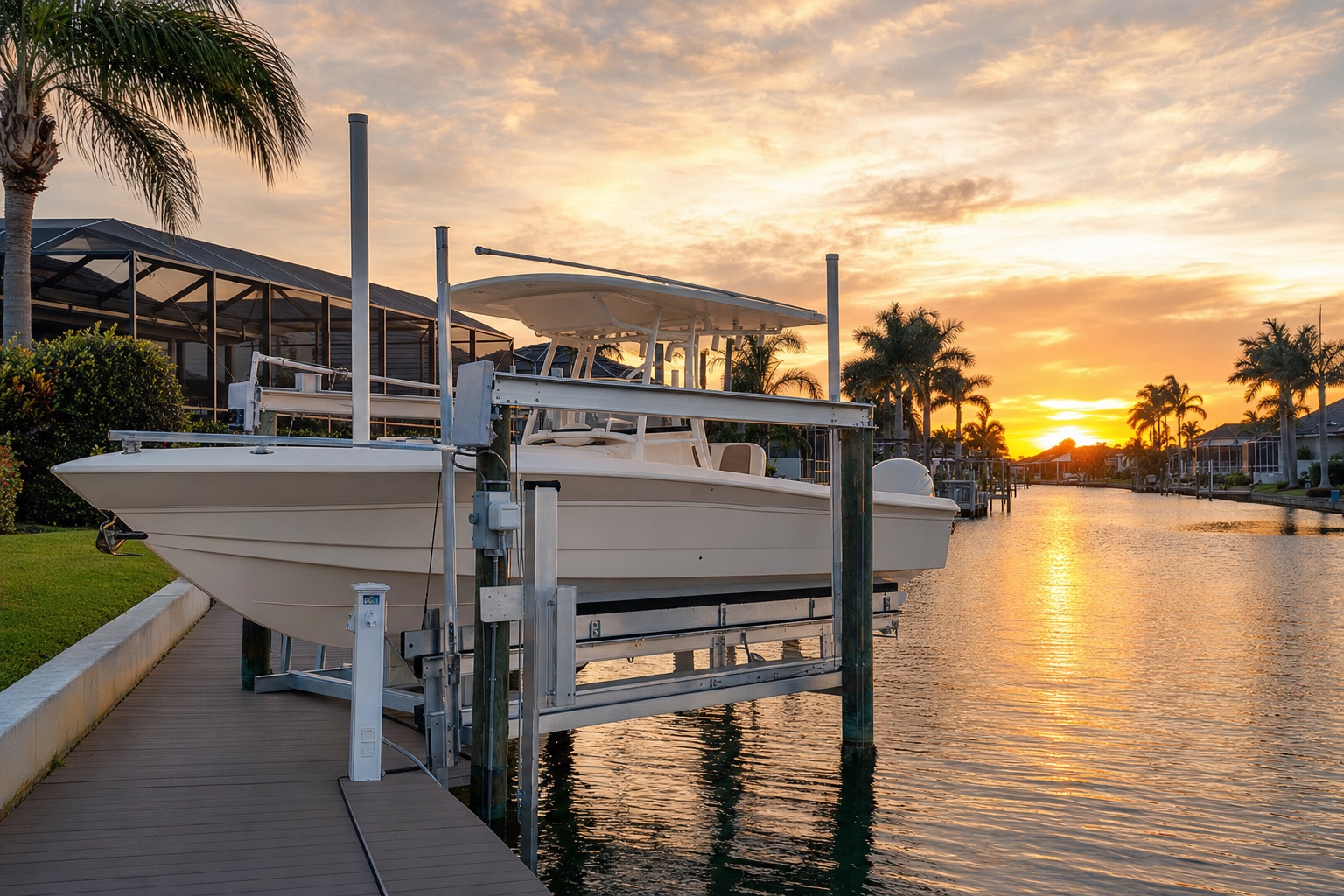
Key takeaways
- There is no universal right answer, and anyone who gives you one has not seen your boat, your lift, your canal, or your policy.
- Your site drives more of this than your boat does. A short, sheltered canal and an exposed run onto open water are two different problems with the same forecast.
- The trailer option is only real if the trailer, the tow vehicle, the route, and a place to put the boat all exist before the storm is named. Otherwise it is a plan on paper.
- Marina haul-out capacity fills early and does not expand for latecomers. If that is your plan, it needs a reservation and a standing arrangement, not a phone call during a watch.
- Whatever you decide, decide it early, strip everything loose, shut the lift circuit off at the breaker, and let your lift manufacturer's guidance and your insurer's requirements make the final call.
This is the question every waterfront owner on this coast asks in June, and the one that draws the most confident wrong answers. Somebody at the ramp will tell you always haul it. Somebody else will tell you a good lift is the safest place a boat can be. Both are describing their own canal.
We install and rebuild boat lifts across Southwest Florida, and we’re not going to hand you a verdict either. What we can do is lay out the considerations honestly, so that when you take the question to your lift’s manufacturer and your insurance agent, the two parties whose answers govern: you’re asking the right things. The full before-during-after arc for the lift lives in the boat lift hurricane playbook; this page is just the decision.
Why isn’t there a universal right answer?
Because the variables that decide it are all local to you. The same forecast produces genuinely different correct choices for two boats a mile apart.
| Consideration | The question to answer honestly | Who actually has the answer |
|---|---|---|
| Site exposure | How much open water does your dock face, and where does water go at your address? | Your observation, plus official forecasts and county emergency management |
| Lift capability | What storm position is your model designed for, and can it hold your boat in those conditions? | Your lift’s manufacturer |
| Lift condition | Are cables, sheaves, frame, cradle, and pilings genuinely sound right now? | An honest inspection, ideally in spring |
| Trailer reality | Do you have a trailer, a tow vehicle, a route, and somewhere to put it? | You, before the season |
| Haul-out reality | Do you have a reserved spot, or a hope? | The yard, in writing, early |
| Timing | Can you complete the move safely, well before conditions turn? | The clock, and your evacuation zone |
| Coverage | What does your policy say about where the boat is kept in a named storm? | Your insurance agent |
Read down that right-hand column. Almost none of the authority here sits with an article, including this one.
How much does your canal matter?
More than most owners assume. Two things drive it: how much water your boat is exposed to, and how much room waves have to build before they reach you.
A short, narrow, sheltered canal with a bend between you and open water is a different environment than a wide basin or a long straight run facing a bay. The distance wind travels over open water is what builds wave energy, and it’s why one dock takes chop another never sees; canal fetch and waves covers the mechanism.
Then layer on water level. Surge is site-specific and not something to estimate yourself, which is exactly the point: if rising water is a real possibility at your address, a boat in the water can float off its lines, and a boat on a lift has clearance that was set for ordinary tide. Watch National Hurricane Center forecasts and your county’s emergency management alerts rather than guessing, and read how storm surge works here so those alerts mean something to you.
The takeaway isn’t a number. It’s that high-exposure owners should plan to get the boat off the water earlier and more often than sheltered ones, and both should know which they are before June.
What does your lift have to be able to do?
Hold your loaded boat, in the position the manufacturer specifies, on pilings and hardware that are actually sound. All three parts, or the option isn’t really available to you.
- Capacity means loaded weight: hull plus fuel, water, gear, and whatever’s in the lockers, not the dry weight on the brochure.
- Storm position is a manufacturer specification. Whether your lift wants the boat high, mid, or low is engineered into that model. Ask them; don’t average the answers you get online.
- Condition is not a detail. Nearly every storm failure we’re called out to started at a weak point already there: a frayed cable, a corroded bracket, a bunk worn enough to let a hull work around, a piling that had begun to move. A lift you’re counting on in September needed inspecting in April.
- Straps and tie-downs are a manufacturer question, not a standard practice, some makers specify them, others don’t want that load on the frame. See tie-down straps and lift bunks.
If your honest answer on condition is “I’m not sure,” that’s itself information about which option to plan for.
What do the off-the-water options actually require?
A complete chain, not an intention. This is where paper plans fall apart.
Trailering it home or inland needs all of this at once: a trailer that fits, with serviceable tires, bearings, lights, and straps; a tow vehicle rated for it and a driver comfortable towing it; a ramp that isn’t backed up; a passable route; and, the one people forget: somewhere to actually put it. A boat in your driveway is out of the water but still in the wind, and in a garage only if it fits. A friend’s place inland means asking in June, not during a watch.
A marina haul-out or dry storage needs a spot, and spots are finite. Yards fill storm capacity from standing customers and early callers, and regional demand spikes at the same hour for everyone. If this is your plan it’s a reservation made early, plus a clear understanding of the yard’s own cutoff. They stop hauling well before conditions get bad, because their people have homes to prepare too.
Moving to a protected basin needs access, fuel, and time to make the run well before conditions turn, and it’s off the table once a warning is up.
How does evacuation timing change the math?
It eliminates options, and it outranks everything. Every version of moving a boat takes daylight, help, and a road or waterway that still works. Those degrade in a predictable order and faster than people expect: storage fills, ramps back up, trailers get borrowed, fuel lines grow, roads get busy, window closes.
Two absolute lines:
- Never go boating to reposition a vessel once a warning is up. No boat is worth that trip.
- An evacuation order for your zone outranks every item on this page. If the order comes and the boat isn’t moved, the boat stays and you go: see evacuating as a waterfront owner.
So the real skill isn’t picking the better option. It’s picking early enough that your option still exists.
So which is it?
Your lift manufacturer’s guidance and your insurer’s requirements decide. That isn’t a dodge: it’s the only answer that’s actually true for your boat. The manufacturer engineered the lift and knows what it’s designed to do in a storm. Your carrier wrote the policy and knows what it requires of you and where the boat is expected to be, and coverage can read differently on a lift, on a trailer, or in storage. Confirm both in the spring, in writing, and you won’t have to make this decision under pressure again.
Whichever way you land, the boat gets the same treatment: strip everything loose: canvas, bimini, cushions, electronics, fenders, coolers, rods, because canvas is a sail and whatever leaves your dock lands on somebody else’s; let rain drain instead of piling up as weight on the cradle; seat the hull properly on the bunks; and shut the lift’s dedicated circuit off at the breaker, not just the switch.
What we can help with is the part underneath the question: whether your lift, cradle, and pilings are in condition to be part of any plan at all. Florida Lifts & Docks has built, serviced, and rebuilt lifts across Southwest Florida since 2008 with our own crew, never subbed, and we’ll inspect what you’ve got and put a written estimate in your hands free and on site. See our boat lifts page or call (239) 397-3400.