
Fetch on a Canal: Why Some Seawalls Take a Beating
Two neighbors on the same waterway can get wildly different wave action in the same storm, the reason is fetch, and it's visible on a map before it's visible on your seawall.
Key takeaways
- Fetch is the open distance wind travels across water before it reaches your shoreline. Longer fetch, stronger wind, and more time all make bigger waves: fetch is the part that's fixed to your address.
- Fetch is directional. A lot sheltered from one direction can be wide open in another, and storm wind rotates as a system passes, so your protected side changes during the event.
- Interior finger canals get short, steep chop. Open-bay, river, intersection, and end-of-canal lots get longer, heavier waves that carry far more energy into a wall.
- Most fetch damage isn't storm damage: it's years of ordinary wind chop and boat wake loosening fasteners, opening joints, and scouring the base of a wall. The storm just finishes it.
- Rip-rap at the toe of a seawall is the single most effective upgrade for a high-fetch lot, because it absorbs wave energy before the wall has to.
Walk two canal-front lots a few hundred yards apart after a blow and you’ll sometimes find one seawall looking untouched and the other with soil pulled from behind the cap, joints opened up, and dock hardware you can wiggle with your hand. Same storm. Same wall construction. Same age.
The difference is usually fetch, and unlike almost everything else about storm risk, you can see it on a map before you ever see it on your property.
What is fetch?
Fetch is the open distance wind travels across water without obstruction before it reaches your shoreline. It’s one of three things that determine how big a wave gets: wind speed, how long the wind blows from that direction, and how far it has to work.
Wind doesn’t create a wave instantly. It transfers energy to the water gradually, over distance and time. Cut the distance short and the wind never gets the chance. You get small, steep, choppy water. Give it a long open run and the same wind builds waves that are taller, longer, and carrying dramatically more energy into whatever they hit.
That’s why a stiff breeze across a narrow finger canal is an annoyance and the same breeze across an open bay is a problem. Estero’s canal and water guide is a case in point, since the water there opens onto a bay instead of sitting in a sheltered cut.
Why fetch is directional, and why that matters in a storm
Here’s the part most people miss: fetch isn’t one number, it’s a number for every direction.
Your lot might be tucked behind a bend to the east with almost no open water in that direction, and stare down a mile of open basin to the west. On an ordinary breezy day out of the east, you’d swear you have a protected lot.
Then a tropical system comes through, and the wind direction rotates as it passes. Over the course of one storm you can get wind from directions your shoreline never sees the rest of the year, including straight down your longest exposure line. A lot is only “protected” until the wind comes from the direction it isn’t. That’s why sizing up your waterfront by how it behaves on a normal Tuesday is misleading.
Which lots take the worst of it?
Not all canal addresses are the same water. Roughly, from most sheltered to most exposed:
- Mid-canal, narrow finger. The most sheltered position there is. Wind has almost no run in any direction, so you mostly get short chop. Your bigger risks are surge and debris, not waves.
- Wide canal or basin. Real fetch in at least one direction, usually along the length of the waterway.
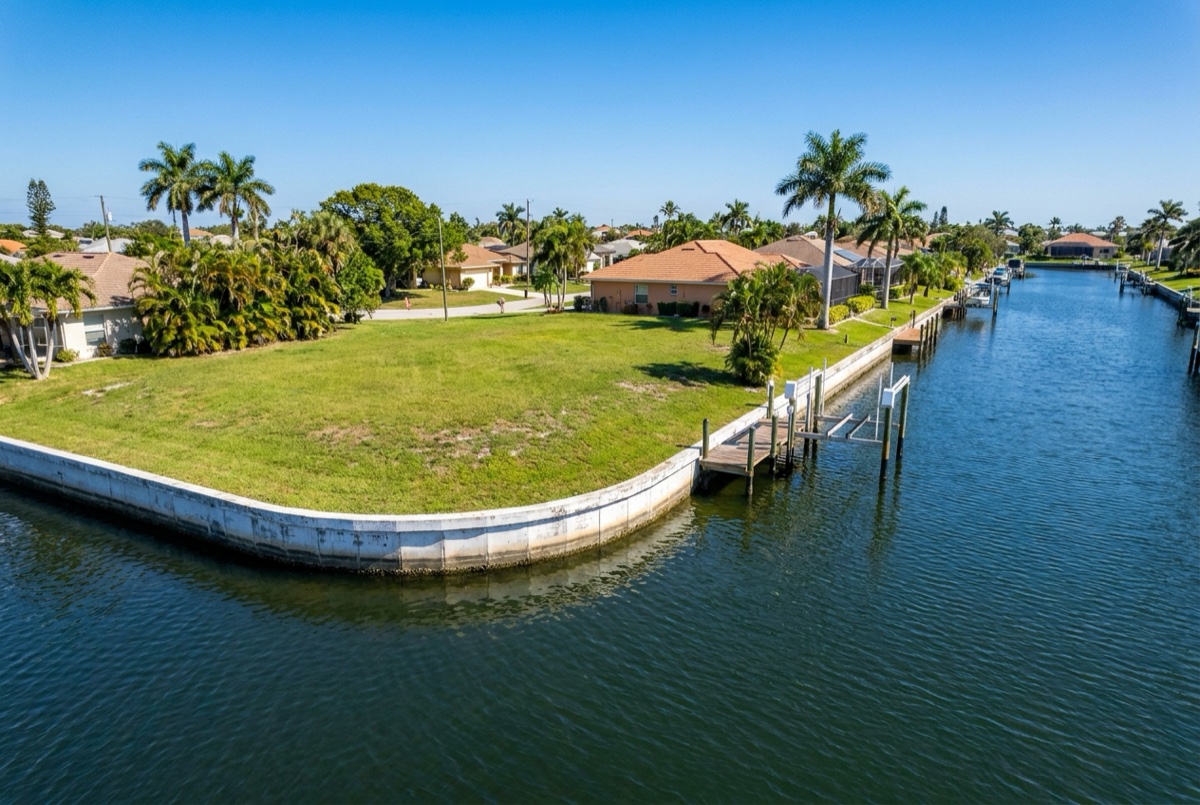
- Canal intersection or point lot. Exposed in multiple directions at once, a corner lot on water works exactly like a corner lot in wind. Whichever way the storm turns, something is pointed at you.
- End-of-canal. The end of the pipe. Waves generated down the length of the canal run all the way to your wall and dump their energy there with nowhere else to go. Dead ends are also where floating debris ends up, so end-of-canal walls take impacts along with the wave load.
- Open bay, river, or direct Gulf-side exposure. The longest fetch there is, plus year-round wave action, plus everything surge brings.
None of this is a reason to panic about an exposed lot. It’s a reason to build and maintain one differently than a sheltered one.
What fetch does to a seawall over time
The damage that matters here mostly isn’t dramatic. It’s cyclic, the same modest load, applied over and over, for years.
Every wave that hits a seawall pushes on the panels, works the joints between them, and then pulls back, dragging water and a little bit of material with it. Multiply by every wind chop and every boat wake for a decade or two and you get the failure pattern high-fetch lots know well:
- Open panel joints where water, and eventually soil: starts moving through the wall instead of being held back by it.
- Toe scour. Wave energy reflecting off the face of the wall digs at the bottom of it, quietly removing the material the wall is bearing against.
- Soil loss behind the cap, showing up in the yard as depressions, low spots that don’t drain, or a cap that no longer sits tight against the ground.
- Cap cracking as the wall loses uniform support and starts working against itself.
Those are the same warning signs covered in signs your seawall is failing, and they mean more on an exposed lot than a sheltered one because the loading never stops.
The best structural answer for a high-fetch shoreline is armor: rip-rap at the toe of the wall. Loose stone breaks up an incoming wave and absorbs its energy before it reaches the wall face, and it protects the base from scour. It’s not glamorous, and it’s the upgrade we recommend most often for exposed lots.
What fetch does to dock and lift hardware
Everything above the water gets the same treatment.
Constant wave motion and wake work on connections: through-bolts and lag screws back off, brackets elongate their holes, cleats loosen their backing, and ladders and railings develop play. Floating docks feel it hardest: they’re in motion all the time, so guide-piling rollers, brackets, and connections on an exposed lot wear out faster than the same hardware in a quiet canal. The floating dock playbook covers what to look at before a storm.
Boat lifts on an exposed lot see it too: a boat that sways or bumps in an ordinary breeze is telling you something about your exposure, and it’s worth factoring into how you set up the rig. As always, the storm-position and strapping decisions belong to your lift’s manufacturer guidance and your insurer, not to a general rule.
The practical move is simple and free: pull up a satellite view of your address and find your longest open line of water. That’s your exposure direction. Then inspect the parts of your waterfront that face it twice as hard as everything else, before hurricane season, not during it. Our seawall storm playbook covers what to check and when.
If your wall faces a lot of open water and you’re seeing joints, scour, or soil loss, get eyes on it early. Those repairs get harder and more expensive the longer they wait. Florida Lifts & Docks has built seawalls, docks, and rip-rap across Southwest Florida since 2008 with our own crew, and estimates are free and on-site. Call (239) 397-3400.