
Boathouse Hurricane Playbook: Before, During & After the Storm
A boathouse puts a roof over the water, which changes everything about storm prep: roof and fastener checks, what to strip out, door strategy, and how to triage posts afterward.
Key takeaways
- A boathouse roof is a large surface over open water: wind gets under it as well as over it, so the connections from roof to posts to pilings are what matter most.
- The pre-season pass is fasteners: roof panel screws and their washers, trim and drip edge, rafter and post connections, and the pilings underneath.
- Strip the interior. Anything stored in a boathouse becomes debris inside a covered space it can't easily leave.
- Roll-up or swinging doors and screen panels are large wind surfaces: decide early whether they come down, and confirm the maker's guidance.
- After the storm, read the roofline and the posts from dry ground before you walk under anything, and keep the lift circuit off until an electrician clears it.
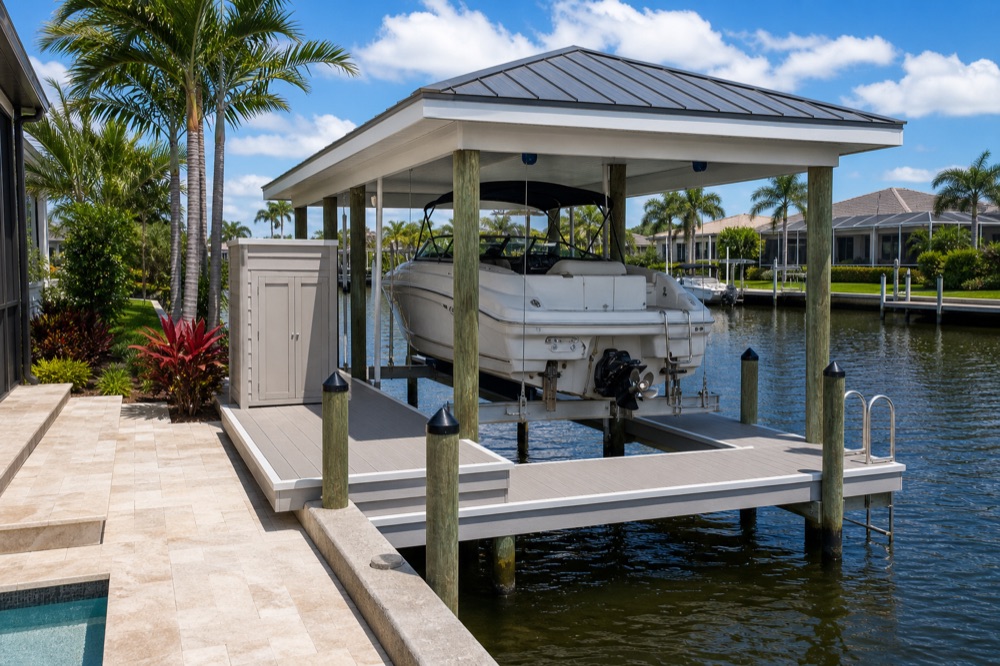
A boathouse is the best year-round protection you can put over a boat in Southwest Florida. It takes the sun and the rain off your gelcoat and keeps debris and bird mess off your upholstery. It also changes your storm math, because unlike anything else on your dock, a boathouse puts a large roof surface out over open water where wind can work on it from every direction.
That’s not an argument against boathouses. It’s an argument for treating the connections as the thing you inspect, because a boathouse in a storm is only as good as the path that runs roof panel to framing to post to piling. Here’s the whole arc: pre-season, final moves, and how to read the structure afterward.
What makes a boathouse different in a storm?
A roof over water catches wind from underneath as well as over the top, and every bit of that load travels down through the posts into the pilings.
A bare lift is mostly open frame: wind passes through it. A boathouse is a surface. Wind moving across the top and pushing up under the eaves puts uplift on the roof, and that uplift is resisted entirely by the fasteners and connections holding the assembly together. Which is why protecting a boathouse is almost never something you do in the last 48 hours: it’s the condition of the hardware, checked in the spring.
The other difference is what a boathouse contains. An open dock sheds loose gear into the water; a boathouse holds it, and anything airborne inside a covered structure hits the structure.
What should you check on the roof and fasteners before the season?
Fasteners, panel edges, trim, and the connections at both ends of every post. Season here is June 1 through November 30: do this in April or May, while a contractor can still get to you.
- Roof panel fasteners. On metal, look for backed-out or spun screws and neoprene washers gone hard, cracked, or flattened. On shingles, look for lifted, curled, or missing tabs. Our comparison of metal vs. shingle boathouse roofs covers how each ages down here.
- Panel seams, ridge cap, trim, and drip edge. Edges are where uplift starts, and anything loose at a perimeter peels first.
- Rafter and truss connections to the beams, and beam connections to the posts. Corrosion at a connector on the water side is common and easy to miss from the deck.
- Posts: splitting, softness, rot at the waterline, any lean.
- Pilings underneath: cracks, spalling, marine borer damage on wood, scour at the base at low tide. If the pilings are moving, everything above them is a secondary problem.
- Gutters and bolted-on hardware: hoists, hose reels, light fixtures, fans.
Get what you find done pre-season. And a hard line: getting up on a boathouse roof over water is not homeowner work. Look from the deck and from a boat, and have a contractor handle anything that requires being on it.
What should come out of the boathouse before a storm?
Everything that isn’t fastened to the structure. A boathouse tends to accumulate: that’s what it’s for, and every item is a projectile in a covered space.
| Category | Move |
|---|---|
| Fishing gear, rods, tackle, coolers | Inside the house |
| Life jackets, lines, fenders, buckets | Inside; coil and stow lines |
| Chairs, tables, grills, trash cans | Off the dock entirely |
| Kayaks, paddleboards, racks | On land, inside if possible |
| Dock box contents | Emptied; box secured or removed |
| Fuel cans, batteries, chemicals | Out, never leave fuel or batteries in a structure that may flood |
| Hanging fixtures, fans, hose reels | Removed if removable, or confirmed tight |
| Boat canvas, bimini, covers, cushions | Off the boat and inside |
Then the electrical: shut the boathouse and lift circuits off at the breaker panel, not just the switches, and bring any remote or control box inside and dry. Nothing under that roof should be energized when water arrives, and the circuit stays off afterward until a licensed electrician has inspected and cleared it. That is the whole homeowner role in dock electrical: off before, and clear of it after.
What’s the strategy on doors and screens?
Treat every panel as a wind surface, and decide early rather than in rising wind.
- Removable screen panels and canvas curtains: the easiest call, down, rolled, stored inside. A screen that lets go becomes debris, and a partially failed enclosure can change how wind loads the rest of the structure.
- Light roll-up or slide-out doors: many are designed to be raised, removed, or stowed for weather. Check what the manufacturer specifies, and if they’re staying, latch them the way the maker intends, not just closed.
- Heavier permanent doors: generally not removable. Confirm the storm guidance from whoever supplied them, and check track, rollers, and latch hardware pre-season while there’s time to fix something.
The work itself: ladders, panels, awkward lifts over water: needs daylight and a second set of hands. Put it on the list days out, not hours.
What about the boat under the roof?
Same decision as any boat on a lift, and there’s no universal verdict. Getting the boat out of the water and inland removes it from rising water and floating debris entirely, which is why most owners look at that first. If it stays on the lift, the storm position, and whether tie-downs are appropriate at all: comes from your lift manufacturer’s guidance for that specific model, and coverage questions belong with your agent or carrier. Under a boathouse there’s one extra thing to raise with the manufacturer: how much vertical room the boat has to the underside of the roof structure at any position you’re considering. The full version of this decision is in the boat lift hurricane playbook.
How do you triage the roof and posts afterward?
Read it from dry ground before you go anywhere near it.
- Assume any downed line is live. Keep the boathouse and lift circuits off.
- Sight the roofline. Does it still sit square and level, or does one corner sag or twist? Are panels lifted, peeled, or missing? Is trim or ridge cap displaced?
- Check each post. Out of plumb? Separated at the top connection or at the deck? Any splitting that wasn’t there before?
- Check the pilings: moved, leaning, scoured at the base, or pushed out of line.
- Don’t walk under it until you’re confident it’s sound. A roof holding on by a few fasteners looks exactly like a roof that’s fine.
- Photograph everything before anything moves: roof, posts, pilings, deck, lift, and the seawall behind it, wide and close. Requirements vary by policy, so ask your agent what they need.
The dock-level version of this sequence is in post-storm dock triage, and the seasonal overview across your whole waterfront is in our hurricane prep guide for docks, lifts, and seawalls.
When to call us: once you’re safe and the photos are done. Florida Lifts & Docks has built and repaired boathouses across Southwest Florida since 2008 with our own crew, never subbed, and permitting is handled in house on rebuilds. We’ll assess the roof, framing, posts, and pilings and give you a written estimate for repair or rebuild, free and on site. See our boathouses page or call (239) 397-3400.