
What Recent SW Florida Storms Taught Us About Docks
We don't have a dataset. We have rebuild work, and taking apart what's left teaches you the same lesson over and over: storms don't create weakness, they find it.
Key takeaways
- The consistent lesson from rebuild work is that storms rarely create a failure from nothing. They find the component that was already compromised and finish it.
- The order is remarkably stable: the piling that was already deteriorating, then the fastener that was already corroding, then the seawall toe nobody had looked at, then whatever was left loose, then the electrical.
- What comes apart is where two pieces were joined, not the pieces themselves. Sound boards lying loose next to intact framing is the most common thing we find.
- A meaningful share of the damage on any given lot did not originate on that lot. Loose items become projectiles, and they travel.
- The structures that hold up best are not the fanciest ones. They are the ones whose boring maintenance was current when the water arrived.
We do not have a dataset, and this page will not pretend to one. What we have is rebuild work: arriving on waterfront lots after storm seasons, taking apart what is left, and seeing which piece gave first. That vantage point is unusual, and what it shows is remarkably consistent from lot to lot.
The short version: storms rarely create a failure out of nothing. They find the thing that was already compromised and finish it. Almost everything worth knowing about storm preparation follows from that one sentence, and it explains why the most valuable work happens in the off-season rather than during a watch.
What actually breaks first?
In rough order, and the order is stable enough to plan around.
1. The piling that was already deteriorating. This is the most common starting point by a wide margin. Rot at and just below the waterline, marine borers hollowing a piling out from inside where nobody looks, or a piling slightly loose for a couple of seasons and tolerated because nothing bad had come of it yet. Pilings carry everything else, so one that gives takes framing, decking, rails, and whatever was mounted on it along with it.
The tell is available beforehand and it is not subtle: a dock that flexes underfoot, a piling you can rock by hand, a section drifted out of line. See leaning and loose pilings after a storm and, for what borers do out of sight, marine borers and piling wrapping.
2. The fastener that was already corroding. What comes apart in a storm is where two pieces were joined, not the pieces. The most common scene on a damaged dock is sound decking lying loose beside framing that is entirely intact, the connections between them gone. Salt has years to work into every bolt, screw, and bracket, fastest wherever a coating was interrupted. Rust blooming around a fastener head is a report on how much of it is left.
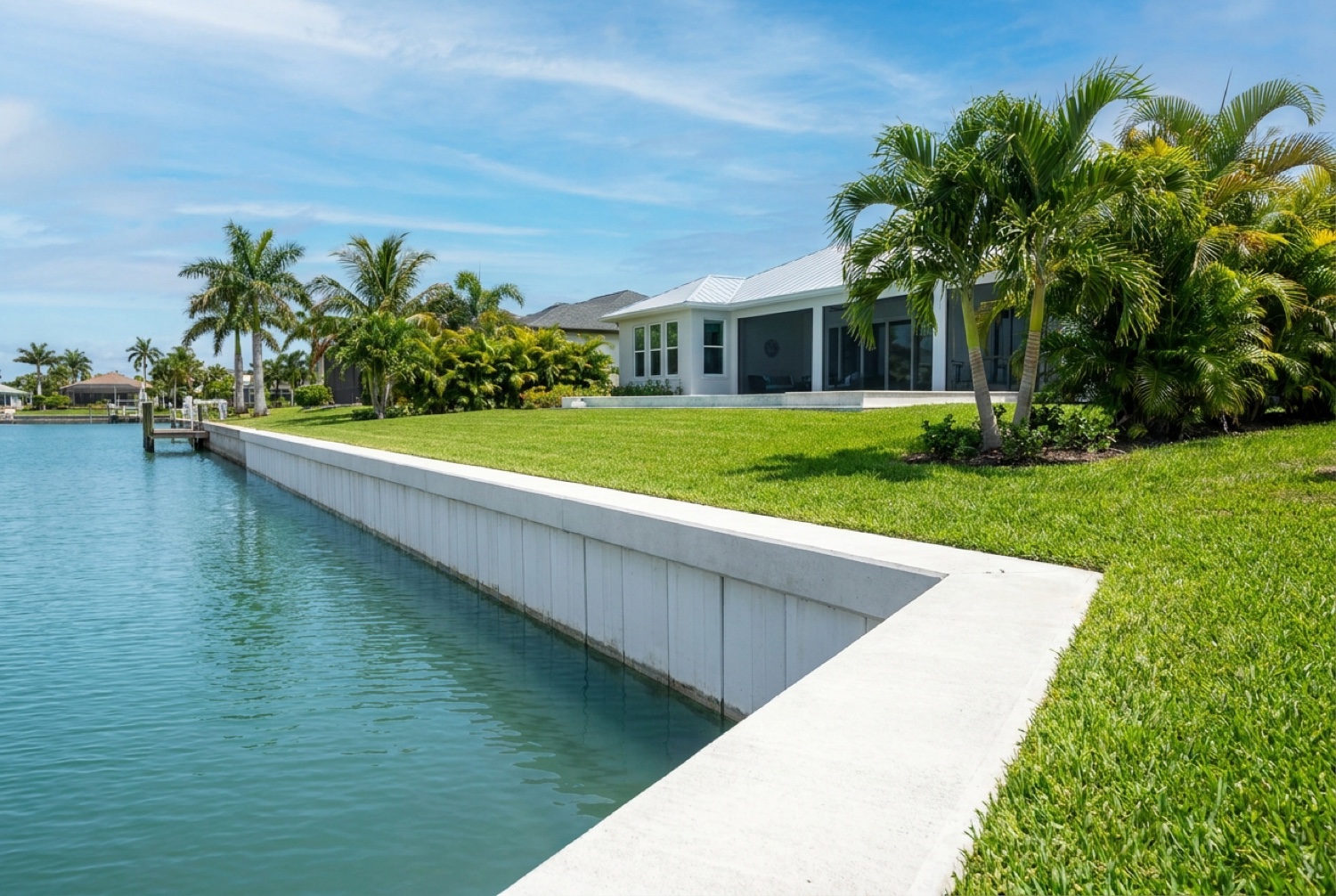
3. The seawall toe nobody had looked at. Different in kind, because it does not announce itself. Everything above the waterline can be genuinely fine while the material supporting the base of the wall has been carried off. Then months pass and the cap cracks, the wall line goes out of true, and the yard starts to sink. It is why we push post-storm inspections on walls that look untouched: see toe scour after a storm.
4. The loose item that became a projectile. Anything not fastened down becomes cargo on moving water: dock boxes, furniture, ladders, coolers, grills, kayaks, canopy panels, unsecured floating sections. Two things surprise people. First, how much damage a moderately heavy object does when current is carrying it. Second, that it does not stay home, much of what we repair on a given lot arrived from somewhere else, and much of what left is now somebody else’s repair.
5. The electrical that flooded. Lift motors, control boxes, outlets, transformers, pedestals, light fixtures. Salt water in an electrical enclosure is not a dry-it-out-and-see situation, and this is where the damage is least visible and the risk to people is highest. It is also where we most often find that nobody could have shut the power off cleanly beforehand, because the dock circuit was shared, unlabeled, or both.
What holds up?
Not the most expensive structures. The best-maintained ones.
| What we find standing | Why |
|---|---|
| Pilings wrapped or replaced | The deterioration that usually starts the chain was not there to start it |
| Docks where hardware had been renewed | Connections still had their strength when the loading arrived |
| Seawalls inspected below the waterline | Nothing had been quietly undermining the base for seasons |
| Docks cleared before the storm | Nothing on the structure became a projectile against it |
| Recently rebuilt structures | Sound components, current hardware, nothing deferred |
None of that is a guarantee, and we will not call it one. Storms produce conditions beyond what residential structures are designed for, and a well-maintained dock in the wrong place still loses. But the pattern is real: boring maintenance separates outcomes far more reliably than the price of the build.
What surprises owners most?
Four things come up again and again.
- How much of it was pre-existing. Owners are genuinely shocked to learn a piling was hollow, and that it would have shown on an inspection. Uncomfortable to deliver, and we deliver it anyway.
- How much came from next door. Debris does not respect property lines.
- That the seawall lies. The dock reports its damage immediately. The wall waits.
- That the boat is often not the story. People plan around the vessel and lose the lift: motors, cables, cradle, and the pilings under it, none of which the boat’s condition tells you anything about.
What should that change about how you prepare?
It moves the work earlier, which is the whole point of this page.
If the failure chain starts with components that were already compromised, the highest-value preparation is not what you do during a watch. It is the unglamorous off-season work: pilings evaluated and wrapped or replaced, hardware renewed, the seawall toe actually looked at, dock power on a dedicated labeled circuit, loose items given somewhere to live that is not the dock.
When it is time to assess afterward, work through the post-storm dock triage guide in order, stay out of the water, and stay clear of anything that may still be energized. If a rebuild is the answer, the design decisions worth making the second time around are in building for the next storm.
One note on documentation: we photograph and describe what the storm did, and separately what was already deteriorating. Your policy and your carrier decide what is covered: confirm that with your agent, but honest, separated documentation is what stands up, and it is the only way we work.
Florida Lifts & Docks has repaired and rebuilt docks, lifts, seawalls, and pilings across Cape Coral, Fort Myers, Naples, and Charlotte Harbor since 2008, our own crew, permitting in-house. If you would rather find the compromised piece now than meet it later, the inspection and repair estimate are free on-site. See our dock repair page or call (239) 397-3400.