
Toe Scour After a Storm: The Damage You Can't See
Fast water pulls material out from the base of a seawall while everything above the waterline looks untouched. Then, months later, the yard starts to go.
Key takeaways
- The toe is where the bottom of a seawall meets the canal bottom. Scour is moving water carrying that material away, and it removes support at the exact place the wall depends on it most.
- A vertical wall is an obstruction. Water forced around it, under it, and back off its face accelerates locally, and faster water carries away more material.
- The drawdown: water rushing back out of the canal after a surge: is often harder on the toe than the water coming in.
- Nothing above the waterline reports on it. A wall can lose meaningful support at the base and look exactly the same from your yard the next morning.
- It announces itself later, as new lean or bow, cap cracks and rotation, opening joints, and depressions or sinkholes in the yard behind the wall.
Of everything a storm does to a waterfront lot, this is the one that hides. Decking is missing or it is not. A piling leans or it does not. But the base of a seawall sits below water, in the one place you cannot look, and a wall can lose a real share of what holds it up while looking untouched from your lawn.
Then months pass, the cap has a crack that was not there, there is a soft spot in the grass, and the wall no longer quite lines up with the neighbor’s. This page is the mechanism behind that sequence.
What is toe scour, exactly?
The toe is where the bottom of the seawall meets the canal bottom. Scour is the removal of that bottom material by moving water.
That sounds mild. What makes it serious is what the toe does structurally. A seawall is not a free-standing fence. It holds back a yard’s worth of saturated soil, using tiebacks pulling from behind and the material at its base confining the buried portion in front. Take material out of the toe and you have not damaged the wall. You have quietly removed part of what it was leaning on.
Why does storm water go after the toe?
Because a vertical wall is an obstruction, and obstructions make water move faster right where they meet it. Water in motion carries sediment, and faster water carries more of it, and coarser. Several things converge at the base of a wall during a storm.
- Flow has to get around it. Water driven along a shoreline meets a hard vertical face and must deflect around it or dive beneath it. Either path means accelerating locally, and accelerated water scours.
- A flat face reflects rather than absorbs. Energy that hits a sloped, rough shoreline gets broken up and spent. Energy that hits a smooth vertical wall comes back off it, some of it directed down along the base.
- The drawdown is often worse than the rise. Water that came inland goes back out fast, low, and concentrated. Plenty of toes survive the water arriving and not the water leaving, both phases are in how storm surge works on our canals.
- Geometry concentrates it. Corners, wall ends, transitions to a neighbor’s wall, and the mouths of boat slips all funnel flow. Scour is rarely uniform; it finds where water is being squeezed.
None of that is exotic. It is why a garden hose digs a hole in a flower bed, scaled up and given hours to work.
Why does it matter if the wall looks untouched?
Because “untouched” is a report on the part of the wall you can see, and that is not the part that changed.
Above the waterline everything can be genuinely fine: cap intact, panels unmarked, joints tight, while the material that was confining the base is now somewhere else in the canal. No crack, no stain, no noise. The wall has less support than it did and has not yet been asked to prove it.
It gets asked later. The next heavy rain saturates the backfill, the next seasonal high water loads the wall, every boat wake adds a cycle. At some point it moves.
How does it show up later?
In roughly this order, over weeks to seasons:
| What appears | What it usually means |
|---|---|
| New lean or bow in the wall’s line | It has lost the balance between what pulls it back and what supports its base |
| New or widened cap cracks, cap out of line | The top is being levered outward as the base gives ground |
| Joints opening between panels | The wall no longer moves as one unit, and your yard has a route to the canal |
| A dip or trough along the wall line | Soil behind the wall is migrating out through or under it |
| Sinkholes, soft ground, sunken pavers | The same process, further along |
Notice that most of those are yard observations, not wall observations. Once a toe is undercut, soil behind the wall has a path to follow, and the yard is where you see the result: see erosion and sinkholes behind a seawall and signs your seawall is failing.
The practical version: keep watching. Walk the same strip of yard, photograph the same spots from the same angles, and pay attention to what is changing rather than what is merely imperfect. Change is the signal, and the full inspection sequence is in post-storm seawall triage.
How does anybody actually find scour?
From the water, when it is safe to be there. Confirming toe condition means an underwater look along the base: undercutting, trenching, panel or sheet exposed below where it should be buried, voids behind the base. That is a diver’s job, and after a storm it usually waits for the water to clear.
From land on a calm day with unusually clear water you may make out a shadow or trench line. Treat that as a hint worth reporting, not a finding, and seeing nothing proves nothing, because our canals are rarely clear enough for that observation to carry weight.
Do not get in the water to check. Post-storm canals hide submerged debris, and an undermined wall can shed material without warning.
What protects a toe once you know?
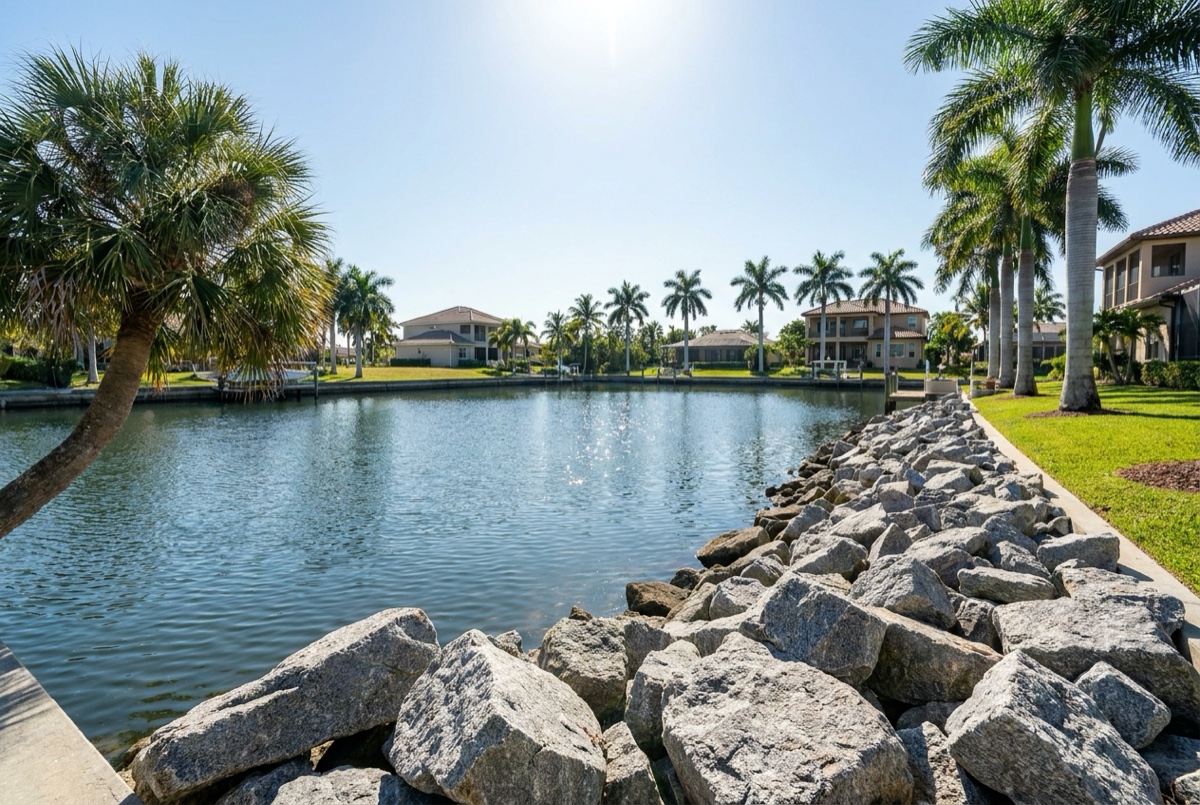
Rip-rap: properly sized armor stone placed along the base: is the standard answer, and it works on both halves of the problem. It physically covers the material fast water would otherwise carry off, and its rough, irregular surface breaks up the wave energy a smooth vertical face reflects straight back down toward the toe. Where scour has already taken material, the repair usually includes restoring what was lost before the stone is placed, plus the bedding that keeps fines from washing out through the rock.
It is permitted work, and the configuration is a site decision, the wall’s condition, the canal, the slope you have room for, and how you use the water in front of it. Our guide on rip-rap to protect a failing seawall toe covers how it gets specified.
Florida Lifts & Docks has built, repaired, and replaced seawalls and placed rip-rap across Cape Coral, Fort Myers, Naples, and Charlotte Harbor since 2008, our own crew, permitting in-house. If your wall came through a storm looking fine and you want the part you cannot see checked honestly, that inspection and any repair are quoted free on-site. See our seawalls page or call (239) 397-3400.